


[ad_1]
In a transfer that reverses almost a decade of apply, California wildlife officers have quietly begun to permit killing mountain lions with a view to defend one other iconic native — bighorn sheep.
Although restricted to the Jap Sierra — the steep, rugged residence of a uncommon sort of the wild sheep — it marks a sea change for California, the place legislators and voters have heaped protections on the massive, charismatic cats that suffered a long time of persecution.
It’s a fancy story — a lesson in ecosystems that includes three linked species and efforts to do proper by all of them.
Whereas some are thrilled, many are dismayed. Some assume it’s the incorrect tack whereas others say it doesn’t go far sufficient to safeguard yet one more beloved animal: deer.
The coverage change got here into aid lately. Within the craggy Sierra Nevada mountains, late final 12 months, a male lion hunted down a number of bighorn. They GPS-collared him and he killed one other sheep.
He was younger sufficient that he hadn’t began breeding or totally established a house vary, so wildlife officers caught him and hauled him to what was presupposed to be his new residence.
However about six months later, he wandered again to sheep nation and killed once more.
So this summer time they put him down by deadly injection, based on Tom Stephenson, who leads the Sierra Nevada bighorn restoration program for the California Division of Fish and Wildlife.
How we received right here
The second lies on the intersection of politics and biology. And it wouldn’t have occurred with out an essential Jap Sierra contingent — hunters.
In February of final 12 months, Brian Tillemans submitted a petition to the California Fish and Recreation Fee spotlighting issues about dwindling numbers of Jap Sierra mule deer, in addition to bighorn sheep. The native hunter, who can be a former watershed useful resource supervisor for the L.A. Division of Water and Energy, informed commissioners the mountain lion inhabitants had “exploded” within the area. A whole bunch of space residents signed the petition.
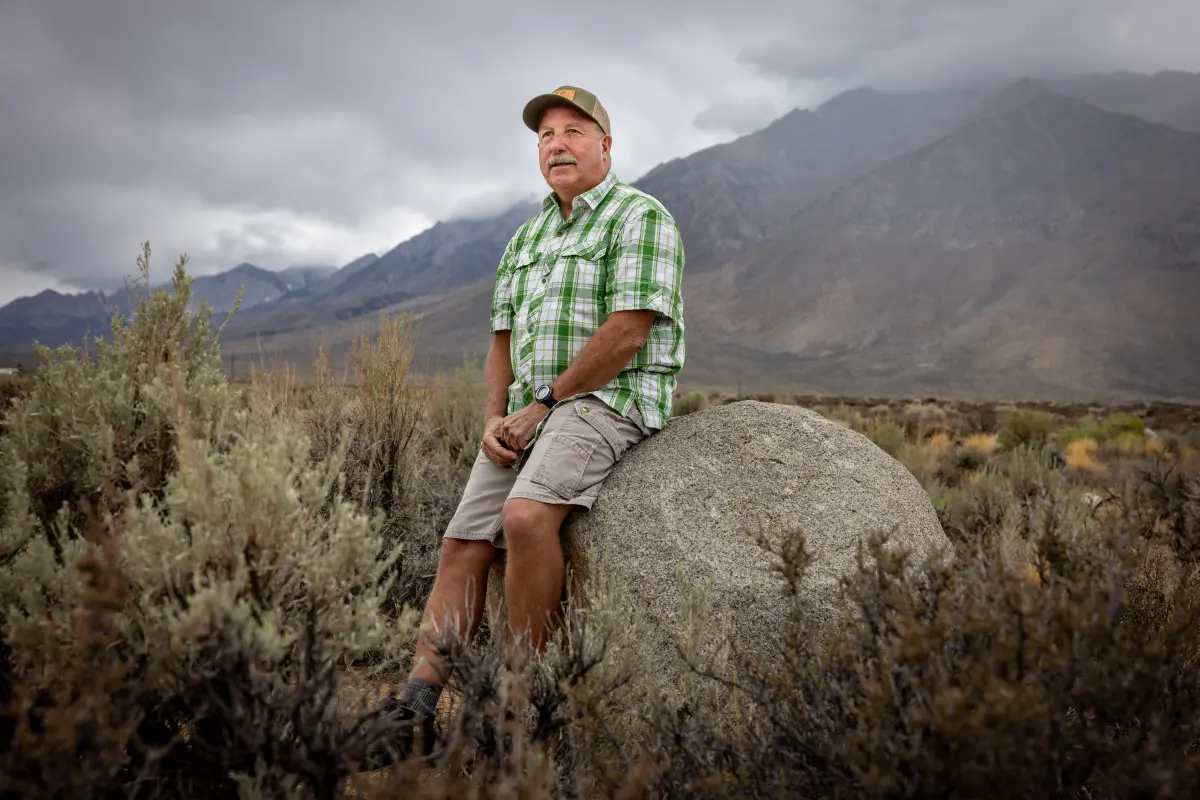
Brian Tillemans, a hunter and former watershed useful resource supervisor for the L.A. Division of Water and Energy, sits outdoors the city of Bishop, close to Mt. Tom, in an space the place Sierra Nevada bighorn go to.
(Jason Armond / Los Angeles Occasions)
“The emotional biopolitics of defending mountain lions is resulting in the demise of two iconic species,” Tillemans informed commissioners. His plea hit a nerve. It sparked a sequence of discussions that led the state to revise its strategy to managing lions.
Mountain lions in California are a “specifically protected species” and it’s unlawful to hunt them for sport. However they are often lawfully killed in restricted conditions. One is when the hefty cats are threatening Sierra Nevada bighorn, one among two subspecies of the sheep that stay within the Golden State. (The opposite sort, desert bighorn, choose the arid Mojave Desert and mountains of Southern California over snowy Sierra peaks.)
California lawmakers gave that proper to state wildlife officers in 1999, the identical 12 months Sierra Nevada bighorn landed on the federal endangered species record.
In 2017 although, wildlife officers stopped killing lions preying on sheep and commenced relocating them as a substitute, Stephenson mentioned.
That has turned out to achieve success for feminine lions and younger ones. However males which have already established a house vary proved harder. They fight their darndest to return to their mates.
In what would turn out to be a extremely publicized fail, two male lions from the Jap Sierra died after being trucked greater than 200 miles to a distant space of the desert.
Bighorn, it appeared, had been left weak.

Sierra Nevada bighorn started to get better after being listed as federally endangered within the late Nineteen Nineties, however latest extreme winters knocked the inhabitants down. At such low numbers, lions can take a heavy toll on them.
(Stephen Osman / Los Angeles Occasions )
By the point bighorn sheep had been listed beneath the Endangered Species Act, they’d been pushed to the brink of extinction by a long time of looking and illnesses unfold by home sheep. As soon as protected, they started to make positive aspects. However a number of extreme winters beginning in 2016 knocked the delicate inhabitants down. At such low numbers, hungry lions can devastate herds. Their complete inhabitants was about 400 final 12 months.
The lions within the Jap Sierra space, in the meantime, are doing properly for themselves. There are about 70 to 80 roaming the craggy mountains, which Stephenson described as a “comparatively giant” quantity. They feed on wild horses that roam the area, which can enhance their ranks.
Transferring lions will nonetheless be the first safety software when possible. However with bighorn in a precarious means, “we simply acknowledge that we have to do every little thing we will to attempt to get this animal recovered,” Stephenson mentioned. So deadly removing was put again on the desk.
John Wehausen, an utilized inhabitants ecologist who has studied bighorn for greater than half a century, is thrilled by the latest coverage adjustments. He expects the bighorn to begin to bounce again. Knowledge assist the effectiveness of eradicating lions to assist the sheep, he mentioned.
He mentioned it’s key for the company to behave shortly to maneuver or euthanize a lion that’s feeding on sheep, to stop it from harming extra. He believes the company was beforehand sluggish, however is now transferring effectively.
“I’ve as a lot as mentioned to them, ‘I don’t actually care the way you get [the lions] out of there. You simply must get them out of there in a well timed option to defend these sheep as a result of that’s what your job is,’” he mentioned.
However Beth Pratt, California regional government director for the Nationwide Wildlife Federation, questions whether or not killing lions to guard sheep is sensible.
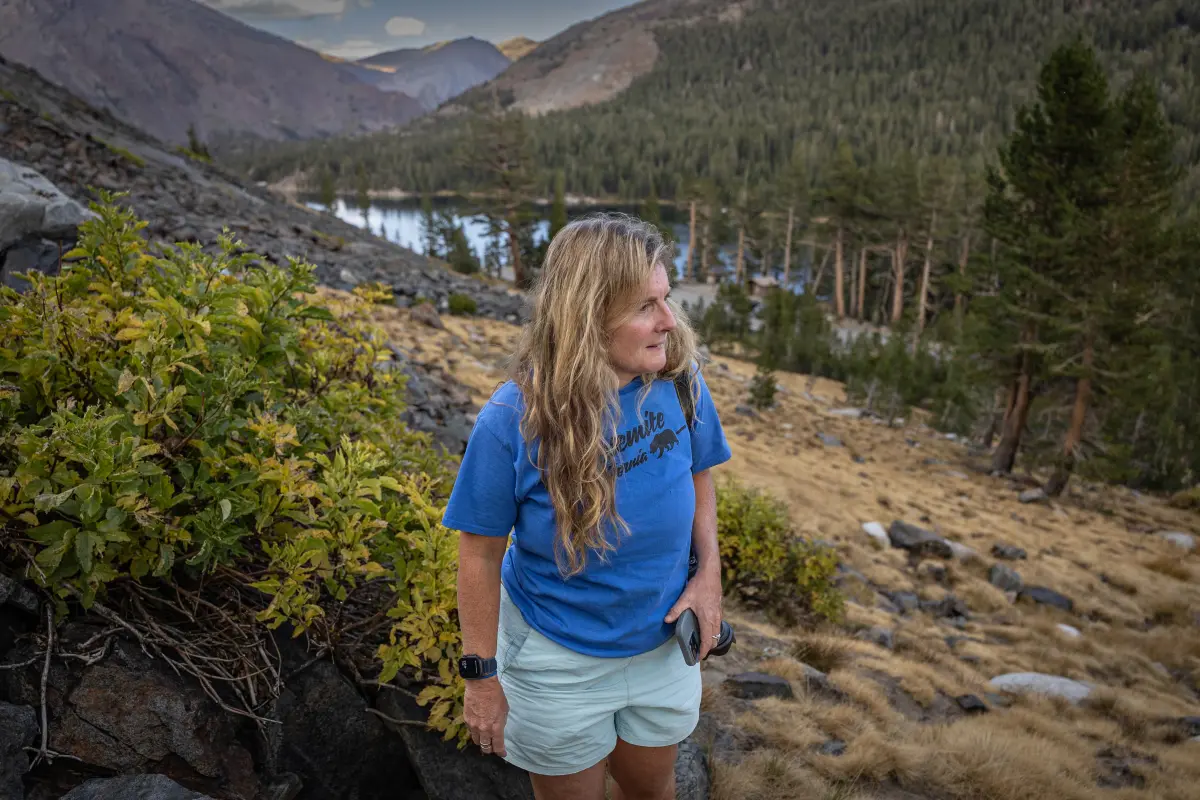
Beth Pratt, of the Nationwide Wildlife Federation, hikes simply outdoors the jap entrance of Yosemite Nationwide Park, close to the city of Lee Vining.
(Jason Armond / Los Angeles Occasions)
“Do you retain blowing away an animal for being an animal, when it’s clearly simply not working?” she mentioned. Many individuals “perceive that predators have a spot in wholesome ecosystems.”
Pratt wonders if there are inventive options, comparable to bolstering the sheep inhabitants by bringing in animals raised elsewhere or stationing guard canine across the herds.
Disappearing deer
For Jap Sierra natives comparable to Danny McIntosh, of Bishop, a small neighborhood a few four-hour drive north of Los Angeles beloved by hunters, climbers and hikers, deer signify a lifestyle.
McIntosh has watched mule deer since he was a child. He’s “infatuated” with bucks, which battle one another throughout mating season. Round his teen years, he began photographing the animals, named for his or her giant, mule-like ears. He’s an avid hunter and likewise enjoys amassing “sheds,” antlers dropped yearly by deer and elk.
After the extreme winter of 2018, he observed a marked decline within the deer inhabitants that he mentioned has solely worsened.
That commentary largely tracks with state Division of Fish and Wildlife findings. In keeping with a 2023 paper, what’s generally known as the Spherical Valley herd dropped 33% from 2016 to 2022.
“What disheartens me essentially the most is that my youngsters won’t ever get to expertise, on the identical stage as I did, flourishing deer herds and the quite a few conventional actions that encompass them,” McIntosh informed state wildlife commissioners throughout a gathering in June 2024.
He largely blames lions and black bears, and isn’t happy with the state’s willingness to kill the massive cats on behalf of bighorn. Although he acknowledged it would assist the sheep, it’s not anticipated to have a significant impression on deer.
“It’s nonetheless not sufficient,” McIntosh mentioned. “Our deer had been the healthiest and the herds had been the strongest when there was trapping happening and there have been no restrictions.”
State wildlife officers don’t have the authority to regulate lions for the good thing about deer.
Hunters need extra deer, “and if somebody can’t snap their fingers and make that occur, it’s irritating” for them, mentioned Stephenson, the state Division of Fish and Wildlife bighorn restoration chief. “There’s a restrict to what number of knobs we will flip to impact any form of speedy change. It’s a protracted, sluggish course of.”
In keeping with Stephenson, it’s difficult. Sure, bears and lions snack on deer. However fires can wipe out vegetation they depend on for meals, too. Harsh winters, punctuated by drought, additionally take a toll.
When there are such a lot of components, it’s arduous to know that are most essential in influencing the inhabitants, he mentioned.
Mule deer are dwindling not simply right here however throughout the West.
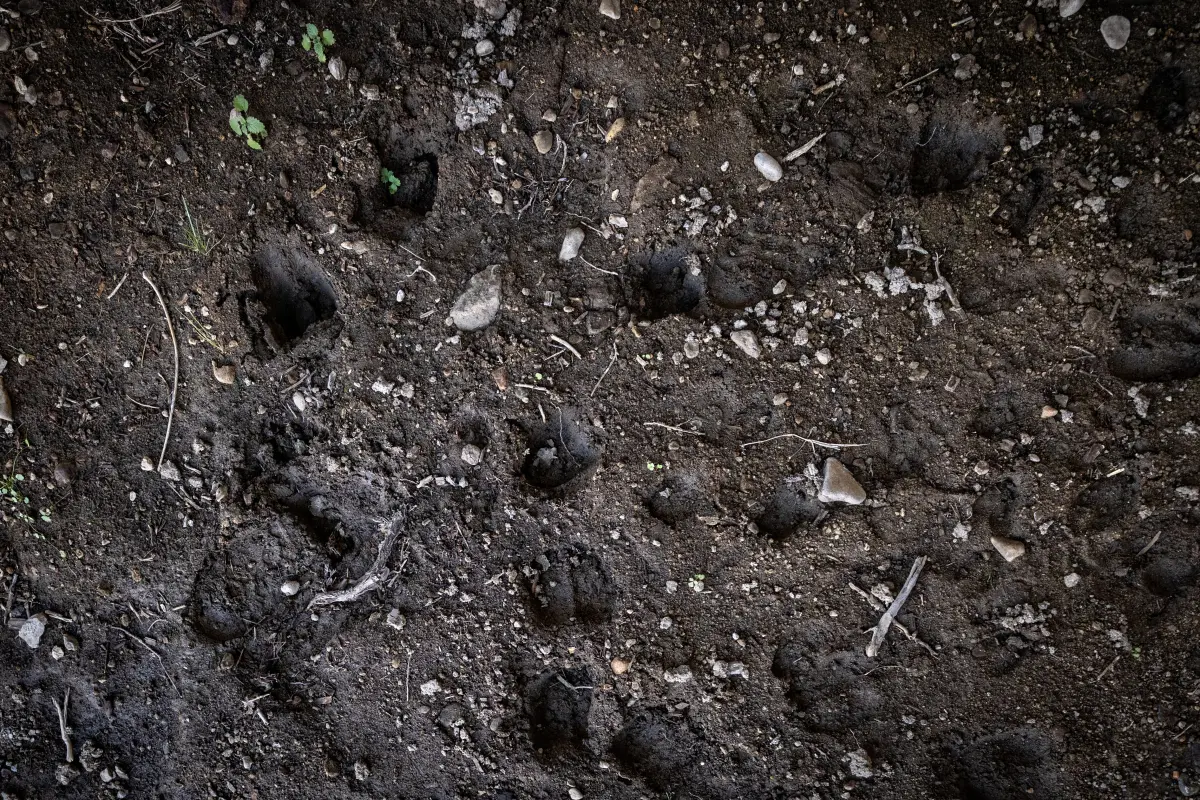
In September, animal tracks dot the mud in a wildlife crossing put in beneath Freeway 395 close to the Jap Sierra neighborhood of Bridgeport.
(Jason Armond / Los Angeles Occasions)
“We’re not involved that the deer inhabitants goes to vanish over right here,” Stephenson mentioned. “I believe it’s a priority from the attitude of a hunter who desires looking alternatives, and who has seen that looking alternative change over the a long time.”
The promise of crossings
There could also be one resolution everybody can get behind — one thing that would provide a lifeline to mule deer with out the necessity to knock out lions.
Hunters and conservationists alike assist constructing a wildlife crossing within the prime roadkill sizzling spot within the Jap Sierra — a lethal stretch of Freeway 395 that runs previous the Mammoth Yosemite Airport. Automotive collisions are the second highest explanation for dying for deer, not counting unknown causes.
On a sunny morning in September, a lifeless doe lay on the aspect of a small street simply off 395, as automobiles whizzed by on the artery that connects communities alongside the Jap Sierra.
Scavengers had up to now solely ripped into her bottom. Tillemans, the hunter from Bishop, who offered a tour of the realm, mentioned it meant she hadn’t been lifeless lengthy.
From 2002 to 2018, about 675 autos collided with deer in lower than 9 miles of roadway. It’s smack dab in the course of the migration routes for the Spherical Valley and Casa Diablo herds, based on a latest examine.
A venture is underway to construct protected passage for fauna right here. As envisioned, two overcrossings and two undercrossings would perform as bridges throughout 4 lanes of site visitors. However its future is determined by lining up cash — a whole lot of it. Extra planning and development is estimated to value greater than $65 million, based on the California Division of Transportation, which is main the trouble.
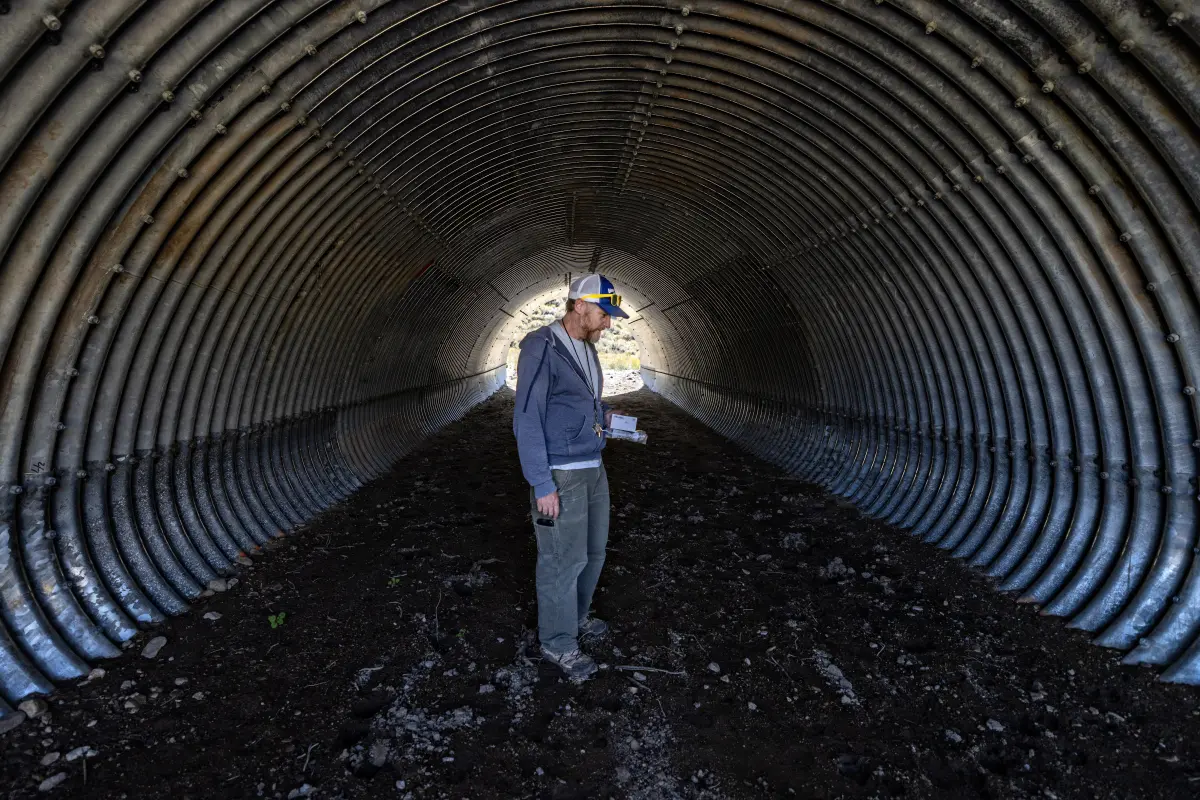
Ben Carter, a senior environmental scientist with the state Division of Fish and Wildlife, seems to be at animal tracks at a lately accomplished wildlife crossing in Bridgeport known as the Sonora Junction Shoulders Mission.
(Jason Armond / Los Angeles Occasions)
It may save the lives of untold deer. And it could be extra believable than permitting a lion looking season, as some would love. That will require a change in state regulation.
“If there’s ever a spot for a deer crossing, it’s up right here,” Tillemans mentioned whereas driving to the proposed venture space.
A lately accomplished crossing about 70 miles to the north could provide an instance of what the opposite one may present.
In early fall, Ben Carter checked a digital camera positioned to seize the goings-on in a corrugated metallic tunnel put in beneath a wide ranging stretch of the 395 north of the city of Bridgeport.
Carter, a senior environmental scientist with the state Division of Fish and Wildlife, had pulled the SD card for the primary time to see what critters may need been early adopters of the new wildlife undercrossing — one among two constructed as a part of a shoulder-widening venture.
Tracks informed their very own story. Cloven hooves had pressed into the comfortable mud. Deer had been there.
[ad_2]
