

[ad_1]
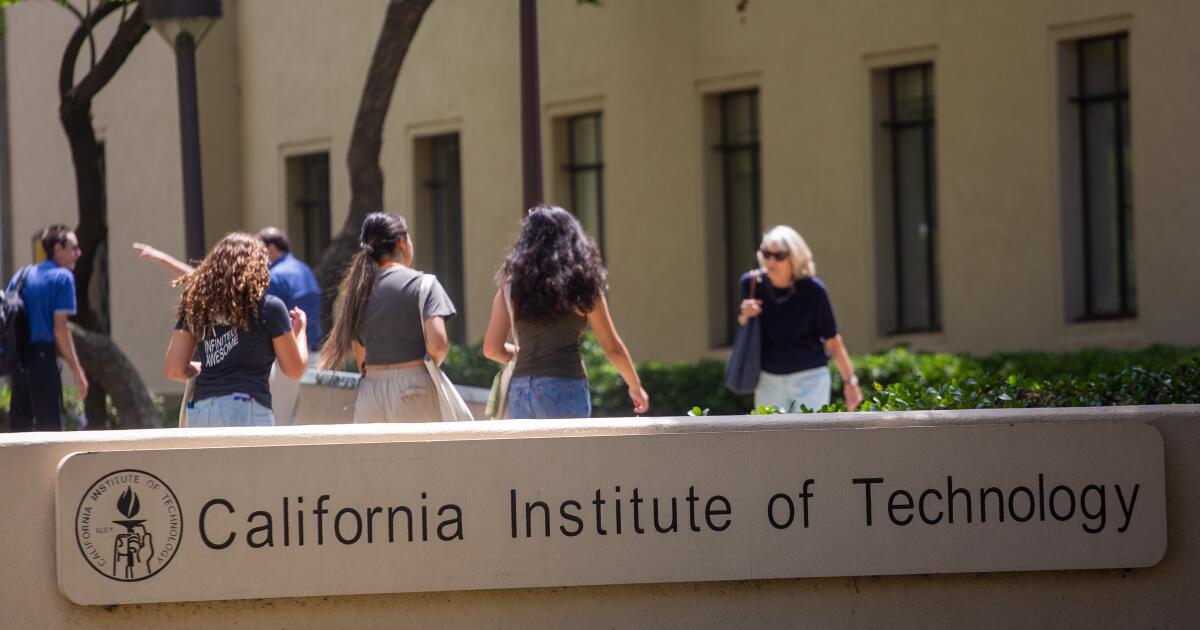
When potential Caltech college students utilized within the fall for early admission, some confronted a brand new, technologically superior step within the choice course of at one of many nation’s most prestigious universities.
Excessive schoolers who submitted analysis tasks appeared on video and have been interviewed by a synthetic intelligence-powered voice that peppered them with questions on their papers and experiments, akin to a dissertation protection. The video-recorded exchanges have been then reviewed by people — college and admissions officers — who additionally evaluated take a look at scores, transcripts, private statements.
College students making use of to school know they’ll’t — or no less than shouldn’t — use AI to jot down their faculty admission essays. So it’d come as a shock that some faculties are utilizing synthetic intelligence to learn them and are incorporating AI into their very own admissions course of to conduct interviews and detect pretend purposes trying to steal monetary help cash.
In some circumstances, schools are quietly slipping AI into their analysis work, whereas others are touting the expertise’s potential to hurry up their assessment of purposes, minimize processing occasions and carry out some duties higher than people.
“We needed to convey the coed voice again into purposes,” mentioned Ashley M. Pallie, the dean of undergraduate admissions at Caltech, the place VIVA, an AI-assisted expertise developed by an organization referred to as InitialView, helped display screen roughly 10% of latest early candidates.
“It may appear unusual to make use of AI to get extra of a human voice, however I consider it as a strategy to convey extra authenticity into the fold,” mentioned Pallie, who mentioned the college is planning to develop its use of AI in admissions in 2026.
Faculties stress that they aren’t counting on AI to make admissions choices however utilizing it as an alternative to assessment elements of purposes, from analysis tasks to transcripts, in addition to to eradicate information entry duties.
“Are you able to declare this analysis intellectually? Is there a degree of pleasure round your venture? That keenness is vital to us,” Pallie mentioned about Caltech’s AI interview bot.
A rising development
Virginia Tech debuted an AI-powered essay reader within the fall. The school expects it is going to be capable of inform college students of admissions choices a month ahead of normal, in late January, due to the instrument’s assist sorting tens of 1000’s of purposes.
“People get drained; some days are higher than others. The AI doesn’t get drained. It doesn’t get grumpy. It doesn’t have a nasty day. The AI is constant,” says Juan Espinoza, vice provost for enrollment administration at Virginia Tech.
The prevalence of AI utilization is tough to gauge as a result of it’s so new, mentioned Ruby Bhattacharya, chair of the admission practices committee on the Nationwide Assn. for School Admission Counseling. NACAC up to date its ethics information within the fall so as to add a piece on synthetic intelligence. It urges schools to make sure the way in which they use it “aligns with our shared values of transparency, integrity, equity and respect for pupil dignity.”
A few of California’s hottest campuses, together with the UCs and USC, don’t use AI to cull candidates, and use solely human readers and admissions workers.
“I don’t assume it’s as black and white as saying utilizing AI in faculty admissions is both good or dangerous in any type of blanket means,” mentioned Gary Clark, UCLA’s affiliate vice chancellor of enrollment administration. “It has a task to play, and that function could evolve sooner or later however, for us by way of the reviewing of purposes and the choice course of, we’ve stored that fairly tight and targeted on a human course of.”
Some faculties face blowback
The College of North Carolina at Chapel Hill confronted a barrage of destructive suggestions from candidates, dad and mom and college students after its pupil newspaper, the Every day Tar Heel, reported in January that the college was utilizing AI to guage the grammar and writing model of candidates’ essays.
The college declined to remark and pointed to its admissions web site, which it up to date after the criticism. “UNC makes use of AI packages to offer information factors about college students’ widespread utility essay and their college transcripts,” the web site says. Each utility “is evaluated comprehensively by extensively skilled human utility evaluators.”
At Virginia Tech, Espinoza mentioned a number of schools within the new expertise however cautious of backlash have contacted him. “The suggestions from numerous colleagues is, ‘You roll this out, we’re watching you, and we’ll see how everybody’s reacting,’” he mentioned.
He burdened the AI reader his college spent three years creating is getting used solely to verify human readers’ essay scores.
Till the autumn, every of the 4 short-answer essays Virginia Tech candidates submit was learn and scored by two individuals. Below the brand new system, a kind of readers is the AI mannequin, which has been skilled on previous applicant essays and the rubric for scoring, Espinoza mentioned.
A second individual will step in if the AI and human reader disagree by greater than two factors on a 12-point scoring scale.
Like many schools, Virginia Tech has seen an enormous improve in purposes since making SATs non-compulsory. Final 12 months, it acquired a file 57,622 purposes for its 7,000-member freshman class. Even with 200 essay readers, the college has struggled to maintain up and located itself notifying college students later and later.
The AI instrument can scan about 250,000 essays in underneath an hour, in contrast with a human reader who averages two minutes per essay. Primarily based on final 12 months’s utility pool, “we’re saving no less than 8,000 hours,” Espinoza mentioned.
Georgia Tech is rolling out an AI instrument to assessment the faculty transcripts of switch college students, changing the necessity for employees to enter every course manually right into a database.
“It’s yet one more layer of delay and stress and inevitable errors. AI goes to kill that, which I’m so enthusiastic about,” mentioned Richard Clark, the college’s govt director of strategic pupil entry. The varsity hopes to quickly develop the service to all highschool transcripts.
Georgia Tech is also testing out AI instruments for different makes use of, together with one that might determine low-income college students who’re eligible for federal Pell Grants however could not have realized it.
In California, the place group schools have confronted an onslaught of faux purposes that steal federal and state help {dollars}, directors are utilizing AI to sort out fraud.
The issue has ballooned for the reason that COVID-19 pandemic, when on-line research grew to become extra widespread. Final 12 months, the state’s group schools had 1.2 million pretend candidates, resulting in roughly $8.4 million and greater than $2.7 million in stolen federal and state help, respectively.
Leaders at Golden West School in Huntington Seashore used to manually display screen for pretend college students. They seemed for uncommon course mixtures, resembling policing, dance and artwork, as indicators of potential fraud. Lately, overburdened workers spent spending 20 to 30 hours per week searching for fakes, mentioned President Meridith Randall.
“However that was untenable,” Randall mentioned.
Immediately, the identical fakes will be flagged utilizing AI developed by an organization referred to as N2N Companies, mentioned Claudia Lee, Golden West School’s vp of pupil companies.
“The AI makes use of algorithms in place primarily based on the knowledge we offer it to search for the patterns, the developments, within the information that would level to fraud,” Lee mentioned.
School present a last test by reporting nonresponsive or no-show college students. Related efforts are being made statewide by means of the California Group Faculties chancellor’s workplace. AI can even assess metadata to detect potential fraud, together with IP addresses, an applicant’s proximity to the faculty primarily based on the IP, and if a number of purposes are coming from the identical laptop.
“We’re an open entry system, so we all the time should steadiness the convenience of utility and enrollment for professional college students with defending the assets, class seats, and monetary help {dollars} for those who actually need it,” mentioned Jory Hadsell, who works within the chancellor’s workplace.
Not all, together with UCs, are shopping for into development
A number of the hottest and prestigious schools in California have to date eschewed AI in admission evaluations.
USC, which acquired 83,500 purposes within the final undergraduate admissions cycle, has dozens of full-time readers who work tens of 1000’s of hours to pore over grades, essays and different utility components.

Glorya Kaufman corridor at UCLA in 2025.
(Myung J. Chun / Los Angeles Instances)
At UCLA, essentially the most applied-to campus within the nation with greater than 145,000 first-year candidates, a group of greater than 300 readers handles the workload. Every pupil is evaluated twice by two individuals, usually highschool counselors and retired highschool counselors who’re specifically skilled.
“The human course of on our facet, I believe, must mirror the human course of on the opposite facet,” mentioned Clark, the UCLA admissions director.
Along with grades, he mentioned, “we’re taking a look at what they share of their private perception query responses and issues that they’ve achieved or devoted their time in direction of outdoors of sophistication. Particularly these qualitative issues, I believe, actually require human analysis.”
The human-centered strategy is equally vital at UC Merced, which has seen the fastest-growing applicant pool throughout the system — a year-to-year practically 45% improve of first-year purposes in 2024 to greater than 51,000.
“Having a human reader assessment the appliance can present some contextual expertise to what that pupil is, has alternatives to do, and what they’re experiencing on the college degree in a means that I don’t assume is might be simply generalized by utilizing a few of the info on the market with AI,” mentioned UC Merced director of admissions Dustin Noji.
Noji famous that though human readers usually are not with out “flaws,” there are additionally issues about expertise. “There’s nonetheless bias in a few of the issues that the big language fashions are utilizing to do the opinions,” he mentioned.
People, too, can step in in methods machines could not be capable of but, he mentioned.
“If we have to attain out to an applicant that could be lacking one thing within the utility however could also be near being admissible, I don’t know that I really feel comfy giving that advising piece over to a machine at this level.”
Gecker writes for the Related Press.
[ad_2]
