

[ad_1]
There are ghosts inhabiting “Sound of Falling” — you simply must know the place to search for them. German director Mascha Schilinski’s astonishing second function might scarcely be extra bold because it affords an impressionistic portrait of 4 younger ladies who take turns residing in the identical home over roughly 110 years.
However the place different motion pictures are overly treasured whereas gathering the invisible string that binds characters from totally different time intervals, “Sound of Falling” is stark and unsentimental. Masking the early twentieth century by way of the current, gliding forwards and backwards between eras with the deftest contact, the movie views the residing as merely the newest iteration of a fragile species that has been consistently struggling in opposition to unseen forces that drag it down, era after era. So lots of the film’s characters are lengthy useless, their hopes and desires now erased, whereas we strut and fret our hour upon the stage.
Profitable the Jury Prize eventually yr’s Cannes, “Sound of Falling” introduces us to Alma (Hanna Heckt), a toddler residing on her household farm in northern Germany round 1910; adolescent Erika (Lea Drinda), who occupies the home within the Nineteen Forties; flirty Nineteen Eighties teen Angelika (Lena Urzendowsky); and Lenka (Laeni Geiseler), a shy tween hanging out along with her mom and sister within the twenty first century. Schilinski doesn’t maintain the viewer’s hand, offering no title playing cards to point which era interval we’re visiting. “Sound of Falling” doesn’t even begin chronologically, opening with Erika as she silently adores her sleeping, bedridden uncle Fritz (Martin Rother), an amputee whose furry chest and sweat-filled bellybutton entrance her. The explanation for Fritz’s harm will finally be revealed, however not instantly — Schilinski is not going to be rushed as her epic story slowly unfolds.
In a sweepingly offhand method, “Sound of Falling” is a canny exploration of how sexism and repression echo throughout the ages. The unconscionable remedy of maids in Alma’s period finds uncomfortable parallels within the Nineteen Eighties, when Angelika is each appalled and intrigued by the leering seems to be of her uncle Uwe (Konstantin Lindhorst). However Schilinski by no means underlines her factors: Occasions happen not as a result of the plot twists are connected to a bigger thematic concept however, relatively, as a result of these ladies’s lives are crushingly commonplace for his or her time intervals. It is just by seeing them in live performance that we totally perceive the entire symphony.
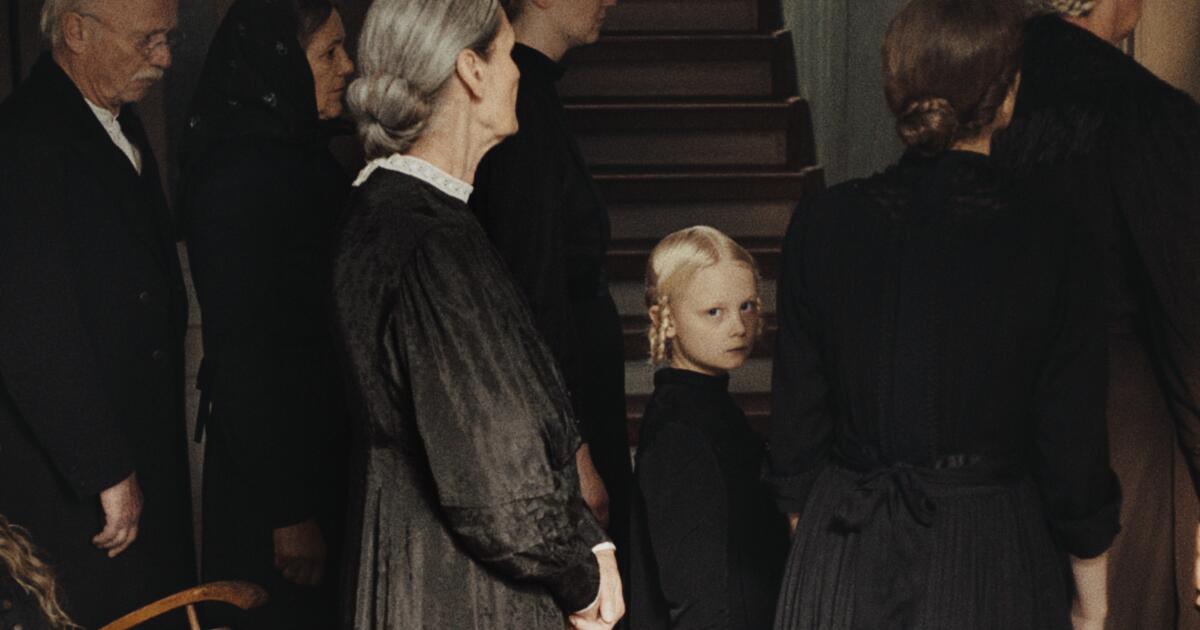
Very like the distinctive current dramas “Aftersun” and “Nickel Boys,” “Sound of Falling” performs as an act of re-created reminiscence. However whereas all three dreamlike movies expertly mimic the imperfect act of remembering, Schilinski’s makes the previous appear irretrievable — a ghost whose presence we will really feel however not contact. “Sound of Falling” presents Alma’s and Erika’s agrarian segments as dusty museum items, with even the Nineteen Eighties and twenty first century parts coming throughout as hazy snapshots. The rueful voice-over from myriad characters is spoken up to now tense, the onscreen moments (even the present-day scenes) seemingly being recollected lengthy after. And Fabian Gamper’s spectral cinematography typically incorporates POV pictures that produce the feeling that we, the viewer, are bodily touring these long-abandoned rooms. When the characters often have a look at the digicam, the impact is chilling, briefly however powerfully bridging the gap between then and now, them and us.
Audiences will regularly notice that there are familial connections between these ladies, though these specifics are greatest left found inside “Sound of Falling’s” temporal drift. Household is central to Schilinski’s work. (Actually: She and Gamper are married, just lately welcoming their first baby.) To date, although, her movies categorical misgivings in regards to the advantage of these bonds. Her 2017 debut, “Darkish Blue Lady,” involved a younger woman scheming to maintain her separated dad and mom from getting again collectively. In “Sound of Falling,” incest rears its ugly head, as does suicidal ideation and a relentless want to flee. The 4 younger ladies by no means meet, but they share a way of despair. Alma’s confusion on the secretive method by which adults behave is not any totally different than Lenka’s insecurity a century later as she befriends a lady (Ninel Geiger) who appears far older and wiser. What if Alma and Lenka might discuss, “Sound of Falling” asks. What would they are saying to at least one one other?
Such questions are central to this elusive marvel, which invitations the viewer to finish the drawing that Schilinski evocatively sketches. Photos and concepts repeat over time intervals: buzzing flies, the taking of photographs, the haunting use of Anna von Hausswolff’s 2015 ballad “Stranger.” The track’s lyrics don’t immediately correspond to the wonder and ache contained in “Sound of Falling” — it’s only one extra layer of enigma in a film that doesn’t reply all its riddles. However these traces are a helpful information to appreciating its ghostly spell: “There’s something shifting in opposition to me / It’s not in step with what I do know / Altering the guts, altering the spirit / Altering my path, altering my soul.” To see this movie is to be reworked.
‘Sound of Falling’
In German, with subtitles
Not rated
Operating time: 2 hours, 29 minutes
Taking part in: Opens Friday, Jan. 23 at Laemmle Royal
[ad_2]
