

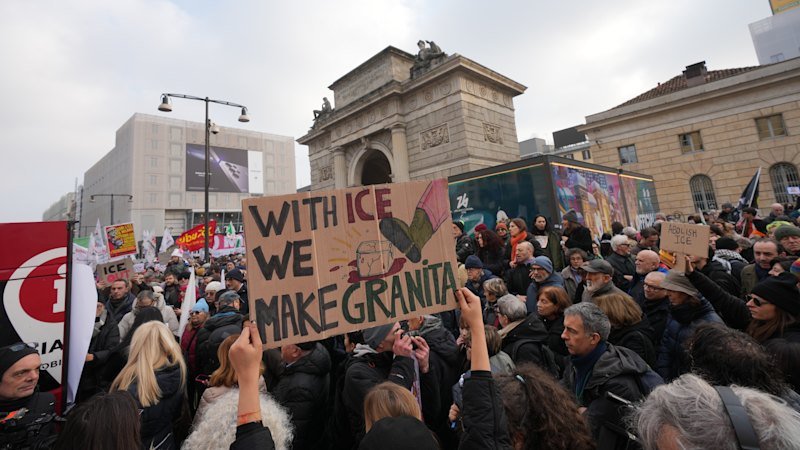
Milan: Thousands of demonstrators flooded the streets of Milan in advance of the 2026 Winter Olympics, voicing strong opposition to the planned deployment of U.S. Immigration and Customs Enforcement (ICE) agents. These agents are set to support and secure the American delegation, headed by Vice President JD Vance, amid growing concerns and public outrage throughout Italy.
Flash Rally in City Center
On Saturday, more than 1,000 people assembled in Piazza XXV Aprile, a bustling spot near Milan’s heart, for a spontaneous rally coordinated by center-left political groups and labor unions. Participants blew whistles—a symbol popularized in Minneapolis amid resistance to ICE following the deaths of Renee Good and Alex Pretti. Demonstrators carried placards with witty slogans like ‘ICE only in the spritz,’ ‘ICE? No, grazie,’ ‘The only ICE we want in Milan is the one under the skates,’ and ‘With ICE, we make granita.’
Amplifiers blared Bruce Springsteen’s recent track ‘Streets of Minneapolis,’ composed in reaction to President Donald Trump’s extensive immigration enforcement policies.
Backlash Against U.S. Security Measures
The gathering highlights a sharp reaction in Italy to announcements that ICE personnel would travel to the Milano-Cortina 2026 Games to assess and counter threats from international crime networks. Early disclosures, lacking specifics on their duties, fueled worries that agents might target Italian residents similarly to tactics seen in U.S. media footage. Milan’s Mayor Giuseppe Sala, whose city will host the opening ceremony along with events like figure skating and ice hockey, firmly stated the agents are ‘not welcome.’ He described ICE as ‘a militia that kills, a militia that enters into the homes of people, signing their own permission slips.’
Subsequent details revealed that Homeland Security Investigations (HSI), an ICE division, would operate from a command center at the U.S. consulate in a advisory capacity. The team in Italy differs from those handling domestic U.S. immigration tasks. Such deployments by ICE to global sporting events, including past Olympics, are routine for security support. Yet, the fierce public response underscores heightened global scrutiny of ICE operations and the anti-American feelings stirred by certain agent actions.
Political and Community Reactions
Alessandro Capelli, secretary of the Milan branch of Italy’s Democratic Party—the primary opposition to Prime Minister Giorgia Meloni’s Brothers of Italy—emphasized the event’s broader significance. ‘We know that today, a lot of people in the world are looking at us, because we are hosting the Olympic Games. It’s not just a sporting event, it’s important for all the world,’ Capelli said. He added, ‘We would like to say that the fight for human rights all over the world, it’s our fight [too]. We are citizens of Milan, we are citizens of the world. We are watching on TV what ICE is doing in the US, so for us it’s quite a normal thing to show our solidarity with people who are fighting.’
Capelli noted varied responses across Italy’s political landscape: ‘Obviously, the democratic and left part are moving with more courage, while [people] in the right say something [like], for example: ‘We don’t like a lot the method of ICE.’ But we have a problem: Steve Bannon is a friend of Giorgia Meloni and [Italy’s deputy Prime Minister] Matteo Salvini, so they have to explain to us how this friendship is going.’
Local Perspectives on the Deployment
Jocelyn Frederick, a U.S. expatriate from Florida who has resided in Italy for nearly two decades, questioned the choice of ICE over other agencies. ‘We’re used to hearing about Homeland Security being involved in major international events,’ she explained. ‘We hear about that happening, and especially for anti-terrorism, but that they would be using the ICE, it sounds like it’s a show of force: ‘We’re bringing our agents. We’re showing that they are strictly connected to [JD] Vance and the administration.’ Like, they’re coming with him. That’s what doesn’t really make sense.’
Frederick observed divided opinions locally: ‘Some people [in Italy] will say, ‘We need ICE here too,’ and then there’s other people who are just very clearly very against it. The majority of people who I speak to are very upset about what’s going on in America in general.’
Along Corso Garibaldi, leading from the square toward a nearby metro station, a bar and gelateria named Icebound added an ironic touch to the scene where many protesters had arrived.
