

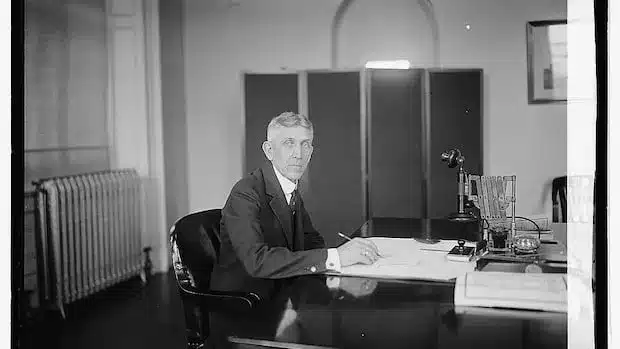
Amid current tensions between Canada and the United States, a Nova Scotian once led the U.S. Mint during the early Great Depression. Robert J. Grant produced the era’s coins as ‘Brother, Can You Spare a Dime?’ captured widespread hardship.
Early Life and Pivotal Mine Accident
Born in 1862 in Springville, Pictou County, Grant attended Pictou Academy before entering the coal mines near Stellarton. In 1880, a life-threatening underground collapse altered his path. As historian Aubrey Dorrington recounts in The History of Stellarton, ‘He was digging coal from the face of the seam when suddenly, without warning, the roof gave way and came crashing down about him and he barely escaped with his life.’ Grant reflected on the dangers and resigned shortly after.
Career Transition to Engineering
A week later, Grant moved to Boston for safer work at a printing company while pursuing night classes. His mining background drew him to the Colorado School of Mines, where he trained as a mining engineer and gained U.S. citizenship. He worked across the U.S., Mexico, and South Africa, mastering gold processing. From 1904 to 1905, he managed a mine in Australia on behalf of Herbert Hoover, a friend.
Ascent to U.S. Mint Leadership
In 1921, President Warren Harding named Grant superintendent of the Denver Mint. President Calvin Coolidge elevated him to director of the U.S. Mint in Washington in 1923. Grant served 10 years under Coolidge and Hoover, overseeing operations during economic turmoil.
Later Roles and Legacy
The Roosevelt administration’s arrival in 1933 prompted Grant to advise China’s government in Shanghai on monetary matters. He returned to the U.S. in poor health before the 1941 Pearl Harbor attack and passed away in Denver in 1949.
A Colorful Anecdote
One apocryphal tale highlights Grant’s extraordinary journey. During a late-life visit to Stellarton, he reportedly conversed with a taxi driver, who asked his name. Grant handed over a U.S. bill and quipped, ‘My name is on the money.’ Though signatures appear on paper currency, not coins, the story endures.
Sean Kirby, executive director of the Mining Association of Nova Scotia, highlights Grant’s path as evidence of enduring historical bonds. ‘There really are these remarkable close historical ties between Nova Scotia, Atlantic Canada, and the United States,’ Kirby states. ‘We hope to restore more positive relations, as they ultimately benefit everyone.’
