

Marine tracking data indicates a total stoppage of large oil tanker movements through the Strait of Hormuz, driving upward pressure on global crude oil prices.
US President Donald Trump stated that the US Navy prepares to escort oil and gas tankers through the critical waterway as soon as possible.
Drastic Traffic Decline
Nearly 20 percent of the world’s oil supply passes through the strait each day. Yet, recent marine traffic visualizations reveal far less activity than usual.
Data shows typical flows on February 27, with patterns shifting sharply from February 28—the onset of Israel and US strikes on Iran, followed by Iranian retaliation across the region.
Mark Douglas, maritime domain analyst at Starboard Maritime Intelligence, noted, “You can see the normal traffic flow on 27 February, followed by a change in traffic patterns from 28 February.”
“It is getting more pronounced in the following days, until we reach March 3 and an effective halt to tankers through the Strait of Hormuz,” he added.
Traffic plunged from around 50 tankers longer than 100 meters transiting in both directions daily to zero, Douglas reported.
Navigation Challenges and Threats
Tracking data exposes widespread GPS jamming, shown by markers leaping between map points, crossing land, or tracing unnatural straight lines. Douglas explained, “This means that, right at a time when commercial shipping is already under the threat of attack, civilian crews of these vessels have to deal with navigation systems that can’t accurately tell them where the ship is.”
Vessels also disable transponders, making some markers vanish.
The commander of Iran’s Revolutionary Guards declared the strait closed, warning of attacks on any ships attempting passage, according to Iranian media.
Multiple tankers suffered strikes since hostilities began, including one in the strait off Oman’s Musandam Peninsula.
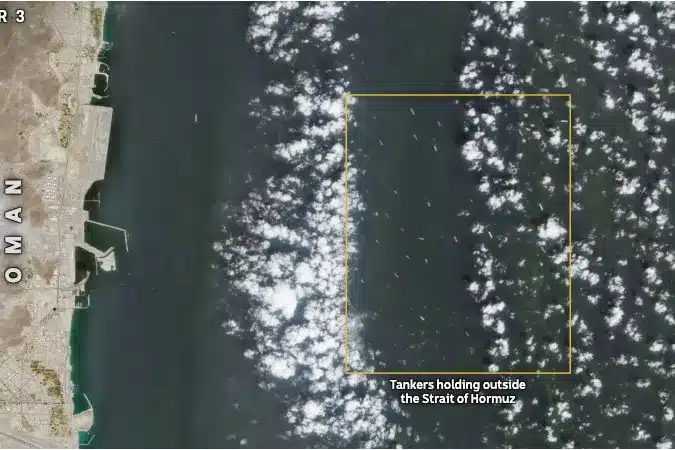
“Many tankers travelling to the Persian Gulf can be seen turning around or anchoring near the approaches to the Strait of Hormuz waiting for a safe opportunity to enter or exit the Gulf,” Douglas observed.
Wider Economic Impacts
The shutdown spikes freight costs and war-risk insurance rates. Fertilizer prices will also rise, as the region supplies a major share globally. Douglas cautioned, “A significant portion of the world’s fertiliser comes from the region, and restrictions on their movement will impact farmers, and eventually consumers.”
