

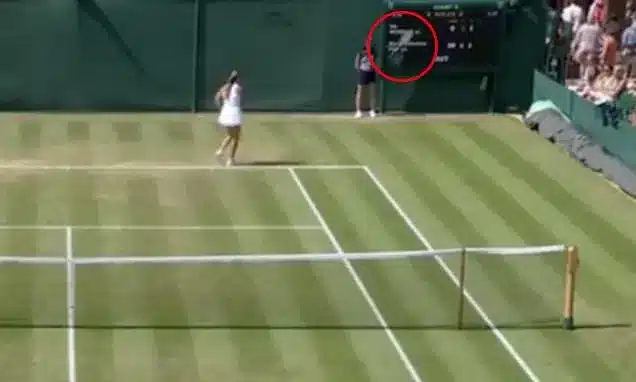
A promising teenage tennis player at Wimbledon has been disqualified from the junior championships after her racquet inadvertently flew into the spectator stands during a tense second-set comeback. The incident led to an immediate default, ending her participation in the prestigious tournament.
Racquet Incident Leads to Default
The unfortunate event occurred during the first-round match of the girls’ singles on Court 11. Germany’s Ida Wobker, a 15-year-old talent ranked 24th in the International Tennis Federation (ITF) junior rankings, was facing Romania’s Maria Valentina Pop. After losing the first set 6-0, Wobker was fighting back in the second, with the score tied at 5-5 and her opponent serving at 30-love. In a moment of frustration after hitting a backhand shot long, Wobker struck the turf with her racquet. The force of the impact caused the racquet to slip from her grasp and, instead of staying on the court, it bounced off the grass and into the seating area occupied by spectators.
The chair umpire swiftly halted the match to assess the situation. A tournament supervisor was called onto the court, and following a review of the incident, Wobker was defaulted from the match. The final score was recorded as a victory for her opponent, Maria Valentina Pop, by ‘game, set and match’.
Rules on Defaults for Racquet/Ball Misconduct
While there isn’t a precisely defined rule dictating the exact circumstances for a default due to an angry racquet or ball throw, the primary consideration for officials is the safety of everyone involved. The severity of the punishment often hinges on whether the errant object poses a risk to umpires, line judges, ball kids, or spectators.
In Wobker’s case, the racquet’s trajectory into the stands, even without causing injury, was deemed sufficient grounds for disqualification under the sport’s code of conduct, which emphasizes player responsibility and the safety of the court environment.
Notable Precedents in Professional Tennis
This incident at Wimbledon echoes similar high-profile defaults in professional tennis, highlighting the strict stance officials take on actions that endanger others. The most widely remembered case involved Novak Djokovic at the 2020 US Open. During his fourth-round match, Djokovic unintentionally struck a female line judge in the throat with a ball he hit behind him in frustration. Despite his immediate and profuse apologies, he was defaulted from the tournament.
Another instance occurred at the 2025 French Open, where Italian player Lorenzo Musetti faced a similar situation. In his quarter-final match, Musetti kicked a loose ball towards a line judge, which struck her on the chest. While he was not defaulted, the incident drew significant attention. Frances Tiafoe, Musetti’s opponent, described the decision to allow the match to continue as ‘comical’. Musetti himself admitted to being ‘a little bit scared’ by the incident, stating it was unintentional.
Wobker’s Reaction and Support
Ida Wobker reportedly accepted the default decision with composure. Following the match, she shared a post on her social media that echoed the sentiments of former German professional tennis player and mentor, Barbara Rittner. Rittner, who serves as a mentor to Wobker, reposted a message on her Instagram story that read, “(Face with rolling eyes emoji) happens (woman shrugging emoji) you learn from it!” This suggests a perspective of learning from the unfortunate experience.
Wimbledon’s Referees’ Office confirmed to The Athletic that the default was issued specifically because Wobker’s loose racquet made contact with a spectator. Fortunately, no one in the crowd sustained any injuries during the incident.
The Importance of Sportsmanship and Control
The disqualification of Ida Wobker serves as a stark reminder of the responsibilities that come with competing at elite levels of sport. While emotions can run high during intense matches, players are expected to maintain control over their actions and equipment to ensure the safety of all participants and onlookers. The ITF rules and tournament regulations are designed to uphold the integrity of the game and protect the well-being of everyone involved.
For young athletes like Wobker, such experiences, though difficult, can be pivotal learning moments. They underscore the importance of emotional regulation and the potential consequences of even momentary lapses in judgment. As Wobker continues her development in the junior ranks, this incident will undoubtedly shape her approach to managing frustration and maintaining composure on court.
Looking Ahead for Wobker
Despite the premature end to her Wimbledon campaign, Ida Wobker’s talent and potential remain evident. Her strong performance in the second set prior to the default indicated her capability to compete at a high level. The focus for her and her team will now shift towards future tournaments, with an emphasis on mental resilience and sportsmanship. The ITF junior circuit provides numerous opportunities for players to gain experience and refine their game, and Wobker is expected to continue her ascent in the rankings.
The incident at Wimbledon, while unfortunate, highlights the stringent safety protocols in place at major sporting events and the commitment of governing bodies to enforce rules that protect spectators and maintain fair play. Wobker’s journey in tennis is still in its early stages, and this experience, though challenging, is likely to contribute to her growth as a player and an athlete.
