

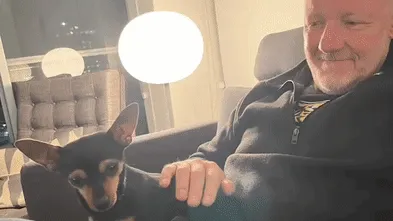
The ability to change one’s mind is a powerful, yet often overlooked, human trait. George Bernard Shaw famously stated, “Those who cannot change their minds cannot change anything.” In an era that can feel marked by rigid viewpoints, this capacity for adaptation is not a weakness but a profound strength. This is a story about such a change, specifically, a transformation in my lifelong aversion to small dogs, culminating in the unexpected joy brought by a tiny canine named Ferdie.
A Lifelong Preference for ‘Proper’ Dogs
My upbringing instilled a clear preference for larger, more traditionally perceived “proper” dogs. Our family dogs were typically medium-sized, embodying a loyalty and companionship I cherished. One memorable exception was a giant foxhound, a gentle giant resembling Snoopy but far exceeding his cartoon counterpart in size, belonging to my brother, a veterinarian. Later, our family adopted Bruce, a rescue blue heeler-kelpie cross. Bruce was the epitome of a “best mate” – intelligent, loyal, and a constant source of comfort. His passing in 2021 left a significant void, with his collar a poignant reminder hanging from the car’s rearview mirror.
Following Bruce’s death, and with our children having moved out, my partner encouraged me to consider getting another dog. However, I felt unable to replace Bruce, or perhaps, to fill the space left by our children. The idea of a small dog, particularly those classified by the pet industry as “toys,” seemed entirely unappealing. I envisioned them as yappy, demanding creatures, more akin to accessories than companions. My preconceived notions painted them as “precious little tyrants” best suited for handbags, a far cry from the robust, dependable dogs I was accustomed to.
An Unexpected Shift: The Chihuahua Incident
The catalyst for change arrived unexpectedly. While dog-sitting a friend’s chihuahua, I found myself charmed by the tiny dog’s affectionate nature. This experience, coupled with my partner’s growing interest in chihuahua rescue sites, began to shift my perspective. It became clear that this wasn’t just about acquiring a new pet; it was about confronting my own rigidity and a potential unwillingness to embrace new experiences.
A particular dog captured our attention: a two-year-old black-and-tan male known as Danger Mouse. He had been struggling to find a home due to behavioral issues stemming from his upbringing in a large family with eleven children. This chaotic environment had left him with severe anxiety. While my initial reaction was hesitation, a deeper realization prompted me to embrace the situation. Sometimes, when faced with prolonged procrastination, allowing circumstances to guide you is the best course of action. Embracing this moment felt like saying “yes” to a new chapter.
Discovering Ferdie: The Prague Ratter Mystery
We decided to adopt him, and given our initial assumption that he was a chihuahua, we gave him a Spanish name: Ferdie. However, Ferdie didn’t quite fit the chihuahua stereotype. He was unusually quiet, showed no aggression towards other dogs, possessed a hearty appetite, and had a longer snout, smaller eyes, and remarkably large ears. He also seemed smaller than a typical chihuahua. During a walk, a stranger suggested he might be a Prague ratter. Initially taken aback by the comparison to a “rat,” we began to investigate.
Research revealed that Prague ratters bore a striking resemblance to Ferdie. Their characteristic traits – a non-barking nature, ease around other dogs, a fondness for food, and a tendency to curl up in laps – aligned perfectly with Ferdie’s behavior. We learned that Prague ratters are rare in Australia, and Ferdie’s journey to our home remains a charming mystery. The name Ferdinand also has Central European roots, adding another layer to his identity.
The Unexpected Charisma of a Small Dog
My previous dislike for small dogs stemmed from a lack of understanding of the unique joy they can bring, not just to their owners, but to everyone they encounter. Ferdie possesses an almost celebrity-like charisma. Strangers are constantly drawn to him, eager to pet him and inquire about his breed. Children, adults, and the elderly alike react with delight, exclaiming over his cuteness. This ability to elicit smiles and positive interactions from passersby, without any effort on my part, is a novel and rewarding experience. Compared to the quiet dignity of Bruce, Ferdie is a social media star in the making, becoming the most photographed member of our family.
This phenomenon aligns with observations on the human-animal bond. Historian Thomas Laqueur, in his book “The Dog’s Gaze,” notes how dogs often serve as the first point of connection for returning characters in literature, like Odysseus’s dog Argos. Laqueur suggests that dogs ‛rings their world into ours,” making us feel less lonely and ‛humanize humans.” Ferdie embodies this, effortlessly connecting with people and brightening their day. He navigates his newfound fame with a calm demeanor, always hopeful for a treat, and notably free from the “small-dog syndrome” often attributed to diminutive breeds. He generally gets along well with other dogs, though occasionally encounters larger breeds that view him with predatory interest.
Home Life: A Tiny Dog, Big Protector
While Ferdie is a social butterfly in public, his behavior at home reveals a different, protective instinct. He seems to view me as someone requiring constant security. A recent survey indicated that 95% of dog owners feel their pets offer unconditional love. Ferdie certainly seems to adore me, but he also perceives visitors as potential threats. He has, on occasion, shown his displeasure towards family members, friends, and service providers, including my brother, son, daughter, friends, mother-in-law, neighbors, and an oven repairman. Newcomers must navigate his initial wariness before he settles.
Prague ratters, it seems, respond differently to discipline than other breeds. Attempts to correct Ferdie’s behavior with a water spray were met with a surprisingly strong reaction. While his protective nature can be challenging, he dislikes being left alone but thankfully doesn’t resort to destructive behavior indoors. He is largely house-trained, though occasional “execitement wees” or poos can occur, usually in a preferred spot outside.
Regarding canine intelligence, a YouGov survey found that 66% of owners believe their dogs are above average in intelligence, with another 27% rating them as average. Only 7% consider their dogs below average. While I might place Ferdie in that latter group, his capacity to bring happiness to so many outweighs any perceived lack of intellectual prowess. His true value lies in the joy he spreads.
Embracing the Future: A Shorter Lifespan, Deeper Appreciation
The realization that Prague ratters have a shorter life expectancy, typically around 12 years, compared to the 20-plus years of chihuahuas, presents another adjustment. This means our time with Ferdie may be limited, underscoring the importance of cherishing every moment. It also means I am on the path to becoming what I once disdained: a “toy-dog person.”
This journey with Ferdie has been more than just acquiring a pet; it has been a profound lesson in personal growth. If one can evolve not only their opinions but also their deepest affections, embracing change in preferences and even confronting weaknesses, then the potential for positive transformation extends far beyond oneself, influencing the world around us.
