

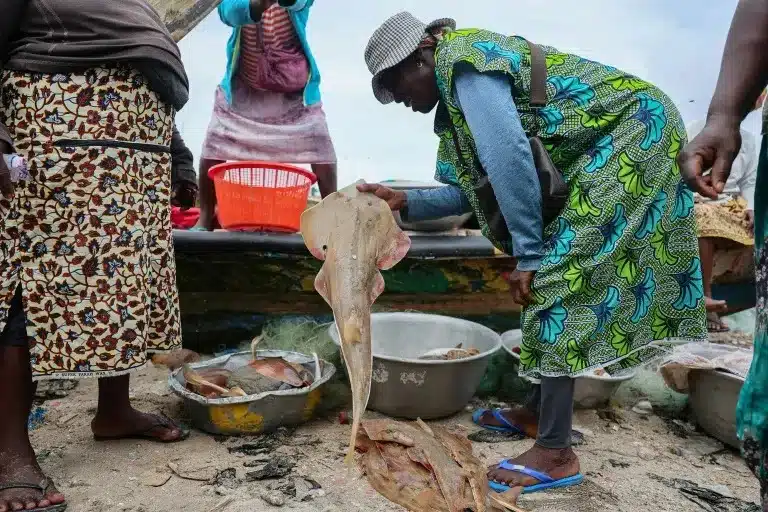
As dawn breaks along Ghana’s Atlantic coast, returning fishing vessels bring ashore their nightly haul – a mix of snapper, crabs, rays, and a distinctive fish known locally as “esene.” Once plentiful, this species, scientifically identified as guitarfish, has become increasingly scarce. For 36-year-old conservationist Issah Seidu, each catch is a stark reminder of the dwindling time to protect these critically endangered marine animals. His journey into marine conservation began in 2018 after studying terrestrial wildlife. A visit to coastal fishing communities revealed what scientists are calling one of the world’s most overlooked conservation emergencies.
The Plight of the Guitarfish
“We visited these communities and observed piles of sharks, rays, and guitarfish being landed without any consideration for conservation,” Seidu recounted. This observation spurred the wildlife biologist, who had never envisioned a career at sea, to action. Guitarfish, closely related to both sharks and rays, are classified as “critically endangered” by the International Union for Conservation of Nature (IUCN). Their meat is a valued local delicacy, and their fins are highly sought after in international markets, contributing to severe population declines across West Africa. Related species like sawfish may have already vanished from Ghanaian waters, and wedgefish are increasingly rare. Seidu fears the guitarfish could be next.
Engaging Fishing Communities for Conservation
A significant hurdle in Seidu’s conservation efforts has been convincing fishermen to alter their practices concerning a valuable catch. His non-governmental organization, AquaLife Conservancy, has been instrumental in raising awareness about conservation needs. Rather than simply demanding an end to guitarfish catches, the organization has introduced alternative livelihood opportunities, notably snail farming. In the coastal community of Adjoa, fishing families are now exploring snail farming as a supplementary income source, with rows of giant African snails thriving in wooden enclosures.
“The fishermen themselves chose snail farming,” Seidu noted, adding that the demand for snails currently outstrips supply. Edward Afful, a fisherman with two decades of experience, highlighted the financial strain caused by diminishing fish stocks. “Shrinking catches have left many crews struggling to cover the cost of fuel for their boats,” he explained. Afful now supplements his income by raising snails. “If we had started this years ago, everyone would have benefited,” he reflected.
Local Stewardship: Mapping Marine Protected Areas
In a landmark move, Ghana established a 703-square-kilometer marine protected area (MPA) in April, spanning a significant stretch of the Atlantic Ocean. This area is slated for co-management by both national government bodies and coastal communities. Professor Francis Nunoo of the University of Ghana’s fisheries science department emphasized the importance of this designation, stating, “There are very unique species in the area that need to be protected, including the guitarfish.”
While national policymakers finalize the framework for the MPA, Seidu and local fishermen in Adjoa and Apam are already demonstrating a practical model. They have created their own “locally managed marine area.” Seidu has equipped fishermen with GPS tracking devices to pinpoint areas where guitarfish congregate and reproduce. Together, they have meticulously mapped approximately 15 square kilometers of crucial guitarfish habitat. “The fishermen are the custodians of these places,” Seidu asserted. “They know where the species congregate and where the nursery grounds are.”
In Apam, trader Evelyn Akorful, 41, has observed seasonal catch fluctuations but confirms a consistent long-term decline. “Now we don’t get as much as before,” she stated, attributing the depletion to destructive fishing methods, particularly the use of lights at sea. For families like hers, every fish caught is vital for covering school fees and daily expenses. “If we don’t get one fish, we try another. We survive by mixing everything,” Akorful explained, holding up two freshly caught guitarfish.
Older residents recall a time when guitarfish were far more abundant. Jonathan Abadu Kennedy, 57, a former local lawmaker known as Uncle Ebo, reminisced, “When I was young, guitarfish were everywhere. You could catch several within minutes using hook and line.” He now attributes the scarcity of large guitarfish to pollution, evolving fishing practices, and the impacts of climate change.
From Local Kitchens to Global Markets
Guitarfish, when dried and salted, is a common ingredient in Ghanaian soups and stews. However, the fins are a significant commodity, exported to international markets, particularly for use in shark-fin soup. “The Chinese market is quite large,” Seidu noted. “It creates additional incentives for fishermen,” complicating conservation efforts.
Seidu believes that true success will be measured not just by the population numbers of guitarfish remaining in Ghana’s waters. “When the majority of fishermen become aware that their actions matter and choose to protect the species themselves,” he concluded, “that is success.” This community-driven approach, combining alternative livelihoods with local marine management, offers a hopeful path forward for safeguarding Ghana’s endangered marine biodiversity.
