

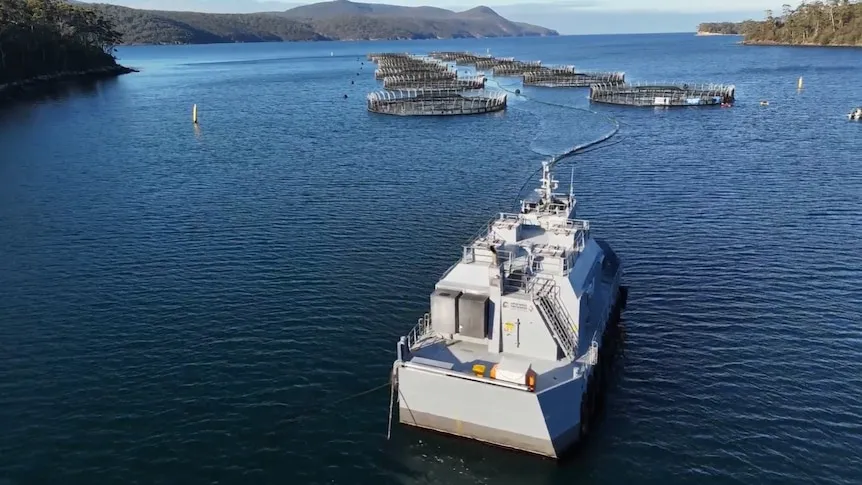
Tasmania’s Environment Protection Authority (EPA) has granted a two-year lease extension for Tassal’s Long Bay salmon farm, located near the historic Port Arthur site. This decision comes despite ongoing community concerns regarding the farm’s environmental impact, particularly its contribution to nutrient levels and algae growth in the shallow bay. The EPA’s assessment concluded that while the farm does release nutrients, these are not the primary driver of the observed algae blooms, attributing them instead to factors like shallow water temperatures.
EPA’s Findings on Nutrient Levels and Algae Growth
The EPA’s monitoring data, published this week, indicated that ammonia and nitrogen levels were elevated near the fish farm during the summer months. However, these nutrient levels reportedly decreased within weeks of the fish pens being seasonally emptied. The authority also noted the presence of ‘nuisance’ algae next to the site, but characterized these levels as “low” and stated they had not increased significantly between 2021 and the projected 2025 levels.
A key point in the EPA’s decision is its assertion that shallow water temperatures, rather than solely fish farm nutrients, are the main cause of algae growth in Long Bay. The authority explained that the bay’s connection to offshore water masses, such as the Southern Ocean, facilitates nutrient exchange. “The effect of shallow water temperatures on algal growth… does not support that persistent nuisance algal blooms are being caused by fish farming,” the EPA stated in its decision document. The EPA also noted that the impact of the farm on an inshore reef area could not be fully assessed due to a lack of baseline data collected before operations began.
Community and Scientific Concerns
The decision to extend the lease has drawn criticism from local residents and environmental groups, including the Tasmanian Independent Science Council (TISC). The TISC, which submitted one of over 80 objections, argued that Long Bay is inherently unsuitable for salmon farming due to its limited water circulation and sheltered nature. The council contends that the majority of human-induced nutrient loads in the bay originate from the salmon farm.
Concerns were also raised by the TISC regarding the methodology of the EPA’s monitoring studies. They questioned the design of the baseline surveys, noting the absence of monitoring sites in the less-flushed northern parts of the bay. Furthermore, the TISC suggested that reports often lacked context regarding the timing and scale of farming activities. The council advocated for a precautionary approach rather than the EPA’s stated “continuous improvement” strategy.
Locals also presented the EPA with “algal mats” as anecdotal evidence of the problem. However, the EPA dismissed this, stating that similar occurrences are observed in areas without salmon farms and emphasized its preference for a rigorous, science-based approach using consistent photo-documentation over extended periods.
Further community concerns have focused on the observed decline in seagrass in the area. While three seagrass sites showed a reduction from 2023 levels—the year a 48-tonne nitrogen limit was imposed—the EPA noted that “little is known” about seagrass’s specific response to fish farm nutrients and that the sample size was limited.
Tassal’s Response and Operational History
Tassal welcomed the EPA’s decision, describing the assessment as “one of the most comprehensive” in Tasmania’s marine farming sector. A company spokesperson stated that the extension provides “important certainty for our people, our operations and the wider Tasman Peninsula community.”
The EPA’s decision document acknowledged that Tassal had committed two environmental breaches at the Long Bay site, which were characterized as “short-lived and… rare.” In its assessment, the EPA also considered Tassal’s broader compliance record across its 18 marine farm licenses, four freshwater hatcheries, and four processing sites in Tasmania. Since 2021, the company has received 14 formal warning notes and 33 convictions for non-environmental matters, primarily related to marine debris. Previous environmental notices were issued for issues including feed dumping, an unreported diesel spill, effluent quality problems, and pollutant discharges at other Tassal facilities.
Future Monitoring and Research Recommendations
As part of the lease renewal, the EPA has recommended further monitoring and studies specifically targeting Long Bay and its surrounding areas. These investigations aim to determine if the 20% reduction in fish feed levels implemented in 2023 has led to improvements in the bay’s ecosystem.
The EPA’s recommendations include:
- Conducting further research into the environmental variations within the shallow, enclosed bay.
- Comparing Long Bay’s conditions with those in the broader Port Arthur and Storm Bay regions.
- Continuing to measure environmental changes since the 2023 feed reduction measures were put in place.
The Greens and other environmental groups have criticized the EPA’s decision. Greens leader Rosalie Woodruff expressed disagreement with the EPA’s conclusions and the monitoring practices employed since 2017, highlighting the lack of pre-operational baseline surveys as a significant issue that hinders accurate assessment of environmental impacts.
