

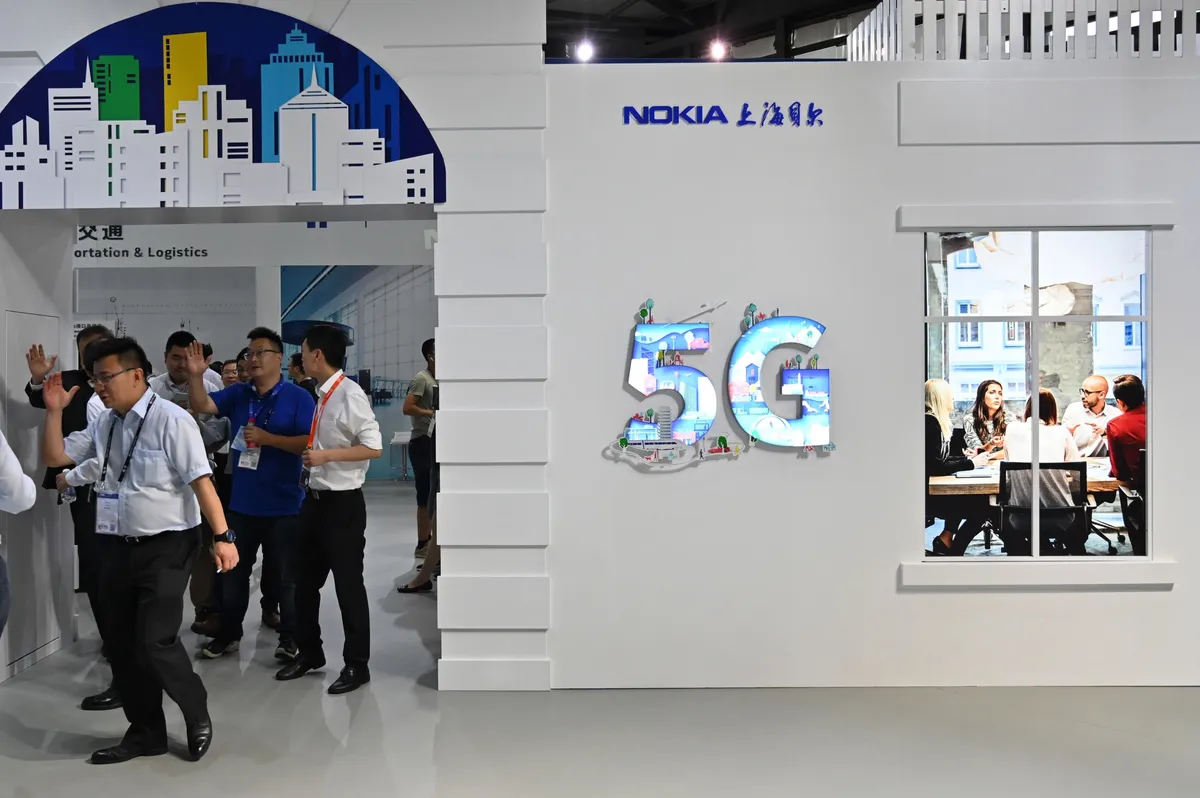
Nokia has confirmed the closure of its radio technology research and development facility in Hangzhou, China, by the end of 2026. This move will impact approximately 1,600 jobs and underscores a widening division within the global 5G supply chain, leading to the formation of distinct technological ecosystems for the upcoming 6G era. The decision reflects Nokia’s diminished presence in China’s telecommunications market and aligns with similar challenges faced by its Swedish competitor, Ericsson.
Nokia’s Hangzhou Facility Closure
Employees at the Hangzhou site were informed of the closure on Thursday, August 13. In a statement, Nokia explained the decision was driven by a need to better align its China operations with its global model, citing a steady decline in its Chinese business over recent years. The Hangzhou facility was central to Nokia’s development of radio access network (RAN) technology, which forms the core infrastructure for 5G networks, including base stations and antenna systems.
While Nokia has confirmed the Hangzhou closure, reports suggest that other Nokia sites in Beijing, Chengdu, Qingdao, and Shanghai may also face similar cutbacks as part of a broader restructuring. These potential closures have not yet been officially confirmed by the company.
Financial Impact and Restructuring Charges
The closure of the Hangzhou R&D hub is a significant component of Nokia’s updated restructuring plan. The company raised its projected restructuring charges for 2026 from €250 million (approximately $289 million) to €800 million (approximately $926 million). Of this total, approximately €350 million (approximately $405 million) is specifically allocated to the overhaul of Nokia’s operations in China. This includes the integration of Nokia Shanghai Bell, a joint venture that Nokia took full control of in December 2025 after acquiring the remaining stake from its state-backed partner.
Nokia anticipates that integrating Nokia Shanghai Bell will yield cost savings of around €200 million (approximately $232 million). Additionally, CEO Justin Hotard announced a further €200 million (approximately $232 million) in European restructuring charges, which analysts estimate could affect over 2,000 positions across the continent. Hotard indicated these additional investments were aimed at capturing further savings opportunities.
Nokia’s workforce has seen a substantial reduction in recent years. From a peak of approximately 103,000 employees in 2018, following the acquisition of Alcatel-Lucent, the company’s headcount had fallen to around 78,000 by the end of 2025. Excluding employees from the recently acquired optical networking specialist Infinera, Nokia was projected to have about 70,000 employees by the end of 2026.
Reasons for Nokia’s Decline in China
Nokia’s revenue decline in China has been particularly steep. In 2018, the company generated nearly €2.2 billion (approximately $2.55 billion) from the Greater China region. By 2025, this figure had dropped to €913 million (approximately $1.06 billion), marking a decrease of over 58% in seven years. A critical turning point occurred in 2020 when Nokia failed to secure key radio access network contracts with China’s major state-backed telecommunications operators.
Initially, this setback was attributed partly to competitiveness issues, with Nokia’s early 5G products lagging behind rivals. However, it evolved into a broader structural exclusion. By September 2025, Nokia executives indicated they had received signals of exclusion from the Chinese market on national security grounds, mirroring the restrictions faced by Chinese vendors like Huawei and ZTE in Western markets. Consequently, Nokia’s combined market share with Ericsson in China’s RAN sector had fallen below 3%.
Ericsson has experienced a similar trajectory. After a surge in China revenues in 2020, the company saw a significant drop the following year, widely seen as retaliation after Sweden banned Huawei from its 5G networks. By 2025, Ericsson’s China revenues had fallen to an estimated $665 million to $905 million, representing about 3% of its global total.
Strategic Implications for 5G and 6G Development
The closure of Nokia’s Hangzhou R&D facility has significant strategic implications, particularly concerning the development of future telecommunications technologies like 6G. China operates the world’s most extensive 5G network, with millions of active base stations. This vast deployment provides an unparalleled environment for testing and optimizing radio access network technology under real-world, high-density conditions.
The data generated from such dense deployments is crucial for advancing technologies like AI-native networks and advanced beamforming, which are expected to be core components of 6G. With its exclusion from China, Nokia, like Ericsson, loses access to this vital R&D feedback loop. Nokia CEO Justin Hotard has highlighted this asymmetry, questioning why Western markets allow high-risk vendors while Western companies are effectively shut out of China.
Analysts note that China’s rapid deployment of 5G-Advanced (5G-A) across hundreds of cities is accelerating the development of key 6G technologies, such as integrated sensing and communications (ISAC). China also holds influential positions within the 3GPP standards bodies that will shape the 6G protocol. This situation has led to concerns about the potential bifurcation of global telecommunications standards into separate Western and Chinese ecosystems.
Addressing R&D and Future Competitiveness
In response to concerns about long-term competitiveness, Nokia emphasizes its continued global R&D investment. The company spent approximately €4.9 billion (approximately $5.67 billion) on R&D in 2025, an increase from the previous year, with first-half 2026 spending also showing a year-over-year rise. Nokia asserts that R&D efforts are being relocated and expanded in other regions rather than being reduced.
The company has also launched an AI-RAN platform, integrating artificial intelligence into the radio access network to enhance performance. However, the development of AI-native 6G networks relies heavily on real-world training data from high-density deployments, a resource that Western vendors excluded from China will have limited access to. Despite strong growth in AI and cloud order intake, the loss of China as a testing ground for traditional RAN technology presents a challenge.
The Global Bifurcation of Telecoms
Nokia’s Hangzhou closure occurs as international bodies debate 6G architectures, spectrum, and security frameworks. The significant real-world 5G data available in China grants it substantial influence over these discussions. The formation of initiatives like the Global Coalition on Telecoms by several Western nations aims to embed security and supply-chain diversity into 6G standards from the outset, learning from the 5G era.
Think tanks and security analysts have warned of a growing fragmentation in global digital hardware markets, with distinct Western and Chinese ecosystems emerging. This bifurcation poses risks to interoperability and innovation. The challenge for the US and Europe, as outlined by policy analysts, is to develop a 6G alternative that is both technologically advanced and affordable, potentially by fostering greater collaboration and strategic investment.
Frequently Asked Questions
Why is Nokia closing its Hangzhou research facility?
Nokia is closing its Hangzhou radio technology R&D facility due to a significant decline in its business in China over the past seven years. The company also cited signals of exclusion from the Chinese market on national security grounds, making commercial recovery unlikely. This closure is part of a broader restructuring program in China.
What does Nokia’s exit from China mean for Western 5G and 6G infrastructure?
Nokia’s exit accelerates the division of the global 5G supply chain into separate Western and Chinese ecosystems. For 6G development, this means Western vendors like Nokia will have less access to the vast real-world data generated by China’s advanced 5G deployments, potentially impacting the development of AI-native radio technologies.
Is Nokia’s overall R&D investment declining because of the Hangzhou closure?
No, Nokia’s global R&D spending is increasing. The company is reallocating R&D capacity to other regions and continues to invest significantly in areas like AI and cloud technologies, positioning itself for the 6G era.
Why is Huawei still operating in Germany while Nokia is being shut out of China?
This asymmetry is a point of contention. While Nokia and Ericsson hold a minimal share in China’s RAN market, Huawei has a dominant position in Germany. Western governments have expressed concerns about high-risk vendors, leading to restrictions on Chinese equipment. Nokia’s leadership has publicly called for greater reciprocity, suggesting that if Western vendors are excluded from China on security grounds, similar measures should be considered for Chinese vendors in Europe.
