

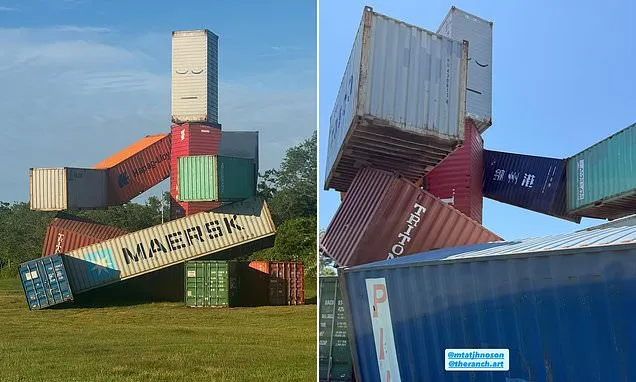
A dispute has erupted in East Hampton, New York, pitting local authorities against a property owner over a large-scale sculpture constructed from rusting shipping containers. The artwork, titled ‘Mediating Figure,’ was erected in June on a Montauk property owned by Max Levai, sparking a legal battle with the Town of East Hampton, which argues the piece constitutes an unpermitted structure.
Controversial Sculpture Sparks Town Lawsuit
The sculpture, created by Los Angeles-based artist Matt Johnson, is composed of several retired shipping containers welded together to resemble a meditating figure. It is situated on ‘The Ranch,’ a property owned by Max Levai since 2021. While Levai has previously displayed art on his land, this particular installation has drawn the ire of town officials, leading to a lawsuit filed in Suffolk County Supreme Court. The town is demanding the immediate dismantling or demolition of the sculpture.
East Hampton’s legal action centers on the claim that the sculpture is an ‘unlawful construction and maintenance of an unpermitted structure.’ Despite the property being privately owned, the town cites a 1983 agreement that purportedly restricts development on the land to agricultural production only. Levai’s property was formerly protected farmland.
Town Attorney Jake Turner emphasized the structural nature of the artwork, stating, ‘They’re welding big pieces of metal together. It needs to go through the building department for applicable safety standard checks.’
Permitting and Zoning Regulations Under Scrutiny
According to town officials, any structure in New York State requires a building permit. Patrick Derenze, the town’s public information officer, explained, ‘If an art sculpture qualifies as a structure under New York State building code, then it will need to go through the applicable building permit application process to ensure that it meets any and all building codes.’
The Town of East Hampton has brought four charges against The Ranch: violation of a conservation easement, failure to obtain a building permit, failure to obtain Architectural Review Board approval, and failure to obtain a certificate of occupancy. The town has secured a legal stay that prohibits any further construction or demolition on the property while the case proceeds.
The issue gained traction during an East Hampton Town Board Work Session on July 7, where a 4-1 vote authorized the exploration of legal action against Levai and his property. The lawsuit was subsequently filed, though artist Matt Johnson was later dropped as a defendant.
Artist and Owner’s Perspective
Matt Johnson chose Montauk for his installation, citing its history as an artist’s colony and its geographical position as the furthest point on Long Island. He told Vanity Fair that Montauk offers a desirable distance from the hustle and bustle, allowing for a different perspective on creative endeavors. ‘I think a lot of times, artists – and I certainly feel this way about living where I live – it’s nice to sort of just get yourself a distance away from all the stuff that’s going on,’ Johnson remarked.
Max Levai has been showcasing a diverse collection of art on The Ranch for approximately five years. He noted that his efforts have generally received positive feedback from local museums and art collectors. ‘Whether it’s these great local museums that are all really supportive, or other people doing similar things to what I am in a non-traditional way – and obviously an incredible amount of affluent collectors are out here, looking to see art in a different context,’ Levai stated.
Levai believes that ‘Mediating Figure’ challenges conventional thinking and encourages viewers to contemplate. He expressed, ‘And that sculpture, certainly, I think kind of defines that, right?’
Community Divided
The imposing sculpture, made from weathered shipping containers, has become a focal point of debate within the affluent Hamptons community. While some residents and art enthusiasts appreciate its unconventional nature and artistic merit, others view it as an unwelcome imposition on the landscape and a violation of local regulations. The legal proceedings initiated by the town underscore the deep divisions the artwork has created.
The Town of East Hampton maintains that the sculpture, regardless of its artistic intent, functions as a structure that must comply with building codes and permitting processes. The outcome of the lawsuit will likely set a precedent for how similar large-scale art installations are treated within the town’s jurisdiction, particularly concerning properties with historical land-use agreements.
Conclusion
The legal battle over Matt Johnson’s ‘Mediating Figure’ highlights the complex interplay between artistic expression, private property rights, and municipal zoning laws. As the East Hampton town government pursues its case against Max Levai and The Ranch, the community awaits a resolution that will determine the fate of the shipping container sculpture and potentially influence future artistic endeavors in the area.
