

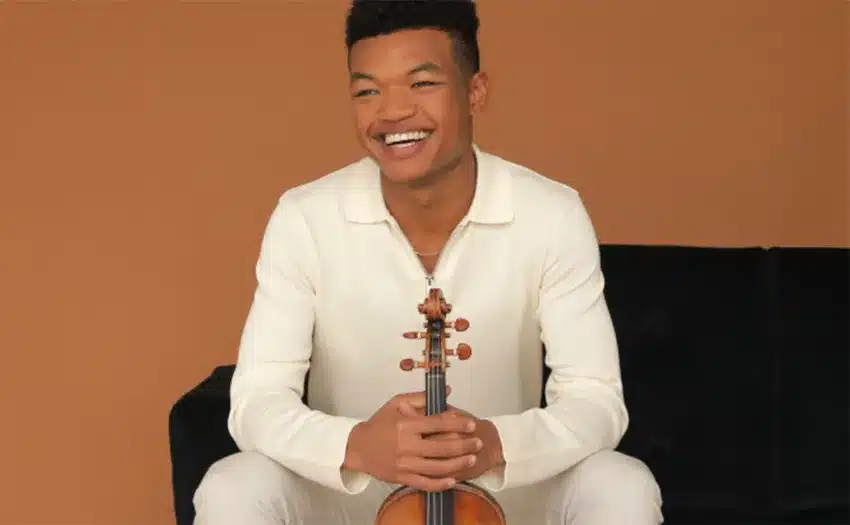
Violinist Randall Goosby is set to make his highly anticipated debut at Tanglewood on Saturday, August 22, performing Florence Price’s Violin Concerto No. 2 with the Boston Symphony Orchestra (BSO). The concert, held in the Koussevitzky Music Shed, will be led by conductor Thomas Wilkins, who also serves as the BSO’s Artistic Partner for Education and Community Engagement. The program also features Dvořák’s Symphony No. 8, Bernstein’s “Chichester Psalms,” and Saint-Saëns’ “Introduction and Rondo Capriccioso.”
A Rising Star’s Artistic Journey
Randall Goosby has rapidly ascended the ranks of classical music, recognized for his exceptional technique and a deeply thoughtful approach to his craft. Even in late 2021, he was already considered one of the genre’s most promising young talents. Beyond his technical prowess, Goosby’s artistic philosophy centers on introspection and purpose, a perspective that deepened during the pandemic lockdown. This period of reduced performing allowed him an invaluable opportunity to reflect on his artistic identity and the messages he wished to convey through his music.
These reflections directly informed his debut album on the Decca label, titled “Roots.” The album thoughtfully explores works by Black composers, examining Goosby’s own position within a musical tradition historically dominated by European repertoire. He has often spoken about the influence of his longtime mentor, Itzhak Perlman, particularly in shaping his distinctive violin tone, likening each musician’s sound to a unique, evolving signature.
Goosby emphasizes that while the role of a soloist demands confidence, the act of performing is not driven by ego. Instead, he highlights the crucial elements of collaboration, attentive listening, and a continuous willingness to learn from fellow artists. His commitment extends to championing composers whose works have been historically overlooked, but he is careful not to reduce music solely to matters of race. His aim is to enrich the concert landscape by introducing diverse voices and experiences, while acknowledging the enduring significance of the established classical canon in his own musical development.
He expresses a forward-looking vision where compositions by Black and other underrepresented artists become a standard part of concert programming, rather than occasional features. Goosby is particularly enthusiastic about leveraging his growing platform to engage with communities that have limited access to classical music, enhance educational initiatives for young aspiring musicians, and inspire future generations to discover the profound, lifelong rewards of musical engagement.
Spotlight on Florence Price
The centerpiece of Goosby’s Tanglewood performance is Florence Price’s Violin Concerto No. 2. Price (1887–1953) holds a significant place in music history as the first Black woman to have a symphony performed by a major American orchestra; the Chicago Symphony premiered her “Symphony in E Minor” in 1933. Despite composing over 300 works, encompassing symphonies, concertos, chamber music, and songs, much of her output faded into obscurity following her death.
A resurgence of interest in Price’s music began in the 1980s through scholarly research. This revival gained considerable momentum after the 2009 discovery of numerous previously unknown manuscripts in an abandoned Illinois home, including her Violin Concerto No. 2. This concerto, completed in 1952, is structured as a single movement. It masterfully blends the lyrical qualities of late Romanticism with distinct African American musical influences and showcases virtuosic demands for the solo violinist.
The Boston Symphony Orchestra has played a role in elevating Price’s profile by including her compositions in recent seasons. However, the broader renaissance of her music is a collective effort, driven by a wide array of orchestras, performers, scholars, and recording projects, rather than the work of a single entity.
A Richly Varied Program
Complementing Price’s concerto, the BSO under Thomas Wilkins will present other significant works. Antonín Dvořák’s “Symphony No. 8,” completed in 1889, is a beloved staple of the orchestral repertoire. Composed during a period of personal happiness for Dvořák, the symphony is characterized by its lyrical melodies, spirited dance rhythms, and vibrant orchestral colors, offering a brighter contrast to the more dramatic tone of his earlier Seventh Symphony.
Leonard Bernstein’s “Chichester Psalms,” written in 1965 for Chichester Cathedral in England, sets Hebrew texts from the Book of Psalms. The work uniquely merges traditional choral music with influences from Broadway, jazz, and Jewish liturgical traditions. Although composed during a time of global conflict, the “Chichester Psalms” conveys a powerful message of reconciliation, compassion, and the enduring hope for peace.
Rounding out the program is Camille Saint-Saëns’ “Introduction and Rondo Capriccioso,” a popular showpiece for violin and orchestra, known for its dazzling virtuosity and captivating melodies.
Conclusion
Randall Goosby’s Tanglewood debut promises to be a significant event, showcasing not only his remarkable talent but also his commitment to expanding the classical music canon. His performance of Florence Price’s Violin Concerto No. 2, alongside other orchestral masterpieces, highlights a vibrant and evolving landscape in classical music, celebrating both established traditions and the vital contributions of underrepresented composers.
