

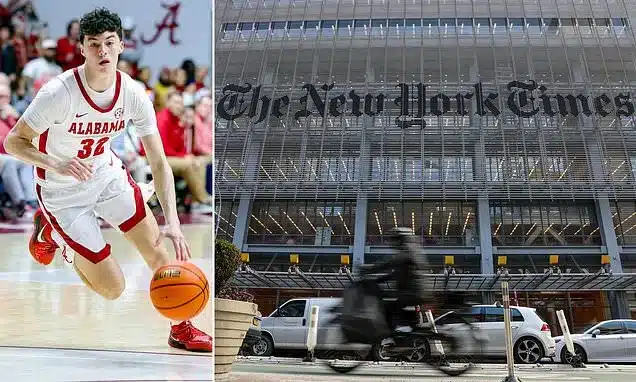
Former college basketball player Kai Spears has been awarded $9.25 million in a defamation lawsuit against The New York Times. An Alabama jury found that the newspaper falsely linked Spears to a fatal shooting, marking a significant legal defeat for the publication, which reportedly had not lost a defamation case in the United States for over 50 years. The verdict concluded a nine-day trial in the U.S. District Court for the Northern District of Alabama.
False Accusation in Fatal Shooting Report
The lawsuit centered on a March 2023 article written by Times reporter Billy Witz. The report erroneously identified Spears, then an 18-year-old freshman walk-on for the University of Alabama, as a passenger in a vehicle present at the scene of a fatal shooting in January 2023. The incident resulted in the death of 23-year-old Jamea Harris.
Witz based the identification on information from an anonymous source described as a “high-level person, professional.” However, during the legal proceedings, the reporter acknowledged the article contained a significant error. The New York Times later issued a correction, but not until after Spears had initiated legal action.
Timeline of the Error and Correction
The initial article was published on March 15, 2023. It incorrectly stated that Spears was in the car with then-Alabama basketball player Brandon Miller when the shooting occurred. The report cited an anonymous source for this information.
Following the article’s publication, Alabama’s athletic director and Spears’s father publicly denied his presence at the scene. The New York Times incorporated these denials into its subsequent reporting and reviewed its initial findings. However, the newspaper did not immediately conclude that a correction was necessary at that time.
Spears officially filed his defamation suit in 2023. The legal action brought forth new details about the incident. Prompted by this information, editors at The Times initiated further reporting, which ultimately confirmed that the individual in the vehicle was not Kai Spears, but rather Cooper Lee, a student manager for the basketball team. The newspaper issued an editor’s note in June 2023, acknowledging the mistake and expressing regret.
The editor’s note stated: “The original version of this article, published March 15, misidentified the person who was in the car with [Crimson Tide star player] Brandon Miller when the shooting occurred. Based on information from a person familiar with the case, the article erroneously identified that person as Kai Spears, a freshman basketball player.” The note further detailed that after initial publication, the university’s athletic director and Spears’s father denied his involvement. The Times included these responses and reviewed its reporting, but did not initially deem further changes necessary. It was only after Spears filed his lawsuit and additional reporting was completed that the newspaper determined Cooper Lee was the individual present.
Spears’s Experience and Impact of False Report
Kai Spears, who was an 18-year-old freshman walk-on at the University of Alabama when the article was published, stated that he was not near the scene of the shooting. He expressed that the situation felt like more than a simple mistaken identity, suggesting a lack of thorough due diligence by the publication.
The false report had severe personal consequences for Spears. He recounted receiving numerous threats on social media platforms like Twitter and Instagram, including messages telling him to commit suicide and labeling him and his team as murderers. Spears emphasized that he had done nothing wrong and was deeply affected by the false narrative being circulated.
In a statement shared on Twitter, Spears declared the New York Times report to be “100% inaccurate” and accused the writer of having “complete disregard for the truth.” He expressed his struggle to process and cope with the widely published false statements. Spears also conveyed his gratitude to Alabama Athletics for refuting the claims on his behalf and shared his profound heartbreak over the tragic death of Jamea Harris.
Legal Proceedings and Reactions
Following the jury’s verdict in favor of Kai Spears, a spokesperson for The New York Times expressed disappointment. “We’re disappointed the jury found The Times liable for an honest mistake,” the spokesperson stated. “We thank the jury for its service, but believe the verdict and award of damages are contrary to law and not supported by the evidence. We are reviewing our legal options.”
Matt Glover, an attorney representing Spears, conveyed his satisfaction with the outcome. He expressed confidence that “this verdict will improve journalism throughout the country,” suggesting a belief that the decision will encourage greater accuracy and accountability in reporting.
Background of the Fatal Shooting
The fatal shooting that led to the lawsuit involved former Alabama Crimson Tide basketball player Darius Miles and his childhood friend, Michael Lynn Davis. Both were charged with capital murder in connection with Jamea Harris’s death. Michael Lynn Davis was subsequently convicted of murder and sentenced to life in prison without the possibility of parole.
The New York Times’s erroneous report implicated Kai Spears in this tragic event, leading to the defamation case and the substantial damages awarded by the jury. The case highlights the critical importance of journalistic accuracy and the potential repercussions of errors in reporting, particularly when they involve serious criminal allegations.
Conclusion: A Landmark Verdict
The $9.25 million verdict against The New York Times represents a rare and significant legal setback for the prominent newspaper. It underscores the profound impact that false reporting can have on individuals’ lives and reputations. The jury’s decision in favor of Kai Spears serves as a powerful reminder of the responsibility journalists and news organizations bear in ensuring the accuracy and integrity of their work, especially when reporting on sensitive and serious matters.
