

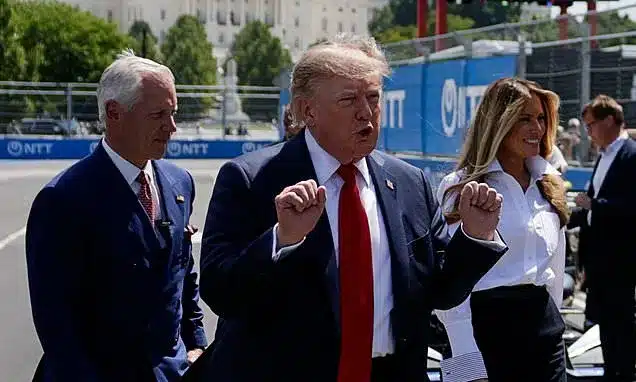
Donald Trump took center stage at the historic Freedom 250 Grand Prix on Sunday, attending the inaugural IndyCar event held in Washington, D.C., as part of the nation’s 250th-anniversary celebrations. The President, accompanied by First Lady Melania, was a prominent figure at the spectacle, which saw NTT IndyCar Series cars race along a unique 1.7-mile circuit weaving through the heart of the capital. The track passed iconic landmarks such as the National Mall, the Washington Monument, and the U.S. Capitol Building, offering a dramatic backdrop for the high-speed competition.
A Presidential Initiative for a Historic Race
The Freedom 250 Grand Prix was established by presidential executive order as a key event to commemorate the United States’ semiquincentennial. President Trump played an instrumental role in bringing the race to fruition, meeting with racing magnate Roger Penske in January to sign the executive order that paved the way for the event. Transportation Secretary Sean Duffy recalled being tasked by the President to conceptualize something “historic and cool” for the anniversary, leading to the ambitious plan for a street race in the nation’s capital.
The initiative aimed to combine the excitement of professional auto racing with a celebration of American history and achievement. “The Freedom 250 INDYCAR race pairs 250 years of American achievement with a sport that embodies speed, ingenuity and the freedom of the open road,” stated Mohammed Ben Sulayem, President of the FIA, acknowledging the significance of the event and congratulating all involved in realizing the vision.
Pre-Race Festivities and Presidential Involvement
The event kicked off with a powerful display of aerial prowess as U.S. Army helicopters, including Chinooks, Black Hawks, and Apache models, conducted a flyover. The U.S. Army’s ‘Pershing Own’ Band also performed on the track, adding to the festive atmosphere. President Trump arrived at the start line and was greeted by drivers, IndyCar personnel, and Roger Penske on pit road. His eldest son, Donald Trump Jr., and his wife, Bettina, were also in attendance, alongside other notable figures.
A highlight of the pre-race ceremonies was President Trump’s ceremonial lap around the circuit. He drove his armored limousine, known as ‘The Beast,’ completing a lap of honor before waving the green flag to officially start the 147-lap race. The President was set to watch the race from a prime vantage point, observing open-wheel cars reaching speeds of up to 185 mph amidst the historic cityscape.
Broader Context: Presidential Engagement with Sporting Events
The Freedom 250 Grand Prix is not the first time President Trump has utilized major sporting events to mark the United States’ 250th anniversary. Earlier in the year, the Trump administration hosted a promotional event for the race outside the White House, featuring drivers and a pit stop demonstration. This follows a pattern of the President engaging with and participating in various sporting celebrations.
For instance, on June 14, the UFC held an event on the South Lawn, where President Trump made a ceremonial walkout before taking his seat. He also created and attended the Patriot Games, a high school athletic competition for the anniversary, which brought together 120 young athletes from across the nation competing for scholarships. More recently, he attended the World Cup final, presenting the trophy and participating in the post-match celebrations.
These appearances suggest a focus on the ceremonial aspects of the presidency, with a particular emphasis on celebrating national milestones through high-profile sporting engagements. The inclusion of the IndyCar race in Washington, D.C., represents another significant instance of this approach, blending national commemoration with the excitement of professional sports.
A Unique Racing Venue
The decision to host an IndyCar race on the streets of Washington, D.C., marked a significant departure from traditional racing venues. The 1.7-mile circuit was designed to showcase the capital’s iconic architecture, providing a unique viewing experience for both spectators and participants. The juxtaposition of high-speed racing against the backdrop of national monuments was intended to create a memorable and visually striking event.
Transportation Secretary Duffy commented on the novelty of the event, noting the speed at which the cars would travel down Pennsylvania Avenue and expressing anticipation for the excitement it would generate. He also drew a historical parallel, mentioning that the last street race in Washington reportedly occurred in 1801, hosted by President Thomas Jefferson, albeit with horses.
Conclusion
The Freedom 250 Grand Prix, initiated by President Trump as part of the United States’ 250th-anniversary celebrations, brought the NTT IndyCar Series to the streets of Washington, D.C. The event featured significant presidential involvement, including a ceremonial lap and the official start of the race. With its unique urban circuit passing national landmarks and its role in the broader context of presidential engagement with sporting events, the Grand Prix stood as a distinctive commemoration of American achievement and the spirit of the open road.
