

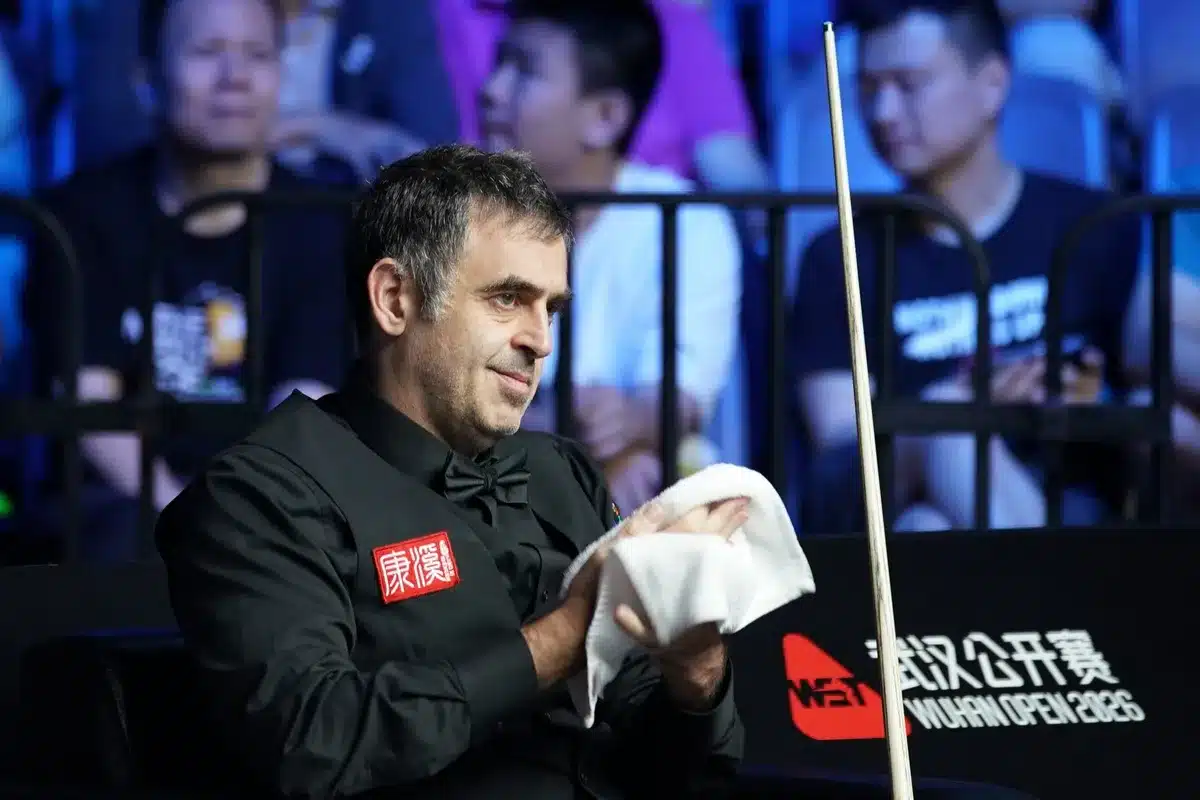
Ronnie O’Sullivan, the seven-time world champion, has expressed a somber outlook on his current snooker form, even after securing a victory at the Wuhan Open. Despite advancing past his first-round opponent, Ashley Carty, with a 5-2 scoreline, O’Sullivan described his performance as “pretty bad” and admitted to feeling a lack of control over his ability to improve.
O’Sullivan’s Candid Assessment of His Game
The veteran player, who remains a formidable presence in the sport at 50 years old and within the world’s top 16, acknowledged that his play against Carty was far from his usual high standards. While he managed three half-century breaks, his highest individual break was only 59. O’Sullivan noted that Carty had opportunities to win more frames, suggesting that the scoreline did not fully reflect the competitive nature of the match.
“My performance was pretty bad really,” O’Sullivan stated candidly following the match. “You have to call it out. I’m not going to lie. I’m not going to try to delude myself and say there was some good stuff. It has been pretty bad for a long time, so I expect to play pretty bad every time I go out there.”
He further elaborated on his internal struggle, admitting that while he has nothing left to prove in the sport, he deeply misses the feeling of playing at his peak and dominating opponents. “I know I don’t have anything to prove and that is what everyone keeps telling me. However, for my own selfish reasons I miss playing well and dominating the table, beating anyone who is in front of me. I miss that feeling, but there is nothing I can do about it.”
A Glimmer of Past Brilliance Amidst Current Struggles
Despite his current dissatisfaction, O’Sullivan’s career has been punctuated by moments of extraordinary brilliance. Last season, he achieved a remarkable feat by compiling two maximum 147 breaks in a single match in Saudi Arabia. This ability to produce flashes of his former magic highlights the frustration he feels in not being able to replicate such performances consistently.
His ongoing campaign at the Wuhan Open offers a chance to rediscover that dominant form. O’Sullivan is set to face rising Chinese talent Yao Pengcheng in the last 32. The draw has seen some notable upsets, potentially clearing a path for O’Sullivan.
Wuhan Open Draw and Notable Upsets
World champion Wu Yize suffered a surprising early exit from the tournament, losing 5-4 to Latvian youngster Artemijs Zizins. Wu was in O’Sullivan’s quarter of the draw, meaning a potential meeting between the two in the later stages is now off the table. Zizins, who has only reached one previous last-16 stage in his career, will now face Stephen Maguire.
The upset of Wu Yize has implications beyond the Wuhan Open, as he was also in contention to become world number one. This development means he will not be overtaking Judd Trump at the top of the rankings this week. Trump himself is currently engaged in a battle to maintain his world number one status, facing challenges from strong competitors like Neil Robertson, Zhao Xintong, and Mark Selby.
Other Top Players’ Performances
Several other top players have begun their Wuhan Open campaigns strongly. Judd Trump opened with a commanding 5-0 victory over Florian Nuessle. Zhao Xintong also secured a dominant 5-0 win against Gao Yang. Neil Robertson demonstrated his prowess by defeating Ben Mertens 5-1, dropping only one frame. Mark Selby advanced past Fan Zhengyi with a 5-2 scoreline, building on his recent triumph at the China Open.
Looking Ahead for O’Sullivan
As O’Sullivan navigates the Wuhan Open, the focus remains on whether he can overcome his own critical assessment of his game. His comments suggest a deep-seated desire to perform at his best, even if he feels the tools to do so are diminishing. The tournament provides a stage for him to challenge these feelings and potentially rediscover the consistent brilliance that has defined his legendary career.
The path ahead in Wuhan presents opportunities, but O’Sullivan’s own words indicate that the greatest challenge may be internal, as he grapples with the perceived decline in his own game and the elusive nature of recapturing peak form.
