

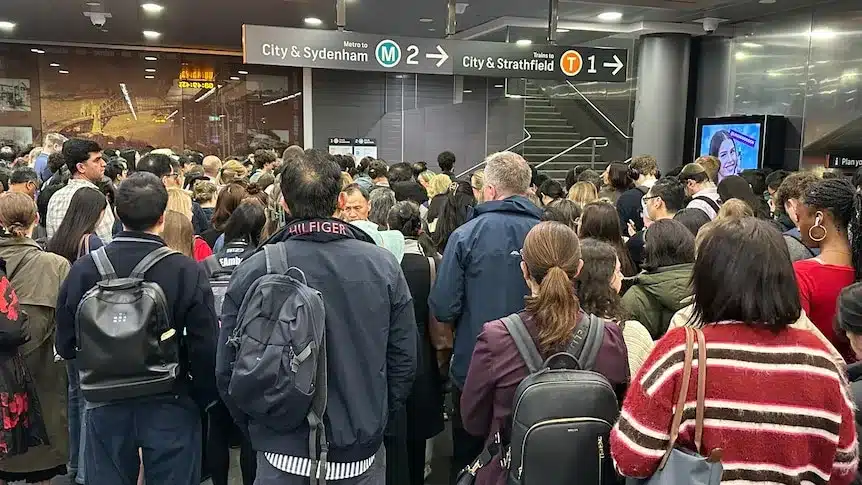
Sydney commuters faced significant disruptions on Tuesday morning as overhead wiring issues caused widespread train delays, marking the second such incident in less than two weeks. The T1 North Shore Line, specifically the city-bound service between Gordon and Chatswood, was replaced by buses, leading to long queues for passengers attempting to reach their destinations.
Overhead Wire Failure Disrupts Key Train Lines
Sydney Trains reported that the disruption stemmed from a loss of tension in the overhead wire at Chatswood. This critical infrastructure, responsible for powering trains, failed overnight due to an issue with a counterweight system. Matthew Longland, CEO of Sydney Trains, explained that these heavy weights are essential for maintaining the necessary tension in the wires that keep them suspended.
“One of those counterweights failed last night,” Longland stated. “The counterweights are inspected regularly, so we’ll obviously look at the history of this particular location, whether there was any incident there that was a problem.” The failure primarily impacted services on the T1 North Shore Western Line and the T9 Northern Line.
Repair Efforts and Commuter Advice
Crews worked through the night to address the fault, with primary repairs reported as complete around 8:30 AM. Longland indicated that secondary work was still required before power could be fully restored, with the aim of having trains back to normal operation on the T1 line towards the city later that morning. Passengers were strongly advised to allow for extra travel time.
To assist those affected, 14 replacement buses were deployed. Sydney Trains also suggested that for passengers traveling towards the city from Chatswood, the Sydney Metro might offer a more efficient alternative. For those originating from the Hornsby area, services on the T9 line running via Strathfield into the city were operating normally.
Longland mentioned that extra staff were present at key stations to help manage passenger flow, which he described as having proceeded smoothly despite the circumstances. He also recommended checking the Opal app for potential alternative bus routes that might be quicker than waiting for replacement services at train stations.
Passenger Experiences and Network Concerns
Despite the efforts to manage the situation, some passengers reported being severely inconvenienced. Commuters described being “packed like sardines” and expressed concerns that the Sydney Metro system could not adequately handle the increased passenger volume diverted from the affected train lines. One woman recounted having to travel from Chatswood instead of her usual Gordon to Chatswood route for university, resulting in her being late.
This incident follows a similar major disruption less than two weeks prior, on Friday, August 14. That event involved overhead wires coming down onto a train, necessitating assistance for hundreds of passengers. At the time, Transport for NSW secretary Josh Murray had noted that a significant investment of $2.1 billion had been allocated for network upgrades, including scanning “every centimetre of overhead wiring.”
Service Adjustments and Alternative Travel
In response to the ongoing work and to mitigate congestion, adjustments were made to the T1 Western Line. Some services originating from Penrith, Emu Plains, and Richmond, which typically terminate at Lindfield and Gordon, were rerouted to terminate at North Sydney. Additionally, all trains on the Central Coast line heading to the city were rerouted to operate via Strathfield.
Sydney Trains encouraged passengers to stay informed about service status and potential alternatives. The advice to check the Opal app was reiterated, highlighting its utility for finding quicker travel options beyond the immediate train station replacement bus queues. The focus remained on restoring full service as swiftly as possible while ensuring passenger safety and providing necessary support during the disruption.
Looking Ahead
The recurring nature of these overhead wiring issues raises questions about the effectiveness of recent network upgrades and maintenance schedules. Sydney Trains has committed to investigating the specific cause of the counterweight failure and reviewing inspection protocols to prevent future occurrences. Commuters, however, continue to bear the brunt of these service interruptions, underscoring the need for robust and reliable public transport infrastructure.
