

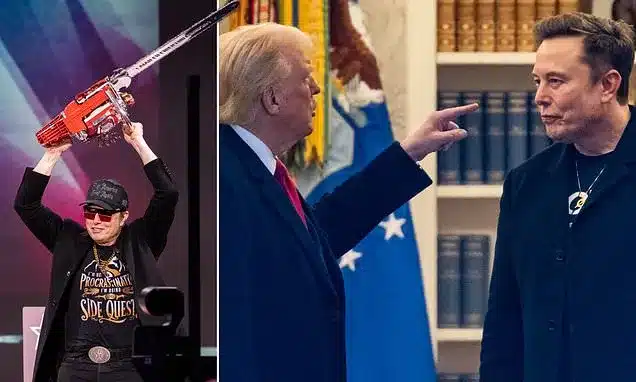
A revealing new memoir offers an inside look at Elon Musk’s final moments within the Trump administration, culminating in a surreal tequila toast and a swift, public falling out with former President Donald Trump. The account comes from Tyler Hassen, a senior aide within Musk’s controversial Department of Government Efficiency (DOGE), who details the internal dynamics and the escalating tensions that led to Musk’s departure and subsequent public feud with the former president.
Inside DOGE: A Glimpse into Elon Musk’s West Wing Tenure
The memoir, titled Inside DOGE: The Real Story from a Senior Insider, paints a picture of Musk’s time leading DOGE, an agency established with the goal of significant cost-cutting. Hassen, an energy executive from Texas, joined DOGE in early 2025 and was quickly given substantial authority within the department. Unlike many former DOGE staffers who have remained silent or scrubbed their online presence, Hassen has chosen to break ranks, offering an unvarnished account of the internal struggles and external conflicts that characterized Musk’s tenure.
The book recounts a specific evening in May 2025, a Thursday night, when Musk gathered his top deputies in his West Wing office. The space, described as surprisingly small, was adorned with photographs of the billionaire. It was during this meeting that Musk offered his colleagues a taste of Tesla-branded tequila, poured from a distinctive lightning-bolt-shaped bottle into plastic cups. While some declined, Hassen reportedly drank his portion and a second, highlighting the unusual circumstances of the gathering.
This seemingly minor event, Hassen suggests, occurred shortly before Musk’s exit from the administration and the subsequent public war of words with Donald Trump. The memoir posits that this toast, initially a moment of camaraderie, took on a different significance in retrospect, marking an unspoken farewell.
The Clash Over ‘One Big Beautiful Bill’
According to Hassen’s account, a significant catalyst for Musk’s departure was his opposition to Trump’s legislative agenda, specifically a bill referred to as ‘One Big Beautiful Bill.’ Musk, who had invested considerable personal resources and influence in supporting Trump’s 2024 election victory, found himself at odds with the administration’s direction on this key legislation. Hassen describes how Musk and his loyalists within DOGE watched as lawmakers appended billions of dollars in new spending to the bill, undermining the cost-cutting principles that DOGE was intended to champion.
Musk’s disapproval was not confined to internal discussions. Within days of leaving his government role, he publicly denounced the bill, calling it a ‘disgusting abomination.’ This stark public criticism signaled a deep rift between Musk and the Trump administration.
Epstein Allegations and Trump’s Retaliation
The public feud escalated dramatically when Musk made accusations linking former President Trump to Jeffrey Epstein. Musk claimed that the unreleased Epstein files were being withheld due to Trump’s alleged involvement. This accusation prompted a swift and forceful response from Trump. Speaking to reporters from the Oval Office, Trump expressed his profound disappointment with Musk and later took to his social media platform, Truth Social, to air his grievances.
In his posts, Trump asserted that he had forced Musk out of the administration, characterizing the billionaire as having ‘gone crazy.’ He also threatened to revoke lucrative federal contracts and subsidies previously awarded to Musk’s companies. Reports also surfaced, attributed to The Washington Post, that Trump privately referred to Musk as a ‘big-time drug addict’ in calls to associates.
Musk, who has stated his ketamine use is medically prescribed, countered Trump’s claims by asserting that Trump would not have won the election without his support. He also reportedly endorsed posts suggesting Trump’s impeachment and replacement by J.D. Vance.
Mediation Efforts and Lingering Distrust
Amidst the public acrimony, efforts were reportedly made to mend the fractured relationship. Vice President J.D. Vance, according to reports from The Wall Street Journal, began working to de-escalate the situation within a day of the initial blow-up. Believing that the public insults had already reached a point where little more could be lost, Vance engaged in discussions with Musk and his allies over several months.
These mediation efforts appeared to yield some results, as Musk reportedly shelved plans to launch a third political party, a move seen as potentially jeopardizing his relationship with the Republican party. The peace initiative culminated in a meeting in May, where Musk joined Trump on Air Force One for a summit with Chinese President Xi Jinping in Beijing. During this encounter, Musk reportedly pledged to contribute at least $100 million to aid Republican efforts to retain control of Congress in the upcoming November elections.
Despite this temporary truce and Musk’s financial pledge, reports indicate that Trump remained deeply distrustful of the billionaire. He is said to have confided in his closest advisors that their relationship would likely never recover to its previous level of closeness.
A Front-Row Seat to the Fallout
For Tyler Hassen, the events surrounding Musk’s departure and the subsequent public spat were a source of considerable personal stress. He describes the experience of receiving a flood of text messages from colleagues as Musk and Trump traded barbs online, feeling a knot in his stomach and breaking into a sweat. His initial enthusiasm for working within DOGE waned significantly as the department’s future seemed increasingly uncertain.
The perceived threat of DOGE being dismantled led Hassen to seek out mementos from the department’s gift shop, purchasing National Park Service merchandise and a Yeti mug for his wife, as if preparing for an imminent departure. Although Musk later deleted the posts containing the Epstein allegations, the memory of the tequila toast lingered, now imbued with the somber realization of an ending.
The memoir promises further insights into the internal workings of DOGE, the challenges of navigating federal bureaucracy, and the complex dynamics between powerful figures in the political and business worlds. Hassen concludes his narrative with a call for ‘DOGE 2.0,’ suggesting a continued belief in the agency’s core mission despite the tumultuous experiences.
