

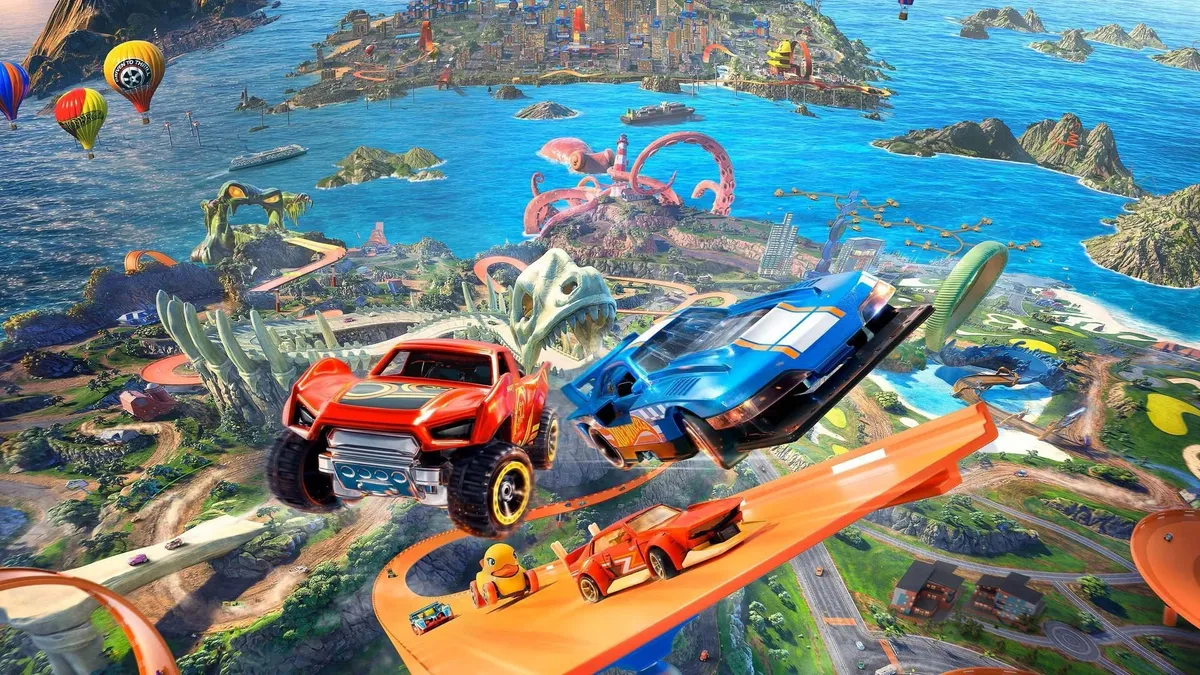
Hot Wheels Infinite Rush enters the open-world racing genre, drawing clear inspiration from titles like Forza Horizon, but struggles to carve out its own distinct identity. Developed by Milestone, the game aims to blend the nostalgic appeal of the Hot Wheels toy line with a realistic city environment, creating a curious mix that may leave both younger players and adult enthusiasts feeling somewhat unfulfilled.
A Visually Promising, Yet Unfocused Premise
The game immediately impresses with its visual presentation. Realistic cityscapes are punctuated by the vibrant orange of authentic-looking Hot Wheels tracks and oversized, fantastical elements like a plastic gorilla. The star attraction, the cars, are meticulously modelled to resemble the beloved toy versions, complete with details like painted-out windows and molded chassis markings, rather than aiming for the hyper-realism of actual vehicles. This attention to detail in the car models is a clear highlight.
However, this visual fidelity clashes with a somewhat muddled design philosophy. The game’s attempt at realism seems at odds with the inherent playfulness of the Hot Wheels brand, creating a disconnect that permeates the experience. While the racing mechanics themselves are competent, the overall package feels like a missed opportunity to fully embrace either a child-friendly arcade feel or a more mature, simulation-style approach.
Navigating a Confusing Interface and Vehicle Classes
Upon booting up Hot Wheels Infinite Rush for the first time, players are met with an overwhelming barrage of explanation screens and instructions. This initial onboarding process stands in stark contrast to the intuitive, pick-up-and-play nature of more accessible titles like Mario Kart. While the basic controls are easy to grasp, the game introduces a vehicle class system that adds unnecessary complexity. Cars are categorized into Speeders, Drifters, Titans, and Versatiles, with distinctions that are often unclear in practice and don’t always feel impactful enough to justify the emphasis placed upon them.
The frustration mounts when players discover that while free-roaming allows for any vehicle choice, many races mandate specific classes, often ones that feel ill-suited to the task. This arbitrary restriction undermines the sense of player agency and can lead to a feeling of being unfairly handicapped, detracting from the enjoyment of the core racing gameplay.
A World of Content, Lacking Distinctive Flavor
Hot Wheels Infinite Rush features four distinct island environments: a bustling city, a desert industrial zone, a tropical paradise, and a Japanese-inspired area. This variety offers visual diversity, but the game’s core gameplay loop can become repetitive. The objective across each island involves earning enough points to challenge a “Rusher,” a boss-like figure reminiscent of gym leaders in Pokémon. This structure provides a loose progression system, but only a fraction of the available races award the necessary points, leading to a lengthy grind before major challenges can be faced.
Beyond progression, the game offers a substantial collection of over 100 cars to unlock, providing a strong incentive for completionists. The racing model itself is solid, delivering functional and responsive handling. Yet, this realism in handling feels like a misstep. When combined with the quasi-realistic environments, the game loses the whimsical charm that defined previous Hot Wheels titles like Hot Wheels Unleashed. Those games successfully captured the fantasy of driving miniature cars through everyday environments like living rooms and gardens, a concept that felt far more unique and engaging than Infinite Rush’s more grounded approach.
Missed Opportunities and a Lack of Personality
The game’s design choices further dilute the Hot Wheels identity. While some eccentric car designs exist, such as a rubber duck on wheels, many of the toy cars are simply scaled-down versions of real-world vehicles. This contrasts with the original Hot Wheels toys, which often featured imaginative, non-road-legal designs and licensed vehicles. The absence of people, both drivers and pedestrians, contributes to an unsettlingly empty and characterless world, making it difficult to feel truly immersed.
On the positive side, the inclusion of split-screen and online multiplayer modes is welcome. However, the inability to engage in free-roam sessions with other players, a feature present in comparable titles, is a significant drawback. This limitation, coupled with a general lack of innovation and a track editor that feels like a tacked-on feature, results in an experience that fails to leverage the full potential of the Hot Wheels license.
Conclusion: A Competent Racer That Forgets Its Roots
Hot Wheels Infinite Rush is a competent racing game that ultimately falls short of its potential. It offers solid driving mechanics and visually appealing car models, spread across diverse environments. However, its confusing interface, restrictive vehicle class system, and a strange adherence to realism over imaginative fun prevent it from standing out. The game feels too basic and repetitive for seasoned racing fans and too complex and restrictive for younger players, resulting in a disappointingly narrow appeal. It’s a peculiar attempt at a family-friendly open-world racer that, in its quest for broad appeal, sacrifices the unique charm and personality that made Hot Wheels a beloved brand in the first place.
Score: 5/10
Formats: Nintendo Switch 2, PlayStation 5, Xbox Series X/S, and PC
Price: £44.99
Publisher: Milestone
Developer: Milestone
Release Date: 10th September 2026
Age Rating: 3+
