

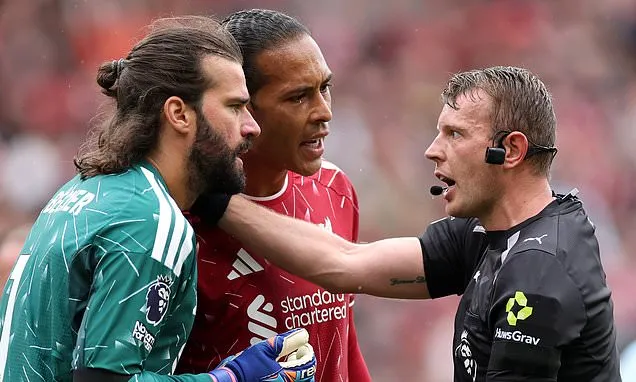
Liverpool goalkeeper Alisson Becker has been fined £8,000 for misconduct following an incident that occurred after the Premier League match against Nottingham Forest on August 29. The Brazilian international was penalized for kicking a fourth official’s board in frustration after the game concluded at Anfield.
Alisson Becker’s Outburst and FA Fine
The incident took place as Alisson was making his way towards the tunnel following Liverpool’s 2-2 draw with Nottingham Forest. The goalkeeper was reportedly incensed by a penalty decision awarded to Nottingham Forest during the match. Morgan Gibbs-White successfully converted the spot-kick, which had been given after Neco Williams was fouled in the penalty area. The match eventually ended all square after Victor Munoz scored a late equalizer for Nottingham Forest.
Following the game, Alisson’s visible frustration led him to kick the electronic board used by the fourth official. The Football Association (FA) subsequently issued a statement confirming the fine:
‘Liverpool’s Alisson Becker has been fined £8,000 for misconduct at the Premier League fixture against Nottingham Forest on 29 August. It was alleged that the goalkeeper acted in an improper manner around the tunnel area after the final whistle. Alisson Becker has subsequently accepted the charge against him and received the standard penalty.’
The goalkeeper has accepted the charge and the standard penalty associated with such misconduct. This fine is separate from the match outcome itself but stems from his reaction to events within the game.
Background: The Controversial Penalty Decision
The penalty that triggered Alisson’s outburst was itself subject to scrutiny. A subsequent review by the Premier League’s Key Match Incidents Panel (KMI Panel) determined that the penalty should not have been awarded in the first place. The panel’s findings indicated that the contact made by Alisson was an unavoidable consequence of his attempt to save the ball and did not meet the threshold for a foul.
However, the KMI Panel also ruled that the Video Assistant Referee (VAR) system, operated by Michael Oliver on that occasion, was correct in its decision not to prompt an on-field review by referee Sam Barrott. The panel unanimously agreed that the incident did not constitute a ‘clear and obvious error,’ which is the threshold required for VAR intervention. The vote split on the initial penalty decision was 3:2 against awarding it, while the VAR’s non-intervention was supported 5:0 by the panel.
KMI Panel’s Assessment of the Incident
The panel’s detailed assessment highlighted the nature of the contact:
- The contact from Alisson was deemed inevitable due to his momentum while attempting to make a save.
- The contact was not considered reckless and fell below the criteria for awarding a penalty.
VAR Non-Intervention Justification
Despite the panel’s view that the penalty was incorrectly given, the decision by VAR not to intervene was unanimously supported. The reasoning provided was:
- The on-field decision did not meet the threshold for a ‘clear and obvious error.’
This situation underscores the complexities and differing interpretations that can arise in football officiating, particularly concerning penalty decisions and the application of VAR protocols. While the KMI Panel’s review suggested an error in the initial call, the VAR’s adherence to the ‘clear and obvious’ rule meant no review was recommended.
Consequences and Precedents
Alisson Becker’s fine of £8,000 is a standard penalty for this type of misconduct in the Premier League. Such incidents serve as a reminder to players about maintaining composure, even in moments of high emotion and perceived injustice. The financial sanction, while significant, also aims to uphold the integrity and decorum expected within professional football.
The review by the KMI Panel, which found the penalty should not have been given, adds another layer to the discussion surrounding the match. While it offers some vindication regarding the initial decision, it does not alter the outcome of the game or the subsequent fine issued to Alisson for his reaction. This case reflects the ongoing debate about officiating accuracy and the emotional responses it can elicit from players at the highest level of the sport.
Conclusion
Alisson Becker’s £8,000 fine for kicking an official’s board highlights the strict disciplinary measures in place for player conduct. The incident, stemming from a controversial penalty decision in the draw against Nottingham Forest, has been compounded by a post-match review that suggested the penalty itself was wrongly awarded. While the goalkeeper has accepted the FA’s sanction, the case also brings attention to the nuances of VAR intervention and the challenges faced by match officials and players alike in the fast-paced environment of professional football.
