

The Resident Evil franchise, a titan of the survival horror genre, continues its enduring reign across video games, film, and other media nearly three decades after its inception. With a new film on the horizon, it’s an opportune moment to explore the rich history and significant impact of this iconic series, which has captivated audiences with its blend of terrifying creatures, resource management, and compelling narratives.
The Genesis of Survival Horror
The origins of Resident Evil trace back to a request from Tokuro Fujiwara, a key figure at Capcom, to creator Shinji Mikami. Fujiwara tasked Mikami with developing a new game based on the 1989 title Sweet Home. Initially hesitant due to his own fear of horror and concerns about marketability, Mikami was reassured by Fujiwara’s perspective: “People who aren’t afraid of anything don’t understand what’s frightening. In my view, you can’t make a horror game if you don’t have any fear.” This insight proved crucial.
Together, Fujiwara and Mikami pioneered a new approach to horror gaming. They integrated innovative mechanics such as a limited inventory system, a vital signs monitor instead of a conventional health bar, and an increased focus on atmospheric scares and gore, enhanced by cinematic cut-scenes. The original game, released in Japan in March 1996 as Biohazard, was groundbreaking for its time, featuring advanced graphics and terrifying encounters. Mikami himself noted the unique thrill of overcoming zombies in-game, stating in 2016, “That was the first time that I really sensed that we had a new genre on our hands.” He coined the term “survival horror” to describe this distinct experience.
Visually inspired by classic horror films like The Shining and Dawn of the Dead, the original game’s premise involved a special operations team investigating a series of murders in Raccoon City, leading them to a mysterious, abandoned mansion. Players were tasked with conserving scarce resources, solving puzzles, and fending off relentless zombies and other monstrous threats. The game’s English localization, released outside Japan, was renamed Resident Evil due to potential copyright issues with the name Biohazard. By December 1996, the game had achieved remarkable success, selling over 4 million copies and becoming the PlayStation’s highest-grossing title at the time.
Expanding the Universe: Games and Beyond
The success of the original Resident Evil laid the foundation for an expansive franchise. It has since spawned eleven more main series sequels, including the critically acclaimed Resident Evil Requiem (released in 2026). Beyond the core numbered titles, the series boasts numerous spin-off games, novels, comic books, and even stage plays, demonstrating its broad appeal and adaptability across different media.
From Pixels to the Big Screen: The Film Adaptations
The inherent cinematic qualities of Resident Evil made its transition to film a natural progression. The early 2000s saw a resurgence in zombie-themed media, with films like 28 Days Later (2002) and the remake of Dawn of the Dead (2004) reigniting audience interest. Writer Alex Garland even cited the relentless zombies of Resident Evil as an inspiration for the fast-moving infected in 28 Days Later.
The first Resident Evil film adaptation, released in 2002, introduced the character of Alice, portrayed by Milla Jovovich, and established a narrative universe distinct from the video games. Despite mixed critical reception, the film was a commercial success, grossing $109 million against a $33 million budget. This financial triumph led to a series of five sequels starring Jovovich: Apocalypse (2004), Extinction (2007), Afterlife (2010), Retribution (2012), and The Final Chapter (2016). Collectively, this original film series garnered over $1.2 billion worldwide.
A subsequent reboot, Resident Evil: Welcome to Raccoon City, was released in 2021, aiming to align more closely with the lore of the early video games. However, its underwhelming critical and commercial performance led to the shelving of planned sequels.
A New Vision for Resident Evil
The franchise is set for another cinematic reimagining with director Zach Cregger, known for his work on Weapons and Barbarian. Cregger views his upcoming film as a tribute to the games that have shaped a generation’s entertainment landscape. “We are the first generation to be informed as much by games as we have been by movies and television,” Cregger stated, highlighting the immersive, first-person perspective that gaming, and particularly Resident Evil, has popularized.
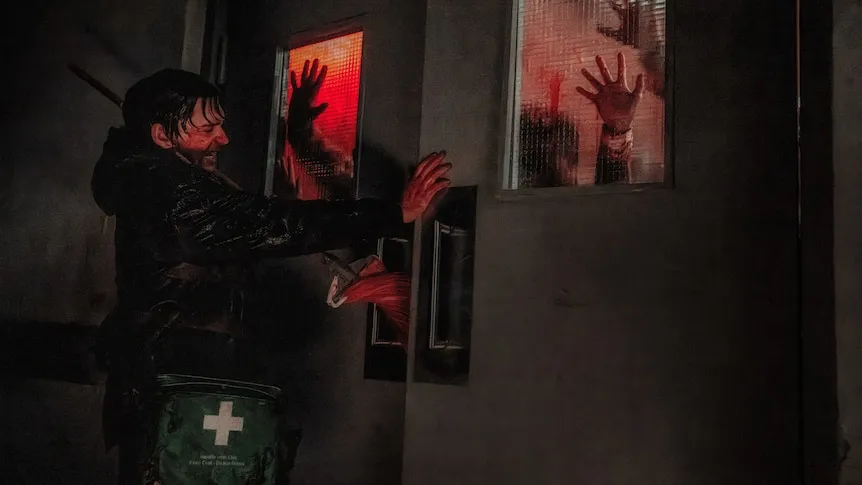
This new iteration stars Austin Abrams as Bryan, a medical courier navigating the dangers of Raccoon City. Abrams described his character as someone experiencing the game’s world for the first time, learning to survive and operate within its mechanics. Cregger’s directorial approach emphasizes authenticity, meticulously recreating iconic elements from the games, such as the over-the-shoulder camera angles, the crucial act of collecting ammunition and supplies, and the signature typewriter save points. Cregger even recounted reshooting a scene specifically to ensure the typewriter’s appearance was accurate, underscoring his commitment to capturing the game’s essence.
Cregger aims to balance the franchise’s characteristic campiness with a strong horror focus, striving to capture the thrilling, action-packed, and gory experience that has defined Resident Evil for millions of fans. “Resident Evil has always kind of embraced a little bit of camp, so there’s a little bit of that, but it’s really horror-forward,” he explained. “I knew if I got the tone wrong, there’s no coming back from that.”
Enduring Appeal
With its innovative gameplay mechanics, terrifying atmosphere, and adaptable narrative, the Resident Evil franchise has cemented its status as a cornerstone of the horror genre. From its humble beginnings as a groundbreaking video game to its multifaceted presence in film and other media, Resident Evil continues to evolve, promising new scares and adventures for both long-time fans and newcomers alike.
