

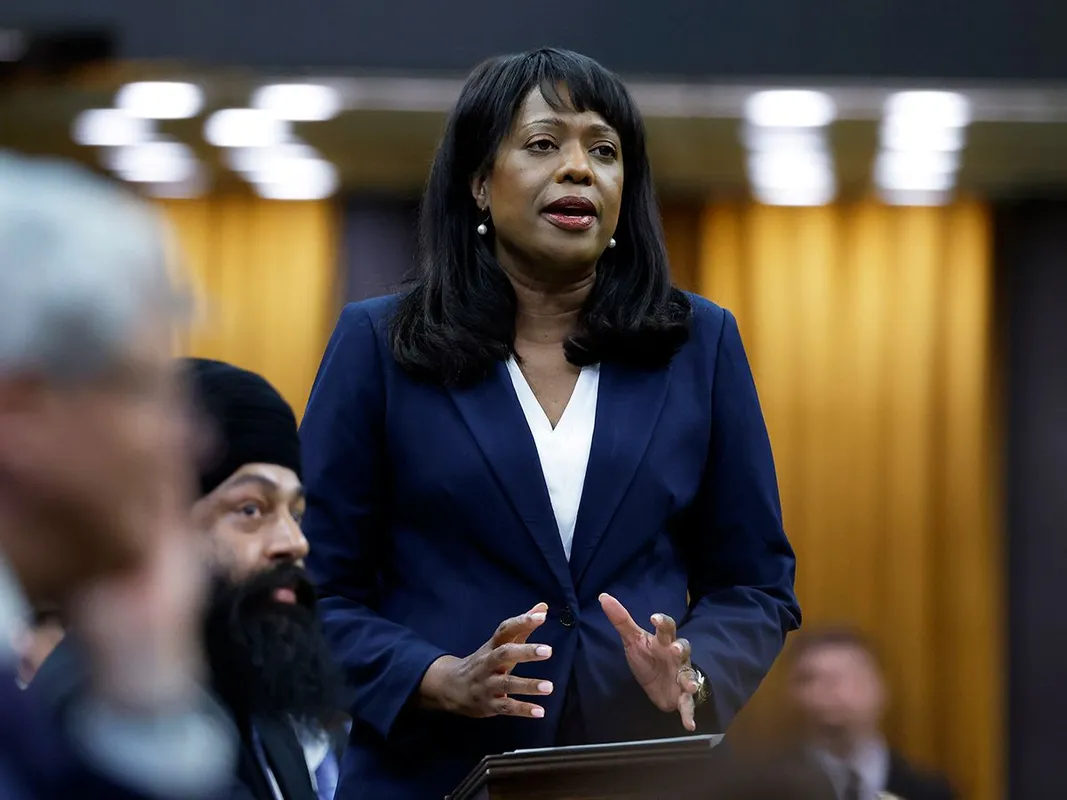
Haldimand-Norfolk MP Leslyn Lewis is seeking over $3 million in damages, alleging a “traumatizing” job interview process at her alma mater, York University’s Osgoode Hall Law School. Lewis, a former Conservative Party of Canada leadership candidate, filed a defamation claim against the law school and a professor, Sean Rehaag, concerning her unsuccessful application for a scholar position designated for a Black person of African descent.
Allegations Against Professor Rehaag
Lewis’s statement of claim asserts that Professor Rehaag actively undermined her candidacy. She alleges Rehaag preemptively alerted academic decision-makers to what she describes as defamatory accusations, claiming he portrayed her as racist, anti-gay, anti-refugee, and opposed to women’s reproductive freedom. According to Lewis, Rehaag “blindsided” her with these allegations during her presentation, creating a hostile environment where she felt verbally abused by him and other academic decision-makers. She claims the intention was to “embarrass and humiliate” her publicly and among her peers, effectively removing her from future academic opportunities.
Lewis further contends that Rehaag told her individuals with her views had no place at Osgoode and that she was not welcome. Professor Rehaag, in his statement of defence, explicitly denies these assertions. York University also denies that the environment was “dangerous, hostile, or abusive,” and both parties dispute any coordinated effort to exclude Lewis from academic roles.
Context of the Job Application
The dispute originated in March 2021, a period when Lewis was both a prominent candidate for federal Conservative leadership and applying for the position at Osgoode Hall, where she had previously earned a doctorate. The role, within Osgoode’s Centre for Refugee Studies, was established to support York’s Affirmative Action program, acknowledging the underrepresentation of Black faculty. York’s defence states the position was created in response to heightened racial awareness following the murder of George Floyd, aiming to recruit a faculty member with a lived experience as a person of Black-African descent to advance racial equality.
Lewis’s claim highlights her past involvement with the centre as a student in the 1990s and her subsequent work in refugee law. She states in her claim that she has advocated for the LGBTQ+2 community, with a particular focus on Jamaica, her birth country, and for women fleeing domestic violence.
University’s Defence and Rehaag’s Emails
York University, in its statement of defence, argues that the questions posed by Rehaag during the nine-minute Q&A segment of Lewis’s presentation were relevant, foreseeable, and appropriate for a faculty recruitment seminar. The university outlined its recruitment process, involving a committee of faculty, students, and administrators who make recommendations to a separate appointment committee, also composed of faculty, students, and administrators. Rehaag was a member of the appointment committee.
The defence states that Rehaag’s emails concerning Lewis were sent before her presentation to a member of the recruitment committee who also co-chaired the Faculty Council’s Equality Committee. These communications, according to the defence, conveyed Rehaag’s perspective that Lewis had publicly expressed anti-gay views, including opposition to legislation banning “gay conversion therapy” and the inclusion of gender identity and expression in human rights codes. The defence further claims Rehaag noted that many at Osgoode would find Lewis’s public stances “antithetical to the equity and social justice aspirations of the law school.”
In a subsequent email, Rehaag reportedly suggested that Lewis’s invitation to present could lead to protests and calls for de-platforming. He recommended consulting with students from equity-seeking groups whose interests might be affected by Lewis’s public positions, citing her opposition to Black Lives Matter as an example.
Lewis’s Counterclaims and Legal Defences
Lewis’s lawsuit alleges that students at her presentation asked questions mirroring the “false statements” allegedly advanced by Rehaag and others. She also claims York University is liable for fostering a “toxic culture” at Osgoode Hall that stifled diverse thought, penalized dissenting views, and utilized “activist professors” as gatekeepers to exclude candidates who did not conform to a “groupthink culture.” Furthermore, Lewis accuses the university of failing to circulate a rebuttal she had prepared following the presentation, as had been promised.
York and Rehaag intend to rely on two primary defences against the defamation claims: qualified privilege and fair comment. Qualified privilege suggests Rehaag acted in good faith, with a legitimate interest or duty in sharing information with individuals who had a corresponding interest or duty to receive it. Fair comment posits that Rehaag’s remarks were on matters of public interest, factually based, recognizable as opinion, and not motivated by malice, representing an honest expression of opinion given the facts.
Damages Sought and Next Steps
While the financial damages specified in legal claims can often be preliminary, Lewis is seeking over $3 million, including aggravated and punitive damages, to address the alleged malice. No court dates have been scheduled for this case.
Lewis, elected to Parliament in September 2021, previously ran for the Conservative leadership in 2020 and again in 2022, losing to the current leader, Pierre Poilievre. Professor Rehaag, director of the Centre for Refugee Studies, primarily focuses his work on immigration and refugee law.
