

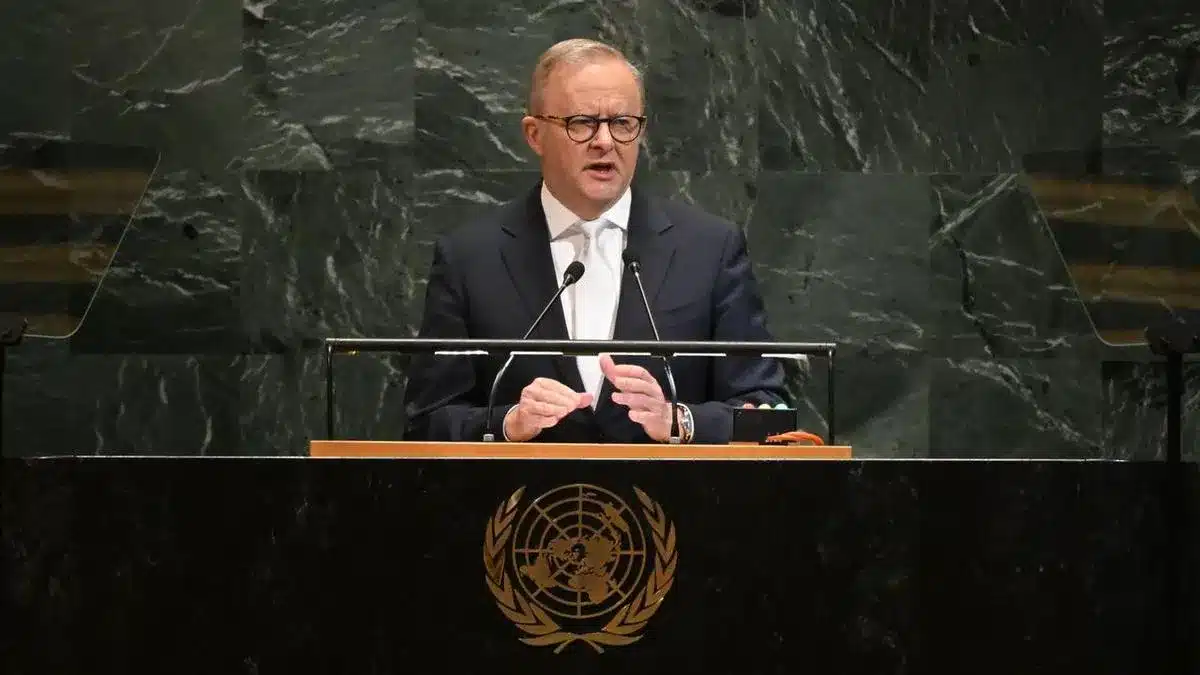
Australia is formally preparing to bid for a non-permanent seat on the United Nations Security Council for the 2029-2030 term, with Prime Minister Anthony Albanese emphasizing the nation’s potential to enhance the council’s effectiveness. The campaign, set to gain momentum as world leaders convene for the UN General Assembly’s high-level week in New York, highlights Australia’s commitment to multilateralism and its vision for a more responsive global security body.
Australia’s Bid for UN Security Council Seat
Prime Minister Anthony Albanese is set to visit the UN headquarters in New York to spearhead Australia’s lobbying efforts for one of the ten non-permanent seats on the 15-member Security Council. The nation is targeting a two-year term, specifically for 2029 and 2030. While the official vote is not scheduled until mid-2028, the diplomatic groundwork and campaigning are commencing now, coinciding with the annual gathering of global leaders.
Albanese articulated his belief that middle powers, such as Australia, are essential for bolstering the Security Council’s efficacy, particularly amidst ongoing conflicts in Europe and the Middle East. “The Security Council needs reform and it needs to be made more effective; there’s no doubt about that,” he stated in a recent interview. “Clearly, there’s a need for the UN to step up. There’s a need for middle powers as well, such as Australia, to exercise the influence that we have.”
The Role of Middle Powers in Global Governance
The concept of ‘middle powers’ in international relations refers to states that, while not superpowers, possess significant economic, diplomatic, or military influence and often play crucial roles in multilateral organizations. Australia, with its established global reputation and active participation in international peacekeeping and funding, positions itself as a key player within this category.
The Prime Minister’s remarks underscore a perspective that the current international landscape, marked by complex geopolitical challenges, requires a more dynamic and representative Security Council. Middle powers, often seen as having fewer hegemonic interests than major powers, can potentially offer more balanced and consensus-driven approaches to global security issues.
Understanding the UN Security Council Structure
The UN Security Council is the UN’s primary organ responsible for maintaining international peace and security. It comprises 15 members:
- Five permanent members (P5): China, France, Russia, the United Kingdom, and the United States. These members hold veto power.
- Ten non-permanent members: Elected by the General Assembly for two-year terms, with five replaced each year. These members are distributed geographically to ensure broad representation.
Australia is vying for a position within the ‘Western Europe and Others Group,’ a regional bloc from which two non-permanent members are typically elected. Currently, Australia and Finland have formally declared their candidacies for the upcoming term. However, other nations within this group could still emerge as contenders.
Australia’s Qualifications and Diplomatic Strategy
To secure a seat, Australia must garner the support of two-thirds of the 193 UN member states, even if its bid proceeds unopposed within its regional group. The Australian government plans to leverage its strong international standing, its history of leadership in peacekeeping operations, and its significant financial contributions to the UN as cornerstones of its campaign.
“We have, I think, a strong case. We have been prepared to lead the world and to be a part of peacekeeping missions,” Albanese stated. He further emphasized Australia’s commitment to multilateralism, noting, “We’re the eighth-largest funder of the UN. We think multilateralism is an important part of Australia’s foreign policy and the UN needs to be at the centre of that.”
Past Experience on the Security Council
Australia has previously served on the UN Security Council, with its most recent term in 2013 and 2014. During that period, Australia played a notable role, including contributing to the international response following the downing of Malaysia Airlines flight MH17. This prior experience is expected to be a key element in its current bid, demonstrating its capacity to contribute effectively to the council’s work.
Upcoming Diplomatic Engagements
Prime Minister Albanese’s arrival in New York is timed to coincide with several high-profile summits and the commencement of the UN General Assembly’s high-level debate. He is scheduled to deliver an address to the General Assembly later in the week, providing a platform to articulate Australia’s foreign policy priorities and its vision for the UN.
The campaign for a Security Council seat is a long-term diplomatic endeavor. Australia’s proactive approach, beginning well in advance of the vote, signals its serious intent and its recognition of the importance of sustained engagement with UN member states. The government’s strategy appears focused on highlighting its credentials as a reliable, contributing, and influential middle power committed to the principles of international cooperation and global security.
Conclusion: A Renewed Push for Global Influence
Australia’s pursuit of a non-permanent seat on the UN Security Council underscores its ambition to play a more significant role in shaping global security responses. By advocating for the enhanced effectiveness of the council and emphasizing the unique contributions of middle powers, Prime Minister Albanese aims to build support for Australia’s candidacy. The upcoming diplomatic engagements in New York will serve as a crucial initial stage in this extensive campaign, setting the tone for Australia’s efforts to secure a voice on one of the world’s most critical international bodies.
