

Apparently nostalgic for the Champagne, pillbox hats and soft-lit glamour that characterised the skies within the Fifties and ’60s, U.S. Secretary of Transportation Sean Duffy urged airline passengers to decorate properly and thoughts their manners forward of the 12 months’s busiest journey week.
“Are you dressing with respect?” he requested in an on-line video. “Are you saying please and thanks?”
Doing so, Duffy urged, would assist to usher in a brand new “golden age of journey” — a phrase that harks again to the mid-Twentieth century flight expertise. The video was a part of a Division of Transportation “civility marketing campaign” that goals to tamp down on in-flight combating and different “unruly passenger habits.”
The PSA leans onerous into earlier-era romance. It opens with Frank Sinatra’s “Come Fly With Me” layered over grainy airport clips as a narrator proclaims that “air journey is a miracle of American ingenuity. … We revered the dignity of air journey. … Flying was a bastion of civility.” Moments later, the footage jumps to passengers brawling in terminals and shouting at flight attendants earlier than Duffy seems on display urging vacationers to deliver bygone civility again to air journey.
Duffy’s name to motion didn’t land easily. The video was mocked over social media and on “The Every day Present” this weekend, when host Ronny Chieng requested, “Are manners a very powerful factor for the FAA to be coping with proper now?”
In line with historians and trade analysts, probably not.
The inside of a British European Airways Vickers plane circa 1960 reveals crew and passengers had extra room to manuever.
(Fox Pictures / Getty Photographs)
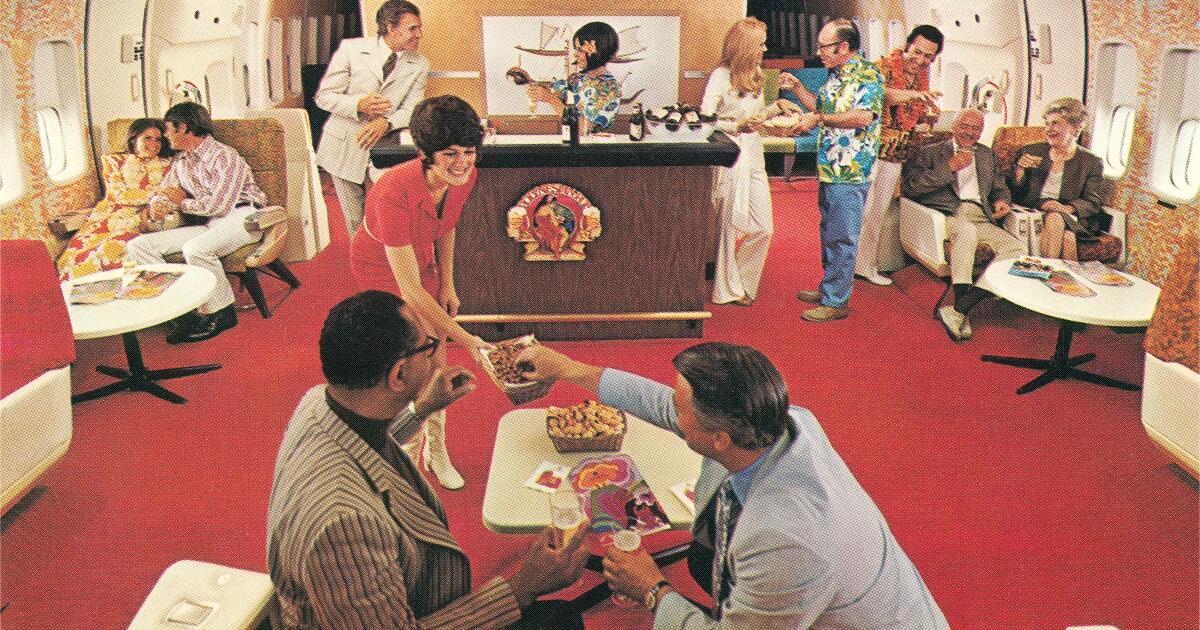
College of Nevada aviation historian and former airline pilot Dan Bubb stated though civility is essential — and violent incidents are unforgivable — manners and mink coats gained’t repair the issue. That’s as a result of the cabin expertise of at this time is all-around unrecognizable from the blue-blooded “golden age” Duffy appears to overlook.
First off, planes had spacious interiors again then, Bubb stated. Some American Airways flights even featured a dwell piano lounge, {and professional} cooks aboard Pan American World Airways served lobster and caviar on fantastic china. There was Champagne and free cigarettes on provide. And stewardesses had been subjected to doubtful age, weight and skirt-length limits — as airways featured their “sky women” in racy commercials, similar to Nationwide Airways’ “Hello, I’m Cheryl. Fly me” marketing campaign.
One factor was clear: Flying was endowed with a way of event, if just for rich passengers and businessmen.
“They received filet mignon. They received mashed potatoes, inexperienced beans and chocolate cake for dessert,” Bubb stated. “Now we’re fortunate if we get a cup of water and a stale bag of peanuts.”
The DOT’s account, he added, leaves out the commonplace frustrations shaping the passenger expertise at this time.
“Sure. It’s essential to be civil. Be good. Be useful. On the identical time, I feel Secretary Duffy has to take a tough take a look at what flying in economic system appears like when individuals are crammed collectively and so they’re combating for the overhead bin house. You may’t blame them for being somewhat bit edgy,” he stated.

At Western Airways’ coaching middle in Los Angeles in November 1966, stewardesses observe serving meals in a mock-up of a aircraft’s inside. Trainees realized to deal with elaborate dishes whereas aloft.
(Bettmann / Bettmann Archive)
Cabin service dominated trade enterprise fashions till the late Seventies, when Congress handed the Airline Deregulation Act of 1978, which ended federal management over airline fares, routes and market entry. The invoice set in movement a fierce interval of competitors and market consolidation.
The winners had been area of interest funds airways and the massive 4 — American, Delta, United and Southwest Airways — which by the 2000s had already reduce the surplus fats from the passenger expertise. Plane had been redesigned to assist a whole lot of passengers with fewer crew members per head, whereas seats had been clustered ever nearer collectively. Legroom plummeted by as much as 20% between the Nineteen Nineties and at this time, research present.
In the meantime, corporations applied pricing algorithms to make sure flights stayed absolutely booked and commenced charging for fundamental facilities together with carry-on baggage, legroom, meals and blankets, in line with Henry Harteveldt, a journey trade analyst and president of Environment Analysis Group.

On the American Airways C.R. Smith Museum in Fort Price, Texas, a restored 1940 Douglas DC-3 plane referred to as the “Flagship Knoxville” offers a way of what air journey was like throughout its “golden age.
(The Lyda Hill Texas Assortment of Images in Carol M. Highsmith’s America Mission, Library of Congress, Prints and Images Division)
“In doing so, airways created a really crowded, nerve-racking atmosphere on the aircraft,” he stated. “Lengthy airport safety traces don’t assist. Neither do lengthy traces on the ticket counter and baggage test. By the point we get onto the aircraft, we’re on edge, we’re exhausted, we’re afraid, and the slightest factor now units folks off.”
Harteveldt stated these shut quarters typically result in altercations on flights. The DOT stated incident experiences doubled in 2024 in comparison with 2019, whereas one in 5 flight attendants skilled bodily incidents in 2021.

Jackie Kennedy, in a skirt swimsuit, and her sister, Princess Radziwill, arrive at La Guardia Airport in March 1961.
(Bettmann / Bettmann Archive)
“There’s no query we’ve overlooked what makes journey enjoyable — the thrill, the relief, the cordial conversations,” Duffy stated in an enchantment to vacation vacationers final week to decorate up, be well mannered and help fellow passengers. “Individuals already really feel divided and pressured. We will all do our half to deliver again civility, manners, and customary sense.”
An evaluation of DOT information confirms the rise in incidents because the COVID-19 pandemic, when conflicts over carrying masks boosted the variety of experiences of unruly passengers. Nonetheless, 2024 noticed about 1.25 incidents per 10,000 flights, the overwhelming majority involving verbal altercations, failure to comply with crew directions or intoxication. Violent episodes are rarer nonetheless, however they continue to be a severe concern, particularly for crew members who deal immediately with passengers.
“The violence that we’ve got seen between passengers and with passengers attacking crew members has completely no place on a aircraft at any time,” Harteveldt stated. “However Secretary Duffy’s name for folks to decorate up as a technique to repair it? Good strive. That’s not going to go wherever. And actually, I feel that undermines the message.”
