

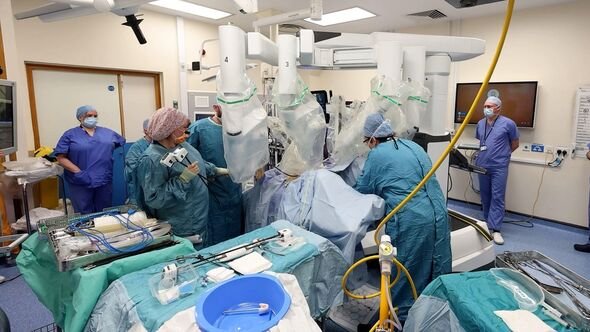
A groundbreaking wave of AI-enhanced surgical robots promises to revolutionize treatments for thousands of patients in the UK’s National Health Service. These advanced systems deliver unparalleled precision in complex cancer and emergency procedures, cutting recovery periods, minimizing risks, and alleviating strain on overburdened facilities.
Advancements in Minimally Invasive Procedures
At the core of this innovation lies the da Vinci 5 system, an intelligent platform that analyzes extensive data streams in real time during surgeries, all while surgeons maintain full oversight. This technology expands access to minimally invasive techniques, featuring incisions mere centimeters in length rather than the traditional 8-10 cm openings. As a result, patients experience reduced pain, fewer complications, and accelerated healing.
Surgeons highlight how these robots enhance control, limit tissue trauma, and safeguard vital structures like nerves and organs. Such precision not only lowers the incidence of severe postoperative issues but also preserves long-term quality of life, particularly in delicate operations.
Transforming Patient Outcomes and Hospital Efficiency
For individuals facing bowel, lung, pancreatic cancers, or intricate gynecological issues, outcomes improve markedly. Traditional hospital stays, often lasting a week or longer, shrink dramatically—many patients now return home within 23 hours. This shift boosts hospital throughput, enabling teams to handle three or four procedures daily instead of one, and frees up beds amid persistent shortages and extended waiting times.
Productivity gains extend beyond recovery speeds. The systems facilitate nerve-sparing approaches in neurological and gynecological surgeries, maintaining functions like sexual health that were previously challenging to protect at this level of accuracy.
Early Adoption and Expert Insights
Royal Stoke University Hospital leads the charge in the UK, integrating the technology through a £12 million contribution from the Denise Coates Foundation, which funds health and community initiatives. The facility will soon operate six da Vinci systems, positioning it among the nation’s premier robotic surgery hubs.
Consultant colorectal surgeon Mr. Philip Varghese describes the platform as a pivotal evolution in surgical capabilities. “This is cutting-edge technology,” he states. “It pushes the barrier of what we can do to the next level of precision and it is genuinely game-changing.”
He compares its capabilities to upgrading from an early smartphone model to a cutting-edge version: “The computer power is quicker, faster, and more accurate, with additional navigational aspects built in. The system has better vision and allows for remote collaboration with clinicians from different hospitals and produces data that allows surgeons to understand surgery like never before, allowing for quicker and gentler surgery. This allows far greater accuracy and reduces the risk of rare complications and deaths.”
Illustrative examples underscore the potential: thyroid extractions now occur via small oral incisions, avoiding neck cuts, while cardiac interventions access the heart through minimal openings instead of sternum divisions.
Mr. Varghese emphasizes the human element: “This is not dangerous. It is operated by a surgeon, with the system constantly monitored and highlighting errors in real time, so the surgeon can adjust immediately.”
National Implications for Healthcare
Health experts view this as a cornerstone for the NHS’s future, enabling safer, faster care for more patients. By shortening stays and enhancing safety, the technology addresses critical challenges, ultimately improving access and outcomes across the system.
