

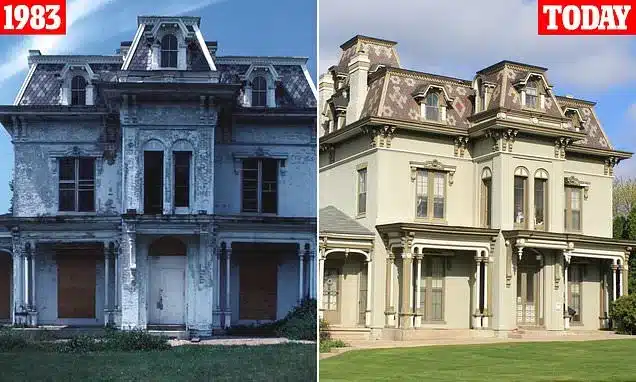
Brothers Christopher and Steve White spent over a year restoring a dilapidated mansion in Ypsilanti, Michigan, which they purchased for just $1. Their efforts have turned the historic Gilbert Mansion into a seven-unit luxury apartment building now listed for $1.13 million.
Discovering the Neglected Gem
Christopher and Steve White first spotted the 19th-century structure in 1986. Broken windows stood boarded up, eaves sagged and rotted, ornate brackets dangled precariously, bricks crumbled, paint peeled away, window frames decayed, and the original front door had vanished entirely.
City officials had struggled for seven years to find a buyer for the property, constructed in 1861—the same year President Abraham Lincoln called for 75,000 volunteer troops amid the Civil War’s outbreak.
“The city was taking proposals to find the best fit for the community,” Christopher White explains. Proposals ranged from a bed-and-breakfast to office space, but the brothers pitched converting the Second Empire Mansard-style home into apartments.
The Whites’ reputation for revitalizing historic properties in the area, including two nearby homes turned into five- and seven-unit buildings, swayed officials. They approved the plan, and the brothers acquired the mansion for $1.
A Storied Past
John Gilbert Jr. built the Gilbert Mansion during the peak of the Second Empire Mansard style’s popularity (1855-1885), inspired by Napoleon III’s Paris renovations starting in 1852. His father, John Gilbert Sr., amassed wealth in mills and real estate before an 1837 downturn left him with limited holdings, including the North Grove Street lot.
Gilbert Jr. restored the family fortune through business ventures and local projects, including structures in Ypsilanti’s Depot Town. By 1860, he constructed the home, praised for its magnificence, complete with Mrs. Gilbert’s rose and lily gardens, an artificial lake from nearby springs, and a smaller pool by the back door.
Gilbert Jr. passed away in 1864, his wife Harriett in 1910. Of their six children, only son William (died 1933 in Grand Rapids) and daughter Alice (last resident until 1920) survived her. The property then passed to Daniel Smith, a Detroit streetcar heater magnate. The city seized it during the Great Depression for unpaid taxes.
Subsequent uses included a World War II social center, a 1950s teen canteen, and activity hubs for the Ypsilanti Boys’ Club (1961-1974) and Girls’ Club (1974-1981), by which time severe disrepair set in.
The Meticulous Restoration
The brothers invested 14 months gutting the 8,000-square-foot interior, preserving original hardwood floors, a rare Pewabic tile fireplace from the famed Detroit firm, and historic common halls. They installed modern mechanicals, drywall, and finishes while researching the Mansard style to maintain authenticity.
The patterned slate roof required minimal work, enduring over a century of Michigan winters intact. “As far as the slate roof goes, it stood the test of time and is in great shape to this day,” Christopher White notes.
Luxury Living Today
The revamped building offers seven apartments from 800 to 1,200 square feet, featuring high ceilings, large daylit windows, a four-story tower with city views, breakfast nooks, built-in bookshelves, and some private porches or patios. Fully occupied with no vacancies, it stands ready for a new owner to continue its legacy.
