

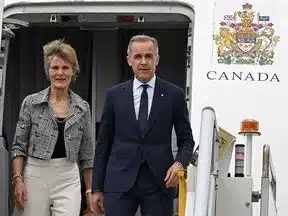
NEW DELHI — Foreign Affairs Minister Anita Anand emphasizes the need for a diplomatic solution following Canada’s support for United States strikes on Iran, which resulted in the death of Supreme Leader Ayatollah Ali Khamenei.
Anand shared these views after a series of meetings in New Delhi on Monday. Prime Minister Mark Carney, meanwhile, traveled to Australia without addressing journalists or holding a planned news conference.
Carney’s Travel and Position on Strikes
During his visit to India, Carney voiced Canada’s backing for the U.S.-Israel operations against Iran. Officials confirmed that upon arriving in Sydney, Carney would prioritize personal commitments and preparations for upcoming business discussions and a speech to Australia’s parliament, before heading to Japan.
Carney landed in Sydney on Tuesday afternoon local time, equivalent to Monday evening in Ottawa. This schedule left Anand to explain Canada’s stance.
The Prime Minister’s Office issued an initial statement highlighting Iran’s nuclear weapons program, noting that Canada supports U.S. actions to prevent Iran from acquiring nuclear weapons and further endangering global peace and security.
Anand’s Diplomatic Outreach
Anand reported engaging with counterparts from Middle Eastern and Gulf states, as well as G7 nations, over the past two days. She stressed Canada’s commitment to a peaceful, diplomatic resolution and urged all parties to negotiate promptly.
“Those conversations have yielded differing responses,” Anand told reporters. “Some countries believe that a diplomatic solution is not possible at this time. Others want to work as quickly as possible to ensure diplomacy becomes the next phase of this horrific situation.”
Canada maintains a firm stance in support of the Iranian people and has imposed around 500 sanctions on the regime. Anand declined to address the legality of the strikes under international law.
Domestic Pushback
A Liberal MP voiced opposition to Canada’s position over the weekend via social media. Will Greaves, MP for Victoria, referenced Carney’s recent World Economic Forum speech on sovereignty.
“Canada cannot endorse the unilateral and illegal use of military force, the killing of civilians, or the kidnap and assassination of foreign heads of government, while also insisting that our sovereignty, our rights, and our independence must be respected,” Greaves stated in an Instagram video. “All states have an obligation to protect civilian life, and no state has the right to wage aggressive war.”
Speaking earlier at an event for Canadian and Indian business leaders in Mumbai, Carney ruled out any combat involvement for Canada. Anand echoed this, stating, “Canada wasn’t involved. We weren’t notified, and we do not have an intention to be involved in any military strikes or operation.”
Security Measures During Travel
As news of the strikes emerged last weekend, officials on Carney’s aircraft in India quickly retrieved secure phones stored for safety. The Prime Minister’s Office explained that the Government of Canada enforces strict information security protocols for official overseas travel, particularly in non-Five Eyes countries, and extends guidance to accompanying media.
“In view of unfolding events in the Middle East, certain government telecommunications devices were moved by Canadian security officials from where they were being stored in case of need on an emergency basis,” the office stated. It also apologized for security personnel inadvertently handling media phones.
