

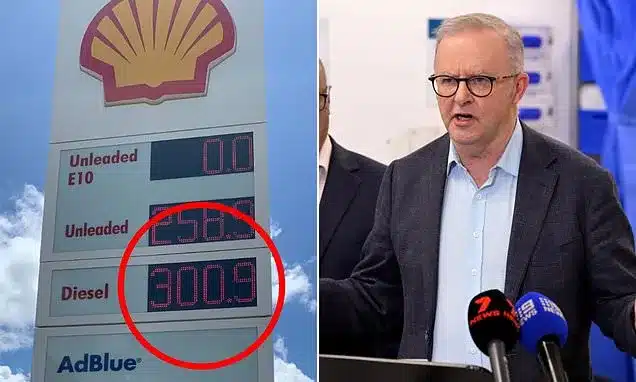
A small town in North Queensland has seen diesel prices exceed $3 a litre at a local service station, while officials warn that petrol could climb to $4 a litre due to escalating Middle East tensions.
Price Surge in Ayr Sparks Local Outrage
The NightOwl Shell station on Queen Street in Ayr raised diesel prices above $3 a litre on Monday and also depleted its supply of standard E10 fuel. Local residents expressed frustration over the sharp increase.
One Ayr resident highlighted the broader impact, stating, ‘Three dollars a litre for diesel. I’ve lived here all my life and I’ve never seen anything like it.’ She noted that higher fuel costs directly raise prices for groceries and medicines transported by truck to regional areas, affecting tradies, miners, and the local economy reliant on diesel.
‘Everything comes by truck up here. Groceries, medicines. Everyone in town pays for it,’ she added. ‘And the economy up here relies on diesel. What about the tradies and people out at the mines who drive in and drive out… how is this sustainable?’
National Fuel Trends and Minister’s Warning
Diesel prices in parts of Sydney and Melbourne approach $3 a litre, with unleaded 91 averaging around $2.45 a litre. The surge follows coordinated US-Israeli strikes on Iran, which closed the Strait of Hormuz—a vital route for 20 percent of global oil supplies.
Assistant Trade Minister Matt Thistlethwaite declined to rule out $4-a-litre petrol during an interview on Sky News. ‘I can’t speculate on what’s going to happen with prices, but obviously, the longer the conflict goes on, the more potential it has to restrict supplies and push up prices,’ he said.
Thistlethwaite emphasized government efforts to secure fuel supplies, including negotiations with Asian partners led by the Prime Minister. ‘But at the moment, people should take what they need and no more, and we’ll continue to work through this situation,’ he advised.
Global Energy Warnings Escalate
International Energy Agency Executive Director Dr. Fatih Birol described the crisis as more severe than the 1970s oil shocks combined. Speaking at the National Press Club in Canberra, he revealed that the world loses 11 million barrels of oil per day—exceeding the 10 million barrels lost across the 1973 and 1979 crises, which triggered global economic turmoil.
Gas markets face even greater disruption, nearly double the impact from Russia’s invasion of Ukraine. ‘This crisis, as it stands now, two oil crises and one gas crash put all together,’ Dr. Birol stated.
Domestic Responses and Calls for Action
Energy Minister Chris Bowen suggested Australians work from home more frequently to ease demand during the shortage. Queensland Premier David Crisafulli voiced concerns over the federal response, while State Treasurer and Energy Minister David Jenetski urged stronger protections for regional fuel supplies in a letter dated March 10.
