

For greater than a month, the Bay Space has been subjected to a seemingly ceaseless stampede of earthquakes — the most recent in a collection of seismic swarms which have rattled home windows and raised fears throughout California.
The newest swarm has been centered within the East Bay suburb of San Ramon, the place a magnitude 4 earthquake struck Friday night time — the most important because the cluster started — and a magnitude 3.9 on Saturday night time. Since Nov. 9, there have been not less than 80 earthquakes of magnitude 2 or higher within the space, based on the U.S. Geological Survey.
Whereas none of those quakes has been significantly potent — which was additionally the case in comparable swarms recorded in Malibu, El Sereno and Ontario since 2024 — some worry the persistent seismic exercise might foreshadow a back-of-mind concern for a lot of Californians: the “Huge One.”
However whereas consultants acknowledge that some main earthquakes are preceded by more-modest temblors, they warning that the swarms by themselves most likely don’t supply a touch of when, or the place, the subsequent main quake will hit.
“There’s gonna be an enormous earthquake within the Bay Space. We simply can’t say precisely when and the place. So try to be ready for that,” stated Annemarie Baltay, a U.S. Geological Survey seismologist.


The specter of a big earthquake all the time looms in California whatever the look of small shakers. There’s a 60% probability of an earthquake of magnitude 6.7 or higher within the Los Angeles area by 2043, and a 72% probability of the identical within the San Francisco Bay Space, based on 30-year estimates calculated by USGS in 2014.
Throughout California, there’s additionally a 48% probability of a magnitude 7.5 quake or higher by 2043, and a 7% probability of a magnitude 8 or higher quake.
It’s true that after each earthquake, there’s a 1-in-20 probability it’ll be adopted by a bigger magnitude temblor. However conventionally, solely half of earthquakes have an simply detectable foreshock, whereas the opposite half don’t.
Southern California has offered some latest examples of swarms that finally fizzled out. The Malibu space had a trio of scary earthquakes just lately — a magnitude 4.6 earthquake on Feb. 9, 2024; a magnitude 4.7 on Sept. 12, 2024; and a magnitude 4.1 on March 9. Nevertheless it has been quieter within the final six months.
Ontario endured a spate of shaking slightly greater than a yr in the past, topping out with a magnitude 4 quake on Oct. 6, 2024. However there have been fewer, a lot smaller quakes to date this yr.
An earthquake swarm centered round El Sereno in Eastside Los Angeles additionally was detected final yr, although that exercise seems to have subsided following a magnitude 4.4 earthquake on Aug. 12, 2024.
The cluster of small San Ramon earthquakes in latest weeks can also be not terribly uncommon. The earthquakes are showing on the northern finish of the Calaveras fault because it runs into Mount Diablo.
Together with the present swarm and one other final month, there have been 9 earthquake swarms within the surrounding space since 1970. They’ve lasted anyplace from two to 42 days, with most magnitudes typically within the 3 to 4 vary, based on Baltay.
“That is nonetheless actually according to these sorts of swarms,” Baltay stated of the present exercise.

Definitely, for residents who really feel the frequent small earthquakes, “it’s actually unsettling … you don’t know when it’s going to finish,” she stated.
None of these earlier swarms resulted in a significant quake on the northern part of the Calaveras fault, which hasn’t ruptured catastrophically in trendy historical past.
Nonetheless, the Calaveras fault is one to look at for California. It’s thought of one of the seemingly faults to rupture in a significant quake for the Bay Space, and has the potential to set off a magnitude 6.7 quake or higher. In 1984, a piece of the Calaveras fault ruptured and prompted the magnitude 6.2 Morgan Hill earthquake, which resulted in 21 minor accidents and $7.5 million in harm.
Additionally of concern are the Hayward fault and the infamous San Andreas fault, based on the USGS.
The smattering of small earthquakes in Southern California generated vital, not altogether unwarranted, consideration final yr.
Actually, 2024 ended up being a file of kinds for modest quakes in Southern California — there have been 15 impartial earthquake sequences that yr with not less than one magnitude 4 or increased earthquake, based on seismologist Lucy Jones. That was the best complete in 65 years, surpassing the 13 seen in 1988.
However final yr’s determine most likely didn’t imply a lot within the higher scheme of issues. In 2025, there have been solely 5 impartial seismic sequences with not less than one magnitude 4 or increased earthquake in Southern California.
That stated, there have been conditions when comparatively modest quakes have preceded big ones.
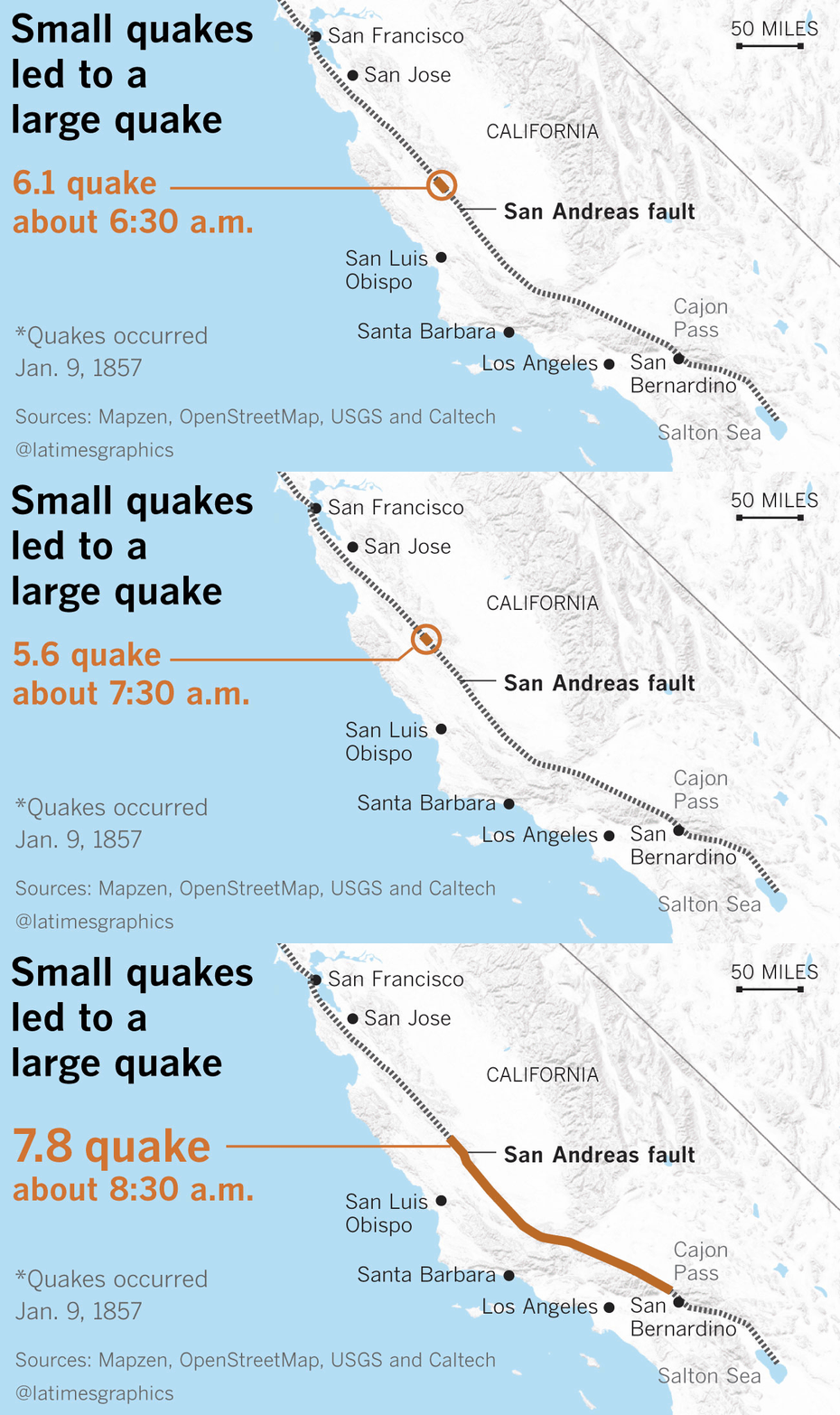
In 1857, a mammoth magnitude 7.8 earthquake ruptured alongside 225 miles of the San Andreas fault, stretching from Monterey County to Los Angeles County. That Huge One hit at round 8:30 a.m. on Jan. 9, 1857, but it surely was preceded in Monterey County by a magnitude 5.6 earthquake an hour earlier, and a magnitude 6.1 earthquake an hour earlier than that.

(Raoul Rañoa / Los Angeles Instances)
After which there have been the 2019 Ridgecrest earthquakes within the Mojave Desert. A magnitude 6.4 earthquake ruptured July 4 at 10:33 a.m., however that was adopted by a a lot bigger magnitude 7.1 earthquake at 8:19 p.m. the subsequent day.

Animation doesn’t mirror precise velocity.
(Swetha Kannan / Los Angeles Instances)
There have been additionally just a few harrowing months in 1992. A magnitude 6.1 Joshua Tree temblor on April 22 of that yr made scientists nervous as a result of its epicenter was solely about 6 miles away from the San Andreas fault. After the Joshua Tree earthquake, the Governor’s Workplace of Emergency Providers issued an advisory for Southern California, warning folks to be on alert for one more, bigger earthquake.
Within the fast aftermath, “nothing occurred, however we stored on having all these aftershocks sitting there proper close to the San Andreas and making us uncomfortable and worrying about it,” Jones stated. The aftershocks finally migrated north, away from the San Andreas.
However these aftershocks crept towards the eventual epicenter of a much more highly effective earthquake within the Mojave Desert — the magnitude 7.3 Landers earthquake of June 28, 1992. That quake resulted in aftershocks that additionally reactivated seismic exercise round Joshua Tree.
“So we now had a steady line of aftershocks coming all the best way all the way down to the San Andreas,” Jones stated.
Hours after the Landers earthquake, a magnitude 6.3 earthquake struck in Huge Bear, “which was on a unique fault, but in addition the aftershocks to Huge Bear prolonged all the way down to the San Andreas in a unique location,” Jones stated.
The end result was so alarming to scientists and officers that the Governor’s Workplace of Emergency Providers issued what was then an unprecedented advisory urging folks to remain off freeways, a name that got here as freeway and bridge collapses from the 1989 Loma Prieta earthquake have been nonetheless on the minds of many.

A California Freeway Patrol officer checks the harm to automobiles that fell when the higher deck of the Bay Bridge collapsed onto the decrease deck.
(George Nikitin / Related Press)
Nothing ended up occurring on the San Andreas fault in 1992, nevertheless.
“It’s most likely the closest we’ve come to a prediction, ever,” Jones stated. “We have been actually fairly nervous about it.”
Nevertheless, there have been different main earthquakes with no simply noticeable foreshocks, Jones stated. These embrace a few of the most damaging in latest reminiscence, such because the 1994 Northridge earthquake, the 1987 Whittier Narrows earthquake and the 1971 Sylmar earthquake.
