

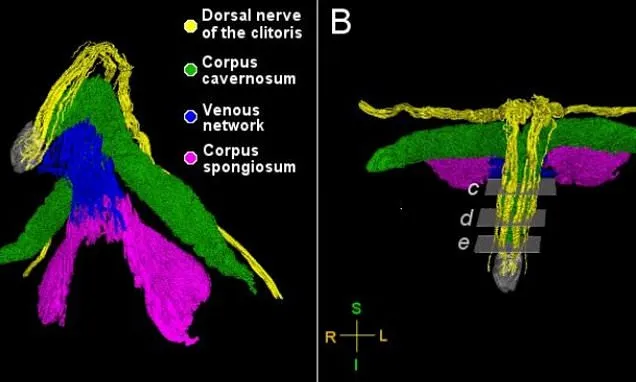
Researchers have produced the first detailed map of the clitoris, confirming its extensive nerve network makes it even more sensitive than previously understood. Using advanced X-ray imaging on postmortem female pelvic samples, the study uncovers a intricate web of nerves essential for sexual pleasure and orgasms.
Breakthrough in Mapping Technique
The clitoris stands as the only human organ dedicated solely to pleasure, transmitting electrical impulses via nerves to enable sensation and response to touch. While its visible glans sits externally, most of the structure lies internally, including the wishbone-shaped dorsal nerve that handles clitoral sensation.
Mapping this organ proved challenging due to its internal embedding amid pelvic bones and organs. Traditional methods like gross dissection or MRI lacked the resolution needed. Instead, scientists employed micron-scale CT scans powered by synchrotron radiation X-ray sources, visualizing nerves as fine as 0.2mm in diameter.
Surprising Nerve Discoveries
Led by Ju Young Lee at Amsterdam UMC, the team found that the dorsal nerve (DNC)—key to clitoral sensation—does not taper off toward the glans as earlier studies suggested. “The DNC does not diminish but instead exhibits a complex tree-like branching pattern within the clitoral glans,” the researchers state in their preprint on bioRxiv.
“The clitoris is a unique organ in the female body, responsible for sexual pleasure,” the study notes. “Early references to the clitoris trace back to ancient times, as in Aristotle’s writings. However, cultural taboos around female sexuality have long impeded scientific exploration.”
Implications for Women’s Health
This map addresses a long-standing gap in knowledge—the penis was mapped over 30 years ago. It aims to dismantle taboos in women’s sexual health and refine surgical practices. Female genital cosmetic procedures, such as labiaplasty, surged 70% from 2015 to 2020. The findings could update the “danger zone” to prevent nerve damage during operations.
