

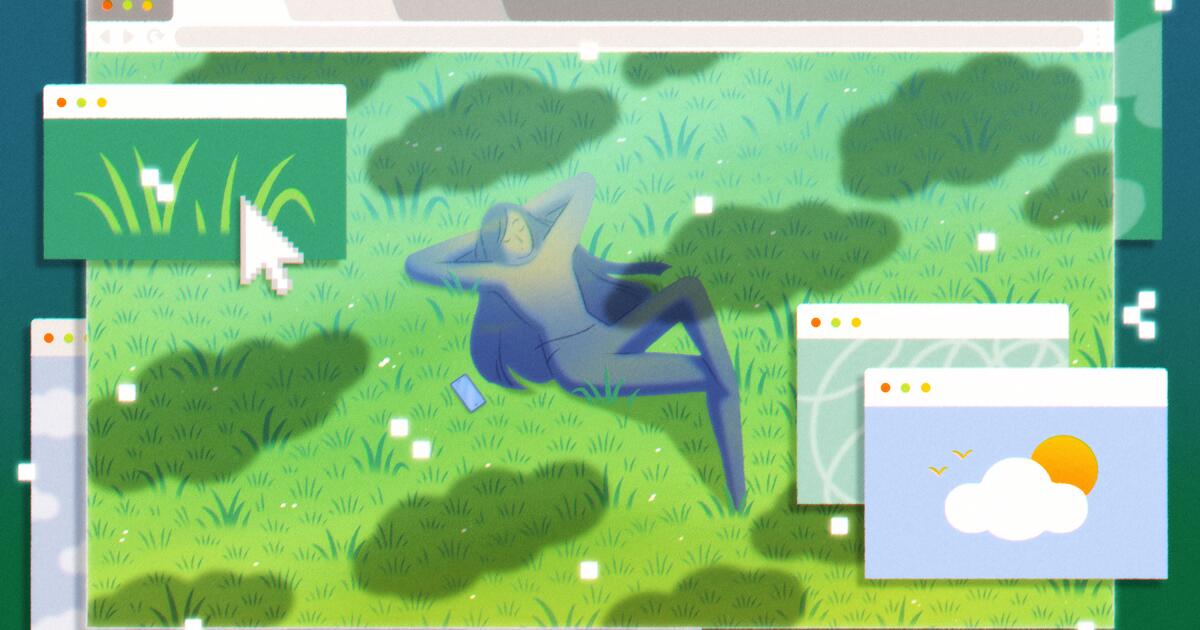
It’s that point of 12 months once more: detox season. Whereas many people will likely be getting into the brand new 12 months embracing Dry January (to cut back alcohol consumption) or doing juice cleanses (for weight reduction), others will likely be performing “digital detoxes,” staying off of their units greater than normal or fully to kick off 2026 with renewed power and focus.

Shelf Assistance is a wellness column the place we interview researchers, thinkers and writers about their newest books — all with the purpose of studying learn how to stay a extra full life.
However what occurs when the detox is over and the refrain of textual content pings, slack dings and social media notifications swells all through the remainder of the 12 months?
Digital detoxes don’t work, says creator Paul Leonardi, a professor of expertise administration at UC Santa Barbara, as a result of they’re short-term fixes that don’t handle our underlying tendencies and tech habits. Which is regarding as a result of we’re drowning in digital connectivity nowadays — to different folks, to information and data, to on-line information — and that may result in a situation often known as “digital exhaustion,” as Leonardi calls it.
The signs? Drained power, lack of focus, a way of aimlessness when scrolling on-line and dread over returning “even only one extra e mail,” he says.
That’s compounded by the havoc gadget overuse wreaks on our our bodies: gazing a pc display all day causes eye fatigue, scrolling on our telephones endlessly may cause “tech neck,” the blue wavelengths from screens disrupt our circadian rhythms, resulting in poor sleep high quality.
But when digital detoxes don’t work, what does?
Leonardi’s new e book, “Digital Exhaustion: Easy Guidelines for Reclaiming Your Life,” focuses on reshaping our relationship with expertise within the long-term, serving to readers develop more healthy tech use habits in order that breaking apart along with your cellphone isn’t crucial within the first place.
Consider Leonardi as a therapist and his e book a {couples} counseling sofa on which you sit along with your accomplice, a hyperactive nonstop-chattering smartphone.
“A therapist doesn’t say, ‘right here is the reply,’ proper?’” Leonardi says. “A therapist tells you: ‘Listed here are a bunch of various issues that you can do, and which one goes to work greatest will depend on your specific scenario.’ That’s actually what this entire e book is about.”
This interview has been edited for size and readability.
How do we all know we’re affected by digital exhaustion and the way is it completely different from common burnout?
Normal burnout, as we apply it to our jobs, is like: “I’m achieved with this job.” You already know, “the job is killing me.” Digital exhaustion is a chunk of burnout. It’s this overwhelming feeling that “there’s an excessive amount of for me to course of and it feels too overwhelming for me to continually be taking note of all the instruments, all the info inputs, all the requests that I’m getting from so many alternative sources.”
The primary massive symptom is apathy. “I don’t actually care about doing this job very properly. I don’t actually care about returning this name.” A second one is a way of hopelessness. Like: “Regardless of how a lot I do, there’s at all times going to be extra. I may spend all day and my e mail would by no means go down.” It’s like Sisyphus pushing the rock up the hill. The third is nearly just like the moth to the flame. “I do know that this factor is admittedly placing me in a nasty temper and it’s making me really feel fatigue and I ought to step away from it, however I can also’t.” It’s this fixed, nearly vicious cycle.

“Digital Exhaustion” by Paul Leonardi
(Riverhead Books)
How is social media particularly digitally exhausting?
It’s a drain on our consideration. Social media — all expertise, however social media particularly — forces us to continually disconnect our consideration from one factor and place it on one thing else. And having to disconnect and reconnect continually is a big driver of exhaustion. Then there’s inference. Inference is the kind of impact that occurs once we’re continually attempting to place all the items collectively once we get little fragments of information and data. We’re like detectives placing the items collectively. That occurs once we’re seeing any person’s social submit and we’re attempting to determine, implicitly, are they a superb individual? Are they being imply? Are they pleasant? Is their life wonderful? Additionally, once we’re attempting to make inferences about what different folks consider us based mostly on our personal social posts: “Do they assume that I’m being haughty as a result of I put this piece of data on the market?” We by no means see the complete image, and placing these puzzle items collectively is exhausting. Lastly: It’s an actual conduit to our feelings. It creates emotions of hysteria in us, emotions of worry, emotions of anger, but in addition emotions of pleasure. And the experiencing of all that emotion is a supply of exhaustion.
You say that we swap between apps and on-line platforms about 1,200 instances per day, on common. What does this “digital switching,” as you name it, do to our brains — and the way can we shield ourselves?
Disconnecting and reconnecting our consideration could be very cognitively taxing. As we transfer throughout apps and platforms and web sites, we continually must reorient. Even in case you’re switching [between] one thing as seemingly innocuous as Zoom and Microsoft Groups, that little swap means “oh, the share your display button is in a unique place.” And the truth that it’s important to take into consideration that, there’s a little bit little bit of stress related to it.
“Instrument auditing” helps. The extra that we will scale back the variety of switches now we have to make, the higher off we’re. So in case you can turn into accustomed to doing all of your video conferencing on Zoom and never have to make use of Zoom one time and Microsoft Groups one other time and Webex one other time, that’s a straightforward means of decreasing the switching prices that find yourself sapping our consideration. [Also], “single thread residing.” The extra that we will push issues into one channel, the much less switches we’ll must do. And the extra that we will keep in a trajectory of labor — or in a set of comparable duties — the much less switching now we have to do. So if I’m a professor making ready for a category, and I’m doing analysis on a paper and I’m placing collectively a presentation and I’m creating lecture notes, I could be on completely different purposes. However the truth that it’s all in service of the identical common process, which is to organize for my lecture, the analysis reveals it reduces the fatigue related to switching.
We ask far more of individuals now, after which it requires us to attend extra to all of those units and apps and every thing — which is admittedly exhausting.
— Paul Leonardi

(Maggie Chiang / For The Instances)
How is digital exhaustion altering household life? Within the e book, you discuss mother and father being overwhelmed by endless coordination on group chats, college apps, carpooling texts.
A part of the issue is that as a result of now we have all these instantaneous connections, folks really feel like they’ll make extra last-minute modifications. So you may get in your workforce sports activities app, and ‘Oh, we’re going to alter the colour of socks for this sport for our soccer workforce.’ We wouldn’t have achieved that 15 years in the past since you couldn’t have texted and gotten a maintain of all people on the workforce so instantly to ask them to alter their socks. We ask far more of individuals now, after which it requires us to attend extra to all of those units and apps and every thing — which is admittedly exhausting. There’s additionally the dread that many mother and father really feel that they’re setting a nasty instance for his or her youngsters by being on their units a lot on a regular basis.

Creator Paul Leonardi.
(Doug Ellis Pictures )
What are some tips for elevating wholesome youngsters within the twenty first century?
One of many issues I believe is admittedly essential is to just be sure you’re demonstrating, and also you’re function modeling, good habits along with your units and platforms. So in case you’re mindlessly in your cellphone, your youngsters will mindlessly be on their telephones. And also you’re additionally sending a sign to them that no matter’s on the opposite facet of your cellphone is extra essential than they’re. And youngsters watch that they usually observe they usually decide up on these alerts. What actually is essential is the standard time that we’re spending as mother and father with our children — that we’re with them and never on our units. And that sends a robust sign about our values.
Does AI exacerbate digital exhaustion or is it a possible answer?
In the meanwhile, I believe it’s principally exacerbating it by giving us a lot further content material to concentrate to. Simply because it’s really easy for everybody to create content material on a whim. Additionally, discuss about expertise is exhausting. We’re continually bombarded with studies about AI and all these predictions about how AI goes to remove our jobs and alter {our relationships}. It’s exacerbating the issue of exhaustion. The place it may actually assistance is, if the instruments may make higher predictions about what info we have to do [a task]. That stops us from having to pause in our work and get on one other software or search engine to seek out one thing. That’s the place it has actual potential and promise for serving to us to cut back our exhaustion.
It’s as much as us to determine how can we orient to our instruments in methods which can be going to present us their advantages with out carrying us out.
— Paul Leonardi
Your e book is stuffed with sensible methods for staving off digital exhaustion. What are a few of your favorites?
On Zoom, flip off your self-view. We find yourself paying an undue quantity of consideration to ourselves and worrying about how we’re presenting ourselves to others. It’s like if we walked round with a mirror in entrance of ourselves all day lengthy. One other one is to have actually good intentionality round what you’re doing in your units. So once you decide up your cellphone, have an finish aim in thoughts — “I’m choosing up my cellphone as a result of I have to examine the climate.” If you happen to don’t, then it’s very simple to get sucked into the subsequent factor and the subsequent factor.”
A 3rd: Deal with coordination as an enormous drawback to resolve all of sudden somewhat than little issues to resolve within the second. A fourth: complementary opposites. Pair intense digital work actions with using your physique, your palms and the bodily world. The extra folks try this, they discover that the much less they wish to get again on their units.
One final technique: Take into consideration controlling your visibility. We’ve been conditioned to guide these very public digital lives by posting every thing and highlighting all of our accomplishments. However the extra we try this, the extra issues there are for us to concentrate to and the extra worries now we have about how different individuals are perceiving us. So flip off learn receipts, typing indicators, analytics that make us really feel watched. That’s how, partly, we management our visibility. And bear in mind: Our applied sciences aren’t inherently good or dangerous. It’s as much as us to determine how can we orient to our instruments in methods which can be going to present us their advantages with out carrying us out. That’s actually the core message of the e book.
