

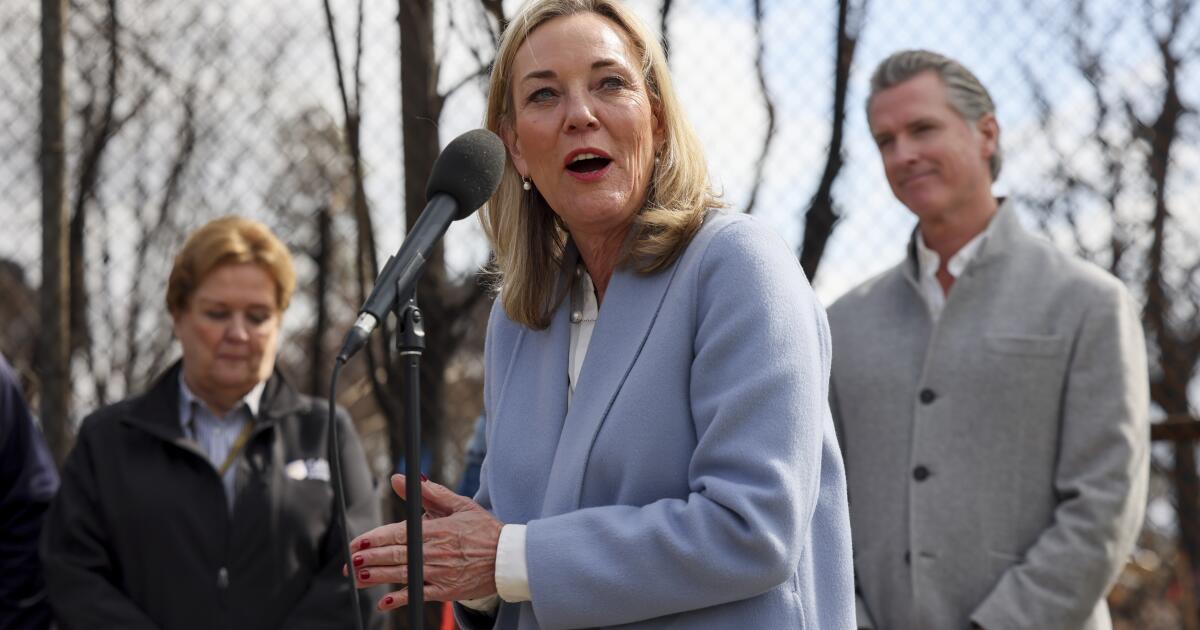
California Gov. Gavin Newsom’s catastrophe chief quietly retired in late December amid criticism over the state’s indecisive stance on whether or not soil testing was needed to guard survivors of the Eaton and Palisades fires.
One yr in the past, Nancy Ward, then the director of the California Governor’s Workplace of Emergency Providers (Cal OES), petitioned the Federal Emergency Administration Company to spearhead the cleanup of poisonous ash and fireplace particles cloaking greater than 12,000 houses throughout Los Angeles County.
Though Ward’s determination ensured the federal authorities would assume the majority of catastrophe prices, it got here with a significant commerce off. FEMA was unwilling to pay for soil sampling to substantiate these houses weren’t nonetheless closely contaminated with poisonous substances after the cleanup — testing that California state companies have sometimes completed following related fires previously.
Following intense backlash from fireplace survivors and California lawmakers, Ward pleaded with FEMA to rethink its soil-testing stance, writing in a Feb. 19 letter that it’s “essential to guard public well being” and “make sure that survivors can safely return to their houses.” Her request was denied.
Nevertheless, in October, Cal OES — underneath Ward’s management — privately thought-about discontinuing state funding for soil testing within the aftermath of future wildfires, in keeping with a confidential, inside draft memo obtained by the Los Angeles Occasions.
The Occasions requested an interview with Ward, and despatched inquiries to her workplace asking about her preliminary determination to forgo soil testing and for readability on the way forward for state’s fireplace restoration coverage. Ward declined the request; The Occasions later printed an article on Dec. 29 about allegations that federal contractors illegally dumped poisonous ash and misused contaminated soil in breach of state coverage.
Ward, who served as Cal OES director for 3 years, retired on Dec. 30; her deputy director, Christina Curry, stepped into the position because the interim chief. Ward additionally didn’t reply to a number of requests for remark for this text.
Ward was the primary girl to function Cal OES director. She had additionally beforehand served as a FEMA regional administrator, overseeing federal catastrophe response within the Southwest and Pacific Islands from 2006 to 2014.
A Cal OES spokesperson stated Ward’s retirement had been deliberate properly prematurely.
“Director Nancy Ward has been a gentle hand and a compassionate chief by a few of California’s largest disasters,” the spokesperson stated. “Her many years of service have made our state stronger, safer, and extra resilient. The Governor is deeply grateful for her dedication and desires her the easiest in retirement.”
The inner memo obtained by The Occasions was written by Ward’s assistant director, and titled: “Ought to the state proceed to pay for soil testing as a part of Non-public Property Particles Elimination (PPDR) packages? ”
It laid out three potential solutions: The state might preserve funding soil testing after future wildfires; the state might defer soil testing choices to the affected counties with the opportunity of reimbursing them; or the state might cease paying for soil testing totally.
A Cal OES spokesperson stated the memo was solely a draft and did not symbolize a coverage change. “The state’s place on soil testing stays unchanged,” the spokesperson stated. “California is dedicated to advocating for the secure, well timed elimination of wildfire particles. Defending the general public well being and well-being of impacted communities stays the state’s foremost precedence.”
The first motive for soil testing is to forestall dangerous exposures to poisonous metals, comparable to brain-damaging lead or cancer-causing arsenic. Since 2007, complete soil testing has been carried out after 64 wildfire cleanups in California, in keeping with the memo. When soil contamination nonetheless exceeded state benchmarks after the preliminary cleanup, the state authorities redeployed cleanup staff to take away extra dust after which retest the properties.
This method, the memo stated, was essential in figuring out dangerous substances that “pose publicity hazards by way of ingestion, inhalation of mud, or by backyard/meals manufacturing.” Soil testing “helps guarantee the protection” of youngsters, seniors, pregnant ladies and folks with well being points who’re “extra weak to soilborne toxins.”
“The State has a protracted precedent of conducting or paying for soil testing,” the Cal OES assistant director wrote within the memo. “Pivoting from this is able to be a major coverage change.”
The memo cites a report from CalRecycle, the company that has traditionally carried out state-led fireplace cleanups, that stresses the significance of the present follow to public well being.
“Soil contamination after a wildfire is an invisible menace,” wrote a CalRecycle official. “If not correctly cleaned and remediated in a methodical method, property house owners might encounter extra hurdles throughout the rebuilding course of and endure extra trauma.”
“Soil sampling,” the official provides, “is the metric by which Recyclable demonstrates that particles elimination operations have efficiently remediated the post-disaster menace to public well being and the setting.”
Nevertheless, such soil testing and extra cleanup prolongs the cleanup timeline and might make it costlier. The memo cites price estimates from CalRecycle which present that soil testing and extra cleanup work often prices some $4,000 to $6,000 per parcel, representing 3% to six% of total particles elimination prices.
The state price projections align with these made by unbiased environmental consultants. Andrews Whelton, a Purdue College professor who researches pure disasters, estimated that soil testing and additional remediation for the Eaton and Palisades fireplace would price between $40 million to $70 million.
All informed, the CalRecycle report states the same old soil-testing course of has been a “comparatively low-cost step” to safeguard public well being.
Additional, though soil testing might add some price, when it’s taken as a proactive measure, it could get monetary savings down the street.
Forgoing soil testing and evidence-backed remediation can generate uncertainty about poisonous contamination, which in flip might decrease the worth of houses in Altadena and Pacific Palisades, Whelton stated. What’s extra, the property proprietor could also be chargeable for soil contamination in the event that they fail to reveal environmental dangers when promoting or leasing.
The inner CalOES memo alludes to this give and take: “Funds saved initially by skipping testing could also be outweighed by later unseen prices, for instance, reinvesting in remediation, addressing neighborhood complaints, litigation, or cleanup failure.”
The U.S. Military Corps of Engineers has fielded over 1,100 complaints filed by property house owners affected by the Eaton and Palisades fires — over 20% of which have been associated to the standard of labor. In response to inside studies obtained by The Occasions, federal cleanup repeatedly deviated from cleanup protocols, doubtless spreading contamination within the course of.
Since then, FEMA officers have backed down from their hard-line stance towards paying for post-fire soil testing in California in an try to shore up public confidence within the federal cleanup.
The U.S. Environmental Safety Company introduced this week that FEMA will conduct a restricted lead-testing program within the Eaton fireplace burn scar that’s supposed to “affirm the effectiveness of cleanup strategies,” in keeping with an EPA spokesperson. The initiative has already come underneath the scrutiny of environmental consultants who say it lacks the rigor of California’s soil testing routine.
It stays unclear if California will proceed to implement soil-testing safeguards that made the state a nationwide chief in fireplace restoration. Although state officers say these will stay unchanged, there isn’t any authorized mandate to observe these procedures.
The inner CalOES memo circulated underneath Ward’s management has solely added to the cloud of uncertainty.
One factor is evident: It’s a moot level for survivors of the Eaton and Palisades fireplace.
As state and federal officers debated the worth of soil testing, most Altadena and Pacific Palisades residents have been left to analyze the extent of environmental fallout on their very own.
