

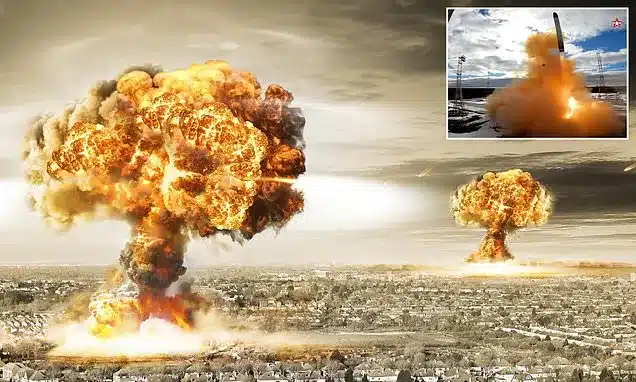
As nuclear threats escalate worldwide, the prolonged horrors following initial detonations could surpass the immediate destruction in terror. Projections indicate tens of millions would perish instantly from blasts targeting cities like New York, Washington, Chicago, and Los Angeles. Yet, the fireballs unleash enduring planetary impacts through deadly radiation clouds.
Research highlights catastrophic effects on human health, ecosystems, and wildlife, where vaporization in the blasts might seem merciful compared to survival conditions. Extensive studies reveal that even a limited nuclear exchange would erode the ozone layer, unleash diseases from unburied bodies, and expose survivors to Acute Radiation Syndrome, a lethal radiation illness.
Escalating Global Risks
The Bulletin of the Atomic Scientists, creators of the Doomsday Clock, recently warned that humanity stands at its closest point to annihilation. Current tensions, including the Middle East conflict risking wider escalation with Russia providing military intelligence to Iran on U.S. forces, accelerate this timeline. The New START treaty between the U.S. and Russia expired on February 5, removing limits on nuclear arsenal expansion and testing. Officials from the U.S., Israel, Iran, and Russia caution that a global catastrophe looms amid rising hostilities.
Disease Outbreaks Surge
Survivors face rampant spread of salmonella, dysentery, typhoid, malaria, dengue fever, and encephalitis. A 1981 New England Journal of Medicine analysis notes the lack of clean water and explosion of insects feeding on street corpses. Untreated sewage and radiation-resistant bugs would transport pathogens globally from decaying bodies.
Power outages render medical equipment inoperable without generators. A 1986 report on the medical implications of nuclear war states: “Many familiar barriers to the spread of communicable disease… will be seriously compromised in the post-attack environment. In their absence.” It adds: “A host of enteric diseases not yet encountered by most Americans may be expected to spread widely.” National Library of Medicine data identifies threats like hepatitis, causing liver inflammation and jaundice, and E. coli, triggering severe diarrhea, cramps, and dehydration.
Ozone Loss Triggers ‘Ultraviolet Spring’
Nuclear blasts generate nitrogen oxides that rise to the stratosphere, destroying up to 70 percent of the ozone layer in a full-scale war involving 10,000 megatons, per a 1975 National Academy of Sciences study—exceeding current global stockpiles. John W. Birks of the University of Colorado explains: “Once most of the smoke and dust was removed from the atmosphere and sunlight began to break through, the biosphere would not receive normal sunlight but, rather, sunlight highly enriched in ultraviolet radiation.”
Enhanced UV-B rays would spike skin cancers in humans, devastate crops, and harm wildlife. Recent findings on a potential India-Pakistan exchange predict 40 percent ozone loss. Michael Mills, lead author from CU Boulder’s Laboratory for Atmospheric and Space Physics, states: “We would see a dramatic drop in ozone levels that would persist for many years. At mid-latitudes the ozone decrease would be up to 40 percent, which could have huge effects on human health and on terrestrial, aquatic and marine ecosystems.”
Radioactive ‘Black Rain’ and Fallout
In Hiroshima, post-bomb fires lofted ash and radioactive particles into clouds, producing oily ‘black rain’ that inflicted severe burns hours later. Weather unpredictably disperses radiation, as seen in 1953 Nevada tests creating distant hot spots. Massachusetts Institute of Technology researchers warn fallout—radioactive particles settling after blasts—could travel hundreds of miles, contaminating everything via wind.
Analyses in the medical implications report estimate up to seven percent of the U.S. receiving fatal radiation doses within two days.
Nuclear Winter Sparks Global Starvation
A full-scale war could claim up to five billion lives from famine. Soot from incinerated cities blocks sunlight, cooling the planet and collapsing agriculture for at least a year, according to a 2022 Nature study. The ‘nuclear winter’ concept, popularized by Carl Sagan in 1983, underscores this blockade.
Firestorms Threaten Even Shelters
Fallout shelters or basements offer no guarantee. Collapsing structures and ignited fuel lines spawn firestorms with gale-force winds sucking oxygen inward. Journal of Public Health Policy research indicates surface infernos raise shelter temperatures to lethal levels, consuming oxygen and causing burns or suffocation for occupants.
