

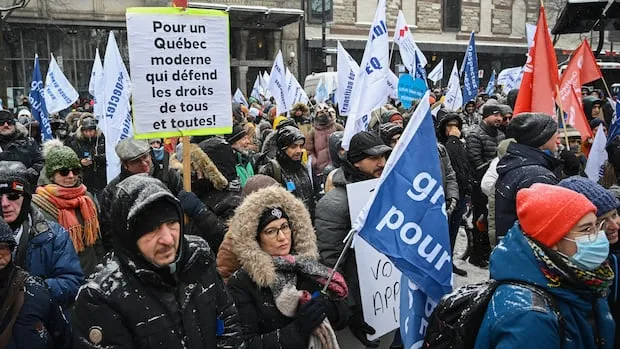
Hundreds of demonstrators rallied in seven Quebec cities, including Gatineau, Montreal, and Quebec City, to oppose the provincial government’s decision to eliminate the popular Programme de l’expérience québécoise (PEQ) immigration pathway.
Impact of PEQ Abolition
The Quebec government ended the PEQ in November, leaving thousands of temporary workers in uncertainty and compelling some to leave for their home countries. The program previously enabled eligible individuals with sufficient French proficiency and specific qualifications to obtain permanent residency selection certificates.
Mariia Kolosova, who relocated from Ukraine to Quebec in 2023, pursued the PEQ route. She intensively studied French and secured a position in tourism to meet the criteria. Just as she accumulated enough experience to apply, authorities suspended and then terminated the program. “The reason I came to Quebec, one of the reasons, was [because] my chances were quite high,” Kolosova stated at the Montreal rally. “Ukrainians, many of us, we don’t have a place to [go] back to. It’s not that easy to change your life from [scratch] again.”
Replacement Program Draws Criticism
Immigration Minister Jean-François Roberge introduced the Programme de sélection des travailleurs qualifiés (PSTQ) as a replacement. This points-based system favors applicants residing outside Montreal and employed in priority sectors such as health care and education.
Florent Pigeyre, an advisor for French citizens abroad, assists newcomers in Montreal with a lawsuit against the government. “I see a lot of [immigrants] contact me because the families are breaking apart, because they have to separate and go back to their country of origin,” he explained. “It was not the plan. It’s not what had been sold to them from the Quebec government.” Pigeyre noted that many arrived following provincial recruitment drives abroad, which highlighted PEQ opportunities, only to face altered criteria under the PSTQ.
Aram Musco, who moved from France to Montreal for studies, faces an unclear future. “The main thing is it’s quite hard to anticipate the next steps,” he said. “With the PSTQ, what’s quite difficult to manage and understand is that the criteria can evolve.” Musco emphasized that PEQ’s French requirements were already stringent, posing no risk to the province’s language, while newcomers bolster the economy.
Political and Community Support
Quebec Liberal and Québec solidaire MNAs joined municipal officials and unions at the protests, urging exemptions for those already established in the province to apply via PEQ. Business groups echoed this call recently.
At the Quebec City event, Québec solidaire co-spokesperson Sol Zanetti stressed, “We need to ensure stability for the people who come here… and that we ensure as well stability for all public services.” In Gatineau, Liberal MNA André Fortin remarked, “The CAQ government has started to blame immigration for all of Quebec’s problems, whether it’s housing, whether it’s health care or education. And that’s simply not the case.” Fortin aimed to reassure immigrants of their welcome in the province.
Government Response
Provincial authorities maintain the PSTQ will accommodate around 29,000 economic immigrants. Minister Roberge rejects PEQ exemptions, though applications submitted prior to abolition continue processing.
