

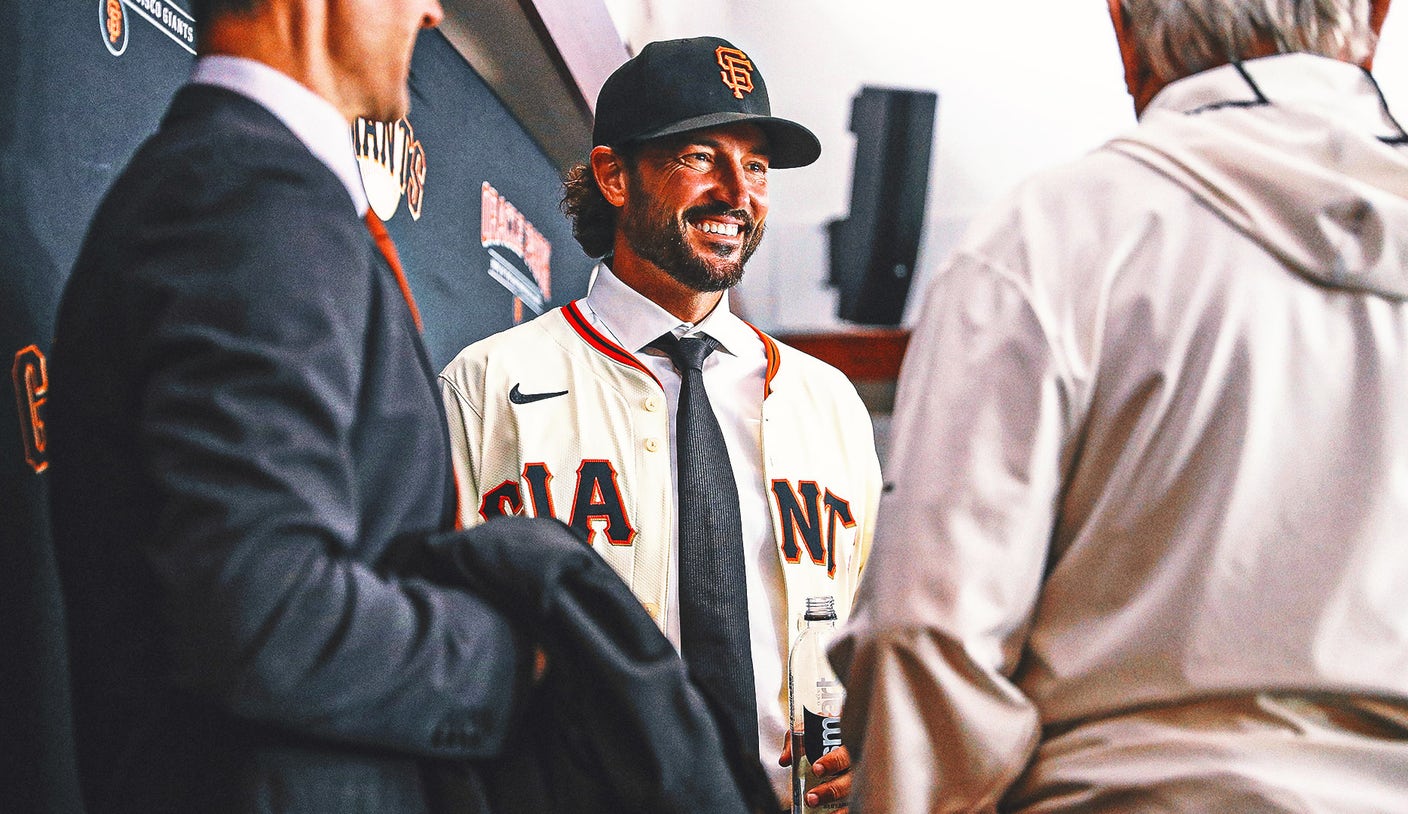
Tony Vitello was a fish out of water at his first ever Winter Meetings.
“I don’t know what I’m doing at this thing, to be honest with you,” the new San Francisco Giants manager admitted last Tuesday to a gaggle of reporters at the onset of his news conference.
These scrums with the media are a managerial responsibility that will soon become a significant part of his daily routine. They won’t always be as chaotic as this one was, which took place against the backdrop of thousands of individuals involved in baseball, meandering without a specific direction or path, in the wide and brightly lit hallways of the Signia hotel in Orlando, Fla. For someone not used to the mass and mess of the annual hubbub of baseball’s hot stove, the Winter Meetings can be unnerving.
Not only is Vitello not used to the professional baseball world, he’s never even been in it. Vitello has just as much experience being the manager of a pro baseball team as your neighbor next door. But, ask him about being the head coach of the Tennessee Volunteers, and he’ll have you schooled. After the Giants hired him in late October, Vitello became the first manager in MLB history to jump directly from college baseball to the major leagues without any professional baseball experience.
So, you can forgive Vitello for feeling overwhelmed by the frenzied nature of the Winter Meetings. But the thing is, it was impossible to tell. Vitello conducted his 30-minute managerial scrum with a relaxed tempo. He gave honest and thoughtful answers. He was energetic. He was funny.

(Photo by Scott Strazzante/San Francisco Chronicle via Getty Images)
That being said, there were still small signs that he was new around here. He kept referring to himself as a coach rather than a manager. He was an open book in a refreshing way, not yet spurned by the inevitable negative coverage that comes with losses and poor records.
“I’m just trying to figure out what’s going on here at both hotels that we’re occupying,” Vitello said. “With the teams in our division or that are out there in general, I don’t know what you’re supposed to say or not. It sounds like the Phillies got better today.” (Moments before Vitello sat down with the media, the Phillies re-signed slugger Kyle Schwarber to a five-year deal.)
Even as Vitello claimed he was unaware of exactly what to do or how to act, he kept saying the right things. Above all, what stood out from his first real foray into the pandemonium of professional baseball was his love of the game — be it at the college level or the big leagues. Vitello offered reminders that fresh ideas on how to improve MLB can come from anywhere, even from an unconventional hire: a self-deprecating college head coach who led Tennessee to its first-ever national title and three College World Series appearances in his successful eight-year run.

(Photo by Wesley Hitt/Getty Images)
“Sorry to go on an even further tangent, but maybe this thing, and who knows if you want to call it the guinea pig, or sacrificial lamb, or if it goes well or doesn’t go well, who cares? I guess I should,” Vitello said. “I wish there was somebody, like, with a shorter haircut and more reputable up here, to say it’s time for college baseball and Major League Baseball to be married a little closer for a lot of different reasons.
“I think working together ultimately makes Major League Baseball a better product, which is great for the fans. Then, sorry, money is a big factor in the world, whether we like it or not. Ultimately, if Major League Baseball is a better product, then there’s more money being made.”
Vitello, 47, believes it took this long for someone to go straight from the college side to pro ball, without any playing, coaching, or minor-league experience, in part because of the improved talent at the college level, which has led to higher interest, which has led to greater national coverage.
It’s all slowly closed the gap between the major leagues.
“You don’t have to be in the SEC,” he said. “You could be out at Coastal Carolina or out on the West Coast. College baseball is now heavily covered by the media. TV is a part of the deal. There’s fans at every game, and the players are better.”
Giants president of baseball operations and former MVP catcher Buster Posey has tasked Vitello with bringing the organization back to greatness. He’s working on a three-year contract with a vesting option for a fourth year. Posey and the Giants want stability at the skipper’s position after Bob Melvin, who managed the club from 2024-25, was fired with a year left on his contract following a disappointing 81-81 finish while falling short of the playoffs again. This was the second time in three offseasons that San Francisco conducted a managerial search before choosing Vitello to lead the 26-man roster.
Vitello has solid pieces in place to help get the Giants back to the postseason for the first time since 2021. Logan Webb and Robbie Ray will lead the rotation, while Matt Chapman, Rafael Devers, and Willy Adames will provide the thump in the lineup. The rookie manager plans to lean on those veterans to help guide him through the ups and downs of his first year. For now, Vitello is viewing his roster through a college-ball lens — including a heavier emphasis on the word “recruit,” rather than “call up” or “sign.”

(Photo by Matthew Grimes Jr./Atlanta Braves/Getty Images)
“I think it’s a really fun roster,” Vitello said of his Giants squad. “It’s almost got a parallel to a college team because there’s high turnover with guys graduating or getting drafted. You’ve got a solid group of guys that are solidified as, at the very least, this is their role. We expect this guy to be our everyday this or that. There’s also open competition at several spots, whether it be on the position side or the pitching side. I think the combination is good to already have a quality roster.”
Another unique aspect of Vitello’s transition from the college side will be facing players in the big leagues that he previously coached while at Tennessee. According to the University’s database, there are seven MLB players and 39 minor league players that hail from Tennessee — including Red Sox ace Garrett Crochet and Giants outfielder Drew Gilbert, whom Vitello will now be managing.
“In the moment, there might be things you say or feelings you have, but when the moment is over, it’s kind of like UFC fighters or boxers, like an NFL game,” Vitello said. “These guys are just trying to kill each other, but afterwards, you have an appreciation because those are the people that push you the most or bring out the most intense feelings and emotions.
“Yeah, it will be unique, and it will be interesting. The one thing about all the reps in pro baseball, they change who you are as a person and who you are as a player. That can be for the worse, certain times, and other times it’s for the better. I think each of those guys will have a different look the next time I see them.”
Naturally, Vitello’s atypical hire drew a lot of attention in the industry, with reporters, executives, and opposing managers all looking for moments to offer congratulations or advice as he sets out on an epoch-making development in baseball history. For an idea of how dream-like the experience has been for Vitello so far, look no further than what happened during and after his first Winter Meetings news conference.
One of the earliest questions asked of Vitello was whether there was anyone in particular he was looking forward to meeting in Orlando. Immediately, he said: “Pat Murphy stands out because of the college background and having competed against him.” Murphy, who won second consecutive National League Manager of the Year honors after leading the Milwaukee Brewers to a franchise-record 97 wins in the regular season, had an extremely successful college baseball coaching career that spanned over 25 years. Vitello joked that maybe it was better to wait until after the 2026 season was over to connect with Murphy, since “he’s as competitive as it gets.”
Minutes after Vitello’s news conference wrapped up, he stepped out into the hallway at the Signia hotel and saw a beaming Pat Murphy walking up to him. A moment later, three-time Manager of the Year Dusty Baker joined them. The newcomer looked like he was doing most of the talking. There was Vitello, a fish out of water, rubbing shoulders with some of the best managers in the history of the sport, letting them learn from him for a change.
“The college game is so good, talent-wise, mentality-wise,” Murphy said last week in Orlando. “And the Major League game is younger now, just the cultures are different. There’s less of the old-school, earn-your-stripes rookie. There’s less of that nonsense. So I think [Vitello’s] transition — and Posey is aware of what he is doing — he’ll get it in order that the transition is simple. And I feel he is most likely 10 instances smarter than I used to be on the time.”
Vitello may not know what he’s doing simply but, however he’s setting the instance of how a college-ball angle may create recent concepts in knowledgeable league that’s lastly open to extra change. Finally, Vitello shall be judged on his wins and losses with the Giants. However, for now, he represents an unprecedented alternative to show how school baseball and the main leagues simply may make one another higher.
Deesha Thosar covers Main League Baseball as a reporter and columnist for FOX Sports activities. She beforehand lined the Mets as a beat reporter for the New York Day by day Information. The daughter of Indian immigrants, Deesha grew up on Lengthy Island and now lives in Queens. Comply with her on Twitter at @DeeshaThosar.
