

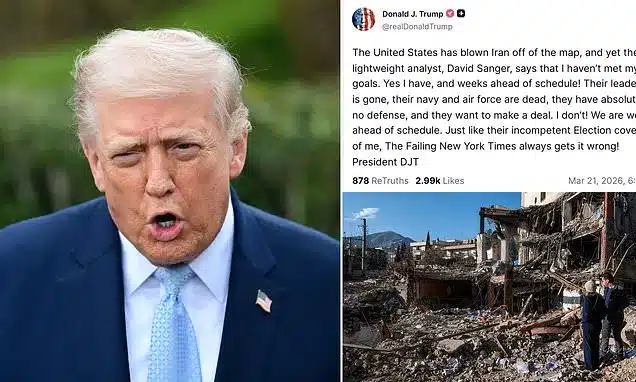
President Donald Trump declares that the United States has obliterated Iran’s military capabilities weeks ahead of schedule. His bold assertion contrasts sharply with mixed signals from his administration as the conflict enters its fourth week.
Trump’s Fiery Social Media Post
In a post on X on Saturday evening, Trump targets critics and emphasizes the campaign’s success. “The United States has blown Iran off of the map, and yet their lightweight analyst, David Sanger, says that I haven’t met my own goals. Yes I have, and weeks ahead of schedule!” Trump writes. He adds that Iran’s leadership is eliminated, its navy and air force destroyed, leaving no defenses, and expresses no interest in negotiations.
Administration’s Contradictory Moves
Trump hints at winding down operations in a Friday post: “We are getting very close to meeting our objectives as we consider winding down our great Military efforts in the Middle East.” Yet, officials confirm deployment of three additional warships and about 2,500 Marines, elevating U.S. personnel in the region to roughly 50,000. This escalation prompts questions about the conflict’s trajectory.
The administration also relaxes certain sanctions on Iranian oil, permitting shipments already at sea to reach global markets. Officials describe the step as a measure to curb rising energy costs during ongoing strikes against Tehran.
Economic Repercussions and Treasury Insights
Treasury Secretary Scott Bessent addresses the oil strategy on X: “At present, sanctioned Iranian oil is being hoarded by China on the cheap.” He notes that releasing the supply introduces approximately 140 million barrels to global markets, equivalent to a few days of worldwide demand.
Markets react sharply to strikes, shipping disruptions, and instability near the Strait of Hormuz, which handles one-fifth of global oil. U.S. stocks decline, with the S&P 500 falling 1.5% on Friday, while fuel prices climb on fears of extended interruptions.
Uncertain Path Forward
Trump comments on the Strait of Hormuz, stating other nations must police it primarily, though the U.S. offers assistance if requested, once Iran’s threat ends. Republican Representative Nancy Mace questions the approach on X: “Bombing Iran with one hand and buying Iran oil with the other.”
No formal cessation of hostilities occurs, and the Pentagon pursues an extra $200 billion from Congress for operations. While large-scale ground troops remain off the table, special forces actions remain possible, signaling an unpredictable next phase.
