

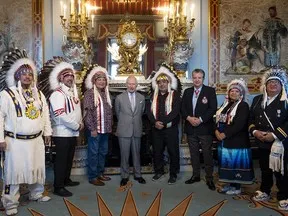
Leaders from Treaty 6 First Nations recently held a private meeting with King Charles at Buckingham Palace. They reaffirmed their nation-to-nation relationship and voiced strong concerns about Alberta’s push for independence.
Earlier, chiefs from Treaties 6, 7, and 8 joined provincial NDP members of the legislative assembly on the steps of the Alberta Legislature in Edmonton. Together, they urged Premier Danielle Smith to reject separatism.
Uncertainty Looms Over Potential Referendum
A separation referendum may occur in Alberta this October. If voters approve independence, the status of First Nations in the province remains unclear.
Pro-independence lawyer Keith Wilson outlines options for Alberta’s 138 First Nations reserves, which span roughly 1.3 percent of the province’s land. Reserves could maintain their current ties with Canada, shift federal treaty responsibilities to Alberta, or negotiate fresh agreements with a new Alberta government.
Critics, including former Premier Jason Kenney, warn that separation would rupture treaties with the Crown. They predict prolonged legal battles and widespread disruptions from First Nations resistance.
Lawsuits Target Referendum Process
Sturgeon Lake Cree Nation, representing Treaty 8 communities in northwest Alberta, has launched a lawsuit. It seeks an injunction to block Alberta from advancing a citizen-initiated separation referendum. The claim emphasizes: “This case is about the consent of First Nations that is required for any separatist process in Alberta.”
Lessons from Quebec Referendums
Quebec grappled with similar issues during its 1980 and 1995 sovereignty votes, under leaders Rene Levesque and Jacques Parizeau. Discussions then focused on partitioning First Nations territories.
Legal scholar Ghislain Otis, a University of Ottawa professor specializing in Indigenous rights and a Quebec bar member since 1984, observes: “The old ways were absolute; it’s either you’re in or you’re out; that’s partition and chaos.”
Otis, who supported yes votes in both Quebec referendums, stresses that secession requires legitimacy beyond technical veto rights. He notes Indigenous opposition stems from their valued connection to the federal Crown, which provides services, benefits, and checks against unchecked provincial power.
Pathways to Reconcile Sovereignty Claims
In a 2022 McGill Law Journal paper, Otis proposes reconciling provincial independence with Indigenous aspirations. One approach envisions an independent Quebec—or Alberta—delegating parts of its sovereignty to Canada, similar to European Union member states sharing powers with Brussels.
A bolder proposal dismantles Canada’s Indian Act and fosters shared sovereignty. Otis critiques traditional views as colonial, where a new state simply inherits federal treaty obligations. Instead, he advocates starting anew: “Let’s negotiate shared sovereignty with Indigenous peoples, and let’s recognize their sovereignty.”
Addressing concerns over Indigenous title on fee simple land, as seen in British Columbia, Otis argues: “The problem with the B.C. case is that it was done by the courts. It was not done through political negotiations by sensible people.” Negotiations, he insists, would create coordinated state-Indigenous relations.
Indigenous communities seek a renewed partnership with the state, Otis concludes: “They just want a new relationship with it.”
