

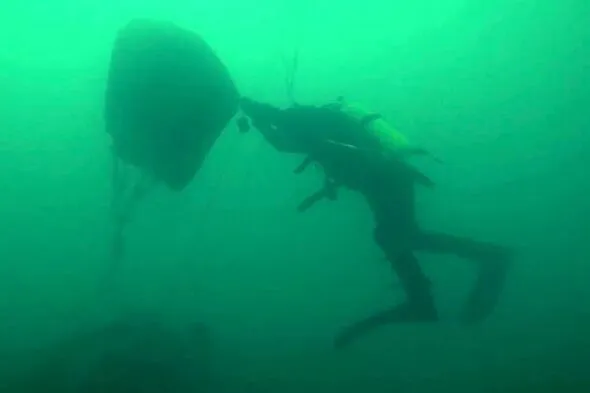
A diver exploring the Pacific Ocean near British Columbia stumbled upon a mysterious object he initially mistook for a UFO, only to discover it was one of the US military’s long-lost nuclear bombs.
The Unexpected Discovery
Sean Smyrichinsky was scouting for fish around Haida Gwaii, an archipelago 80 kilometers west of British Columbia’s coast, when he spotted a massive 12-foot-long object resembling a halved bagel with large, basketball-sized bolts molded into its circular frame.
“It was the strangest thing I had ever seen,” Smyrichinsky recalled. Excited, he surfaced and told his crew, “My God, I found a UFO.”
After sketching the object on a napkin, an experienced local suggested it might be a long-lost bomb from a Cold War-era incident.
The 1950 Bomber Crash and Missing Nuke
The object matched descriptions of a Mark IV nuclear bomb lost during a US Air Force B-36 bomber training flight on February 13, 1950. The intercontinental bomber, departing from Alaska for a simulated drop over San Francisco, suffered engine failures, forcing the crew to abandon it.
Before ditching the aircraft, the crew jettisoned the 10-foot, blimp-shaped, five-tonne bomb into the Pacific Ocean. The US military maintained it was a dummy capsule filled with lead, not a live plutonium-core weapon capable of obliterating cities.
Smyrichinsky’s research confirmed the connection: “A big circle with these balls… bigger than basketballs.” These spheres housed the bomb’s explosives. The crash site was about 50 miles south of his dive location.
“I’m right in the right area and it looks like it could be a piece of that thing. What else could it possibly be? I was thinking UFO, but probably not a UFO, right?” he said.
Broader Context of Lost Nuclear Weapons
The US military has six unaccounted-for nuclear warheads, referred to as “broken arrow” incidents—code for accidents involving nuclear arms. A similar claim of a dummy bomb arose in 1958 near Tybee Island, Georgia, but 1994 documents later confirmed it was a fully armed Mark 15 hydrogen bomb.
Canadian Investigation
In 2016, following Smyrichinsky’s report, Canada’s Department of National Defence ed keen interest. The Canadian Armed Forces deployed a vessel to examine the site.
Officials reiterated the US claim that the bomb was inert but proceeded cautiously: “Nonetheless we do want to be sure and we do want to investigate it further. A team specialising in unexploded ordnance will determine what risk, if any, the object poses and whether it should be retrieved from its resting place or left as is.”
