

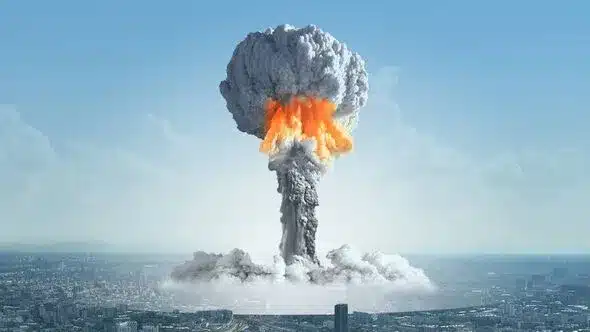
A Spanish farmer endured a lifetime of trauma after a U.S. nuclear bomb crashed directly into his garden during a mid-air collision in 1966. This incident highlights ongoing concerns over six unaccounted U.S. nuclear warheads from 32 documented “Broken Arrow” accidents—code for nuclear mishaps—each capable of devastating a city and claiming millions of lives.
The Mid-Air Collision Over Spain
On January 17, 1966, a U.S. B-52 bomber, armed with nuclear weapons and patrolling the skies, collided with a KC-135 refueling tanker over Spain. The crash tore open the aircraft, killing all four crew members on the tanker, two in the B-52’s tail section, and one who ejected but whose parachute failed. The remaining four B-52 crew members bailed out successfully.
Four hydrogen bombs detached from the bomber and plummeted toward the remote village of Palomares. Witnesses spotted a massive fireball a mile away, but no nuclear detonation occurred thanks to safety parachutes on the weapons.
Direct Impact on Villagers
One bomb landed intact in a riverbed and was recovered the next day. However, two others had faulty parachutes and exploded conventionally upon impact.
Farmer Pedro Aragón was walking home with his grandchildren when one bomb struck his tomato field. “We were blown flat. The children started to cry. I was paralyzed with fear. A stone hit me in the stomach, I thought I’d been killed. I lay there feeling like death with the children crying,” he recounted in 1968.
Another bomb hit near a cemetery, scattering radioactive plutonium and creating craters. Local resident Señora Flores described the chaos: “I was crying and running about. My little girl was crying, ‘Mama, Mama, look at our house, it is burning.’ Because of all the smoke I thought what she said must be true. There were a lot of stones and debris falling around us. I thought it would hit us. It was this terrific explosion. We thought it was the end of the world.”
Investigation and Cleanup
U.S. Air Force lawyer Capt. Joe Ramirez led the investigation in Palomares. “There were a lot of people talking, there was a lot of excitement in the conference room. Everyone kept talking about a ‘broken arrow’. I learned then that ‘broken arrow’ was the code word for a nuclear accident,” he explained in 2011.
Upon arrival, Ramirez observed smoke rising from wreckage amid scrambling villagers and smoldering debris. Remarkably, no human or livestock deaths occurred. Local rescuers, including a schoolteacher and doctor, recovered airmen remains, while fishing boats saved three crew members from the Mediterranean. The fourth survived near the village and received hospital care.
Gen. Wilson oversaw cleanup efforts. That first night, Spanish Guardia Civil reported a bomb in a nearby riverbed, prompting an immediate guard. By morning, search teams located two more bombs. Air Force personnel formed human chains with Geiger counters to map contaminated zones.
Ultimately, about 1,400 tonnes of radioactive soil were shipped to a storage site in South Carolina. U.S. and Spanish officials downplayed the event, staging a press photo op where the U.S. Ambassador to Spain, Angier Biddle Duke, swam off Palomares weeks later.
