

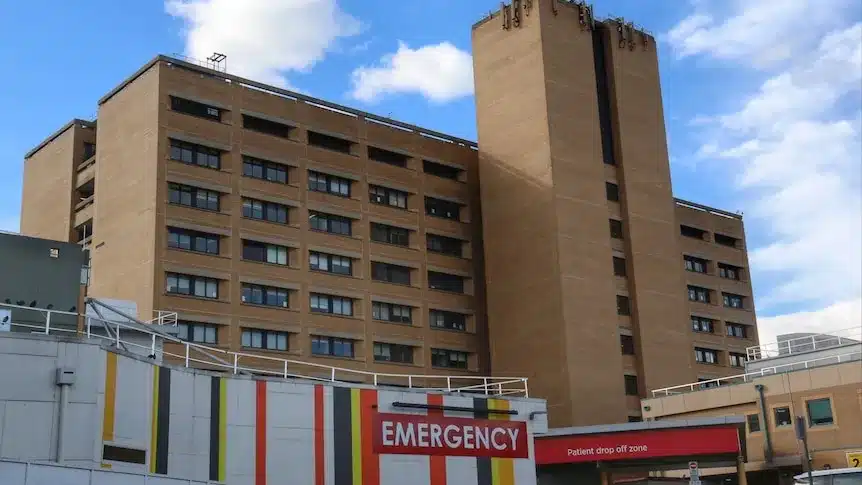
A knife produced by a patient at Canberra Hospital’s Behavioural Assessment Unit evaded detection during an initial police pat-down search, triggering a multi-hour security lockdown on Wednesday afternoon.
Details of the Incident
Officers transported a 35-year-old man to the unit after he breached a psychiatric treatment order. They conducted a search upon apprehension and confiscated one knife before handover. However, once inside, the man revealed a second knife he had hidden, prompting eight staff members to take shelter in the secure staff station.
Deputy Commissioner Scott Lee explained, “At the time we located him, he was initially searched and we did locate a knife on him, and then we returned that man to the behavioural assessment unit at Canberra Hospital and then we departed.”
He added, “It does appear that while we did locate a knife on him, there was a second knife that he had secreted that … we did not locate with the initial sort of pat-down search that was undertaken by our officers.”
Search Protocols and Limitations
Officers receive training on searching individuals, but the knife’s hiding spot lay beyond typical pat-down areas. Deputy Commissioner Lee noted, “A pat-down search can locate items in sort of easily locatable areas on a person’s body, but where he had secreted this knife [it was] very unlikely that a pat down search would have located it.”
He emphasized that a strip search remained inappropriate due to mental health legislation and the setting. Metal detector wanding typically applies to criminal cases, not initial mental health responses.
Canberra Liberals leader Mark Parton raised concerns about the search thoroughness.
Resolution and Tactical Response
Australian Federal Police negotiators and a tactical response team arrived to manage the situation. They deployed a flashbang grenade to distract the man, enabling them to disarm him safely.
Deputy Commissioner Lee clarified, “The idea behind the use of that device was to disorientate the male so that our police could get close to him, remove the knife from him and safely resolve it for him, in terms of his safety, our officer’s safety, but also the health staff in that location as well.”
He recognized the ordeal’s impact on staff, describing it as “traumatic” despite their physical security during the three-hour confinement.
Joint Review Underway
ACT Health Minister Rachel Stephen-Smith announced a joint review of the incident. She stated, “One of the things I think we need to look at and review is the length of time that police spent negotiating, seeking to negotiate with someone who was in severe psychiatric distress and probably not in a position to sort of logically negotiate with police.”
The minister praised staff resilience: “[Staff] did an incredible job and I want to thank all the staff involved, the way that they supported one another through the incident.” No immediate judgments occur pending review completion.
Canberra Health Services deputy chief executive Liz Lopa highlighted prior staff concerns over the secure station’s single entry-exit point. “Ironically … we actually had architects in there only a couple of weeks before doing a design to see how we could put in a second door so staff could have a second exit out of that area,” she said.
Minister Stephen-Smith noted, “I think when you are in a new facility, there’s always things that you realise once you start using the facility that you didn’t think of when you were looking at it on paper or even looking at it in built form.” An investigation probes initial design proposals.
Police Role in Mental Health Calls
The review will examine police involvement. Deputy Commissioner Lee affirmed, “As we do with all these types of matters, we will capture any learnings from it, both for our own people but also in terms of the issues here.”
Ongoing consultations address police responses to mental health risks. He stressed, “In those circumstances, police will always continue to respond because we need to be there to support the other agencies.” Police presence carries stigma, prompting measured attendance to avoid escalation.
