

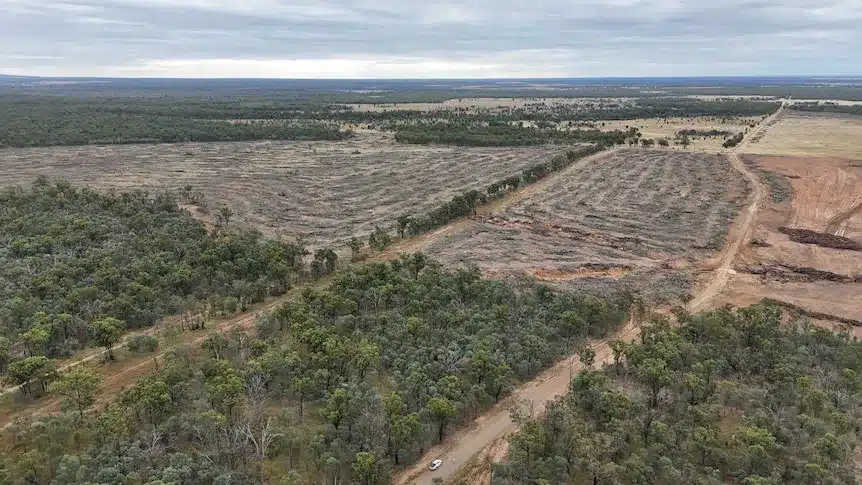
The federal government investigation concludes that a central Queensland coal mine did not violate national environmental laws during recent vegetation clearing activities.
Background on the Gemini Coal Project
Mining company Magnetic South develops the Gemini Coal project near Dingo, 120 kilometers west of Rockhampton. The operation anticipates a 25-year lifespan, extracting up to 1.9 million tonnes of coal annually.
Drone footage captured approximately 200 hectares of cleared land at the site, prompting allegations of unauthorized activity under the Environment Protection and Biodiversity Conservation (EPBC) Act. This legislation requires referrals for actions likely to significantly impact protected matters, including threatened species such as the greater glider, bridled nail-tail wallaby, and koalas potentially present in the area.
Investigation Findings
The Department of Climate Change, Energy, the Environment and Water (DCCEEW) conducted a review and determined no breaches occurred. A spokesperson for the department confirms the clearance adhered to a prior “Not a Controlled Action (NCA) if undertaken in a Particular Manner (PM)” decision from 2010.
This NCA-PM ruling deems the specified mining development unlikely to significantly affect protected species. The approval, originally granted to Dingo West Coal Pty Ltd, transferred validly through subsequent owners—Cockatoo Coal in 2013 and Magnetic South in 2015—as it applies to the action itself, not the proponent.
Conservation Groups Raise Concerns
Environmental advocates express disappointment over the outcome. Dr. Claire Gronow, central Queensland coordinator for the Lock the Gate Alliance and an environmental scientist, states, “It’s just really concerning to us that the EPBC Act doesn’t provide stronger mechanisms to protect habitat for our list of threatened species and also for water resources.”
She questions the ongoing validity of the 2011-era approval amid ownership changes. Ghungalu woman Zhanae Dodd, who participated in ceremonies with traditional owners at the site, affirms, “We know that land was cleared. We were there on the ground. We could hear the trees falling.” Dodd adds, “We know that it has real impacts on our people, and those impacts aren’t recognised in current legal frameworks.”
The group pledges to pursue all available channels to voice objections.
Freedom of Information Documents Spark Questions
Publicly released Freedom of Information documents reveal DCCEEW correspondence advising Magnetic South’s legal team to obtain fresh approvals. One email notes, “There is no mechanism under the EPBC Act to transfer an NCA-PM decision from an old project owner to the new project owner.” It continues, “an NCA-PM decision is only valid for the original proponent” and “A historic NCA-PM decision is not a guarantee the same or similar action would be considered an NCA-PM again, if such a decision were being made today.”
Dr. Gronow highlights the discrepancy: despite prior advice from senior officials, the 2025 clearing evaded breach status. She anticipates future reforms will strengthen protections for threatened species habitats.
Next Steps for the Project
Magnetic South declines further comment. With the mining lease secured, environmental authority approved, and rehabilitation bond lodged for the initial stage, construction preparations advance. Any northern site expansion requires separate EPBC approval.
