

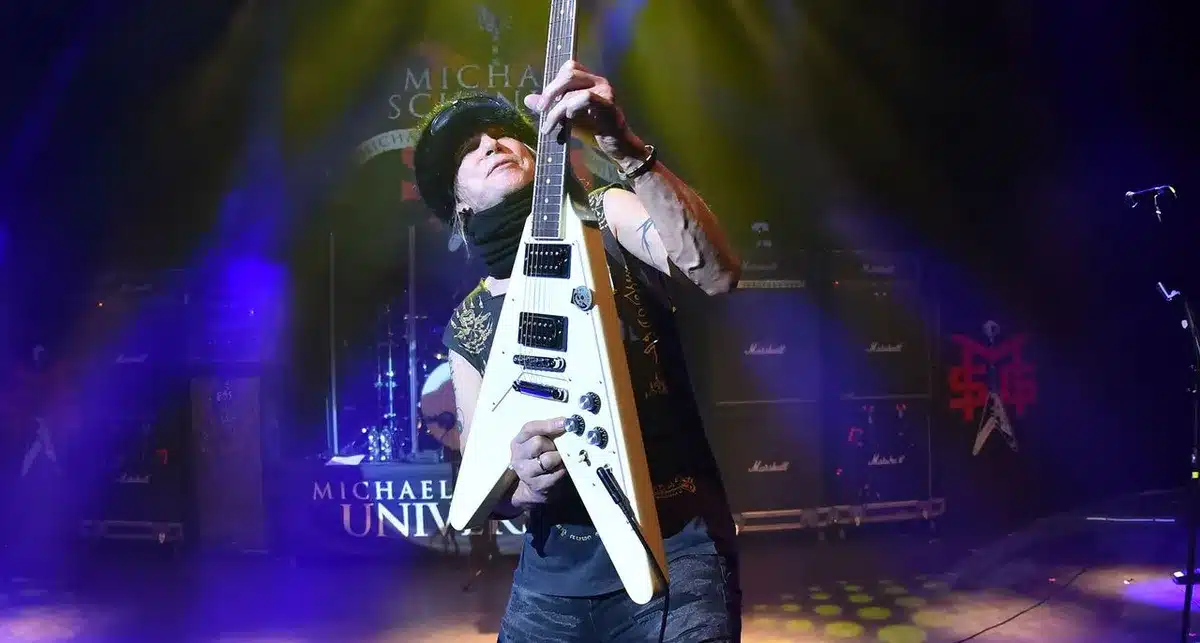
Michael Schenker Reflects on Lifelong Pursuit of Self-Expression
Guitar virtuoso Michael Schenker, at 70 years old, maintains an infectious enthusiasm that belies his age. His interviews are often characterized by a free-flowing, uncensored delivery, revealing a unique perspective on music creation and the industry. Schenker’s core philosophy centers on the belief that enthusiasm, self-confidence, and spontaneity are the cornerstones of happiness, a sentiment he clearly embodies.
His latest offering, Don’t Sell Your Soul, marks the 13th studio album from Michael Schenker Group (MSG) and signifies a powerful return to his signature rock sound. This release is the second installment in a planned trilogy. The preceding album, My Years with UFO, released in June 2024, featured re-recorded versions of 11 songs Schenker penned during his tenure with the British rock band UFO between 1972 and 1978. The album boasts collaborations with notable artists such as Slash, Dee Snider, Roger Glover, Stephen Pearcy, and Axl Rose.
Schenker conceived My Years with UFO not merely as a collection of reinterpreted classics but as an educational journey for his fans. “Many people think I was born musically in the ’80s,” Schenker explained, “because when you search for ‘Michael Schenker’ online, you primarily find ‘Michael Schenker Group,’ with little about UFO or Scorpions.” He elaborated, “With My Years with UFO, I aimed to showcase the songs I created during my formative years, from ages 17 to 23. Each year brought improvements in my guitar playing and songwriting. This record serves as a reminder for me and an education for those unaware of my origins.”
Schenker’s departure from UFO in 1978 followed escalating tensions with vocalist Phil Mogg, culminating in a physical altercation. This event prompted Schenker’s decision to leave the band. His initial solo venture, the self-titled Michael Schenker Band album, was released in 1980. The subsequent four years proved to be a highly productive period, yielding three more studio albums and two live recordings from MSG.
‘Don’t Sell Your Soul’: A Return to Form
Don’t Sell Your Soul recaptures the dynamic and melodic style previously heard on Schenker’s 2022 album, Universal. It reflects his consistent songwriting approach, which he terms “freedom of expression.” This philosophy prioritizes spontaneity, authenticity, and instinct over technical adherence or prevailing trends. “I’ve never been concerned with technicalities,” Schenker stated. “When I assemble a musical idea for a song, I can’t definitively say if it’s major or minor. People comment on my shifts between the two, but I’m unaware of them. Perhaps I utilize parts of scales, but I don’t know their names, modes, or anything of that nature. That aspect simply doesn’t interest me.”
While working on Don’t Sell Your Soul, Schenker was simultaneously exploring more experimental and atmospheric compositions for Freedom of Expression, the intended third album of his trilogy. Initially planned as an instrumental project, the direction shifted unexpectedly when producer and vocalist Michael Voss spontaneously added vocals one evening. Schenker found that Voss’s vocal contributions enhanced the songs, leading to the album adopting a vocal-centric approach with Voss as the lead singer.
“I’ve always operated on instinct,” Schenker emphasized. “That is freedom of expression. To compromise my actions based on external expectations or to be swayed from my path by fame and fortune would be akin to selling my soul.”
Looking back over his five-decade career, Schenker acknowledged moments where financial opportunities presented themselves. In 1978, he briefly rejoined Scorpions following Uli Jon Roth’s departure to contribute to the album Lovedrive, though he did not remain with the band. After the tragic death of Randy Rhoads, Schenker was the first guitarist approached by Ozzy Osbourne. However, he opted to pursue his own artistic vision rather than join Osbourne’s band.
“With Scorpions, I offered my assistance as a gesture to my brother [Rudolf],” Schenker explained. “They were in a transitional phase and needed help with an album, so I acted as a catalyst. When Ozzy extended an offer, an internal warning signal prompted me to decline. The message was clear: I had recently departed from UFO and Scorpions, and it was crucial to process my situation.” He continued, “My intention was to continue developing my own sound and expressing myself authentically, rather than chasing trends, which both Scorpions and UFO seemed to be doing after my departure.”
Track-by-Track Insights from Don’t Sell Your Soul
Don’t Sell Your Soul features songs built upon the powerful riffs and neo-classical guitar leads characteristic of early MSG. Schenker predominantly utilized his iconic black Gibson Flying V for the recordings, incorporating modern production techniques to give the album a contemporary edge. The album stands as a testament to Schenker’s unwavering commitment to his instincts, whether delivering anthems, ballads, or rhythmically unconventional tracks.
1. Don’t Sell Your Soul
This song originated in my mind before I touched a guitar. I was humming a melody and envisioned a guitar part to accompany it, which is an unusual creative process for me. I was on tour, driving, and had time for reflection. When I finally picked up my guitar, the song unfolded step by step, keeping me engaged. I incorporated a wah pedal, an effect I hadn’t used in a long time, as I felt drawn to that particular sound. Michael Voss suggested adding delay and other effects, but I preferred a raw, dry sound, so I intentionally kept it that way. The lyrics are personal, reflecting my own journey, which is something I rarely do.
2. Danger Zone
I collect musical ideas, or ‘pieces of gold,’ as I play. When I stumble upon a compelling riff, I set it aside. For ‘Danger Zone,’ I revisited one of these collected ideas to initiate the song, which then inspired the bridge and chorus sections. It’s interesting because I don’t know which song a riff is intended for when I create it. I then begin assembling these pieces randomly. I don’t actively search for the ‘best’ idea; I simply explore my collection, and if it works, I use it. If not, I move on to something else.
3. Eye of the Storm
I initially developed a sketch for this song, but after Bodo [Schopf] laid down the drums, it gained a more profound feel. I was uncertain if I wanted to retain the guitar parts I had already recorded. The following day in the studio, Michael Voss played the track back for me to assess. He had already made some significant contributions, and the way he had arranged it sounded remarkably unique. I felt no need to alter it further. It didn’t stand out as a lead guitar-focused track but rather as something more atmospheric and intriguing. I concluded that what I had done the previous day was perfect.
4. Janie the Fox
This song possesses a distinct, almost eerie quality from its inception. I believe I drew inspiration from the acoustic instrumentals we initially explored for Freedom of Expression. I combined cleaner guitar tones with a distorted riff I had previously written, which contributes to its unique atmosphere. Michael embraced this, and one night after I left the studio, he had a profound experience. While working on the vocals, he looked out his large glass window and saw a fox observing him. He described a feeling of complete harmony with nature, which inspired him to write the lyrics and vocal melody. This creates a compelling contrast between the wild, spooky opening and the beautiful, melodious chorus.
5. I Can’t Stand Waiting
I started with a riff from my collection of musical ideas. I then developed the verse, bridge, and chorus. Michael later worked on it, and when I returned the next day, he played me his version. It was excellent, and he made it catchier, as he has a more contemporary sensibility. My approach is purely self-expression. When I present my music, it’s a sketch. Then, when others contribute, they bring their own distinct perspectives.
6. Sign of the Times
This was a thoroughly enjoyable track. I employed a palm-muted arpeggio, which is a technique I frequently use to explore different string applications. This element integrates seamlessly with the vocals and becomes a prominent feature of the song.
7. The Chosen
The fast-paced section at the end emerged spontaneously. It’s a rather unsettling song with clean guitars in the background and off-kilter parts that don’t quite resolve. While working on it, I envisioned scenes from classic Tom and Jerry cartoons, with the cat pursuing the mouse. I felt it would be effective to create a sonic representation of someone being chased and trying to escape.
8. It’s You
This is the only other song I conceived entirely in my mind without initially using a guitar. I find it difficult to articulate the process of capturing the song’s emotional duality – its blend of sadness and happiness. It’s a feeling that manifests in the riffs. The rock riff I played contributes to a more upbeat feel, but this was an organic development, not a conscious decision.
9. Six String Shotgun
I initially created an instrumental musical sketch that was fairly standard. Subsequently, guest vocalist Robin McAuley [McAuley Schenker Group] wrote the lyrics. When he informed me the title was ‘Six String Shotgun,’ I initially assumed it was about violence. However, it might be intended ironically. Robin’s lyrical choices are his own; I don’t directly influence that aspect, and sometimes the music and lyrics have disparate origins.
10. Flesh and Bone
This track has a distinctly hard-rock sound. It wasn’t an attempt to balance a slower song; it was purely an act of self-expression. I only record what I genuinely wish to create and share with others.
11. Surrender
There’s a galloping rhythm in this song. It’s amusing because I recall a member of Iron Maiden claiming they invented the gallop. However, the gallop rhythm existed long before, evident in television shows like Bonanza. It was also utilized in rock music much earlier; I employed it on UFO’s ‘Lights Out.’ It’s a rhythmic element I’ve always enjoyed, lending an adventurous quality that works effectively in certain contexts. It feels innate, a beat that intentionally avoids resolution, making it difficult to dance to.
Don’t Sell Your Soul is currently available. Additionally, the Michael Schenker Group’s six-disc box set, Live & Ready: 1980–1984, is also released.
