

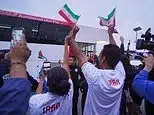
US Revokes Iran’s World Cup Ticket Allocations Amid Diplomatic Tensions
Iran’s football federation announced Tuesday that the United States has rescinded its allocation of World Cup tickets, a move that comes just two days before the tournament is scheduled to commence. The federation has voiced accusations that the U.S. is deliberately hindering the attendance of Iranian supporters, citing ongoing diplomatic friction between the two nations.
Reports indicate that the U.S. has introduced a series of administrative obstacles for Iran’s participation in the global football event. These challenges have included the denial of visas for some of Iran’s support staff, amidst a backdrop of strained relations. The situation is further complicated by recent military actions involving the U.S. and Israel concerning Iran.
Federation Statement Highlights Objections
In a statement released by the Iranian football body, it was asserted that with less than three days remaining until the 2026 World Cup kicks off, the United States has once again taken steps to prevent Iranian fans from attending the national team’s three group stage matches. According to the federation, FIFA regulations stipulate that participating nations should receive eight percent of the tickets for each match, intended for distribution to their supporters through official channels.
The statement further detailed that Iran had already initiated ticket sales for its group stage games against New Zealand, Belgium, and Egypt, all scheduled to be held in the U.S. This was done after the federation received its allocated quota, and some fans had already made travel arrangements. However, in an unexpected turn of events, the ticket allocation granted to the Iranian Football Federation has been withdrawn. Consequently, the federation stated it is currently unable to provide any tickets to supporters of the national team.
The federation characterized this action as being “contrary to the spirit governing international competitions and the principle of equality among participating countries.” They have formally appealed to FIFA and tournament organizers to uphold principles of neutrality, fairness, and established regulations, urging them to facilitate the presence of Iranian supporters.
Team Relocates Training Base Amidst Tensions
The escalating tensions have also influenced Iran’s logistical arrangements, prompting the team to shift its World Cup training base from Tucson, Arizona, to the Mexican border city of Tijuana. This decision was made over the weekend.
Upon arrival in Mexico, Iran’s World Cup squad was observed wearing badges commemorating 168 children who were reportedly killed in a U.S. missile strike. This gesture was made in the context of the ongoing diplomatic dispute. reports February 28 detail an incident where a U.S. missile struck a girls’ school in Minab, Iran, resulting in the deaths of approximately 175 individuals, predominantly young girls.
Iran is scheduled to begin its World Cup campaign against New Zealand in Los Angeles on June 15. This will be followed by a match against Belgium in the same city on June 21, and a game against Egypt in Seattle on June 26.
Regional Tensions Continue to Escalate
Simultaneously, tensions in the Middle East have intensified. Over the weekend, Israel conducted a new series of strikes targeting military sites in western and central Iran, with reports of explosions heard across the country. The Israeli Defense Forces confirmed striking military targets belonging to the “Iranian terror regime.”
Iran reportedly retaliated on Monday morning with its own wave of attacks, and explosions were detected in central Israel as air defense systems engaged incoming fire. These exchanges follow a period of missile strikes between Iran and Israel.
Diplomatic Interventions and Ceasefire Calls
Reports suggest that a prominent political figure, Donald Trump, intervened by contacting Benjamin Netanyahu, reportedly urging a halt to retaliatory actions. Trump is quoted as having stated, “If Bibi strikes them back, it’s just gonna keep going like the last 47 years, or the last 3,000 years.” He is reported to have called for both sides to cease hostilities after recent strikes.
Trump subsequently issued a public call for “Israel and Iran must immediately stop shooting,” emphasizing that “stupidity” should not impede peace talks. He indicated that both nations were seeking an immediate ceasefire and that final negotiations were progressing, though subject to potential setbacks.
A statement attributed to Trump indicated that a blockade would remain in place until a “Final Deal” was reached, suggesting an expectation of swift developments. Following this strong ultimatum, Iran appeared to de-escalate, announcing a halt to its attacks on Israel. However, the Iranian military command warned that any further “aggression and hostile acts” from Israel or its allies would result in “much more severe and crushing measures than before.”
Trump has consistently expressed a desire to forge a peace deal with Iran. He reportedly described the initial Iranian strikes on Israeli soil as detrimental to the peace process and advocated for calm. He is quoted as telling one news outlet that an agreement was imminent, potentially to be signed within the coming week, but that recent events had complicated the situation.
