

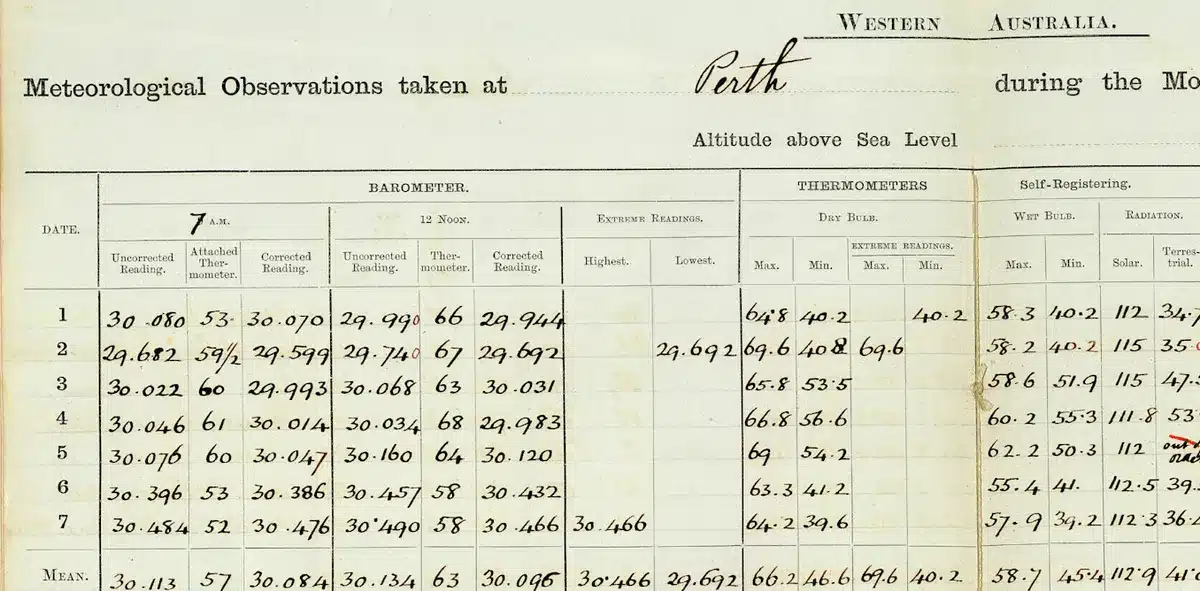
Two centuries of meticulous weather records from Perth, Western Australia, are providing crucial insights into how climate change is altering storm patterns and increasing future climate risks. A new study, leveraging historical meteorological data dating back to 1830, has reconstructed the longest daily pressure record for the Southern Hemisphere, offering an unprecedented view of severe storm behaviour over nearly 200 years. This research is vital for understanding long-term climate fluctuations and refining predictions in a warming world.
Unearthing Historical Weather Data
Understanding how Australia’s climate has varied, especially before widespread fossil fuel combustion, requires delving into historical observations. While official meteorological data often begins in the early 1900s, older records exist in national and state archives. These valuable documents, often fragile and handwritten, need to be digitised and transcribed – a process known as data rescue. Previous efforts in Australia primarily focused on temperature and rainfall, leaving a significant gap in historical atmospheric pressure data, which is a key indicator of storm systems.
Atmospheric pressure measurements are fundamental to meteorology. Sudden drops in pressure signal approaching stormy conditions, while stable or rising pressure indicates calmer weather. By recovering pre-1955 barometer readings, which were often only available in original handwritten registers, researchers can reconstruct past weather maps. This allows for a day-by-day analysis of large-scale atmospheric circulation patterns that drive extreme weather events, from intense low-pressure storm systems to high-pressure heatwaves.
Consolidating Nearly Two Centuries of Data
The recent study focused on rescuing multiple daily pressure readings from Perth, bridging the gap between the Bureau of Meteorology’s (BoM) records from 1942 and earlier observations. This comprehensive dataset consolidates 196 years of weather information from four historical sites:
- Swan River (1830–1875)
- Perth Gardens (1876–1900)
- Perth Observatory (1897–1908)
- Perth Regional Office (1907–1944)
This extensive data collection builds upon prior analyses of temperature extremes in other Australian cities, enabling a more robust evaluation of severe storm trends across southern Australia. The researchers identified 141 severe storms that affected Perth between 1830 and 2024, cross-referencing their findings with historical newspaper accounts to verify their impact.
Storm Trends and Climate Change Link
One of the study’s significant findings is the observed decline in Perth’s winter storms since approximately 1970. This trend is strongly linked to shifts in the Hadley cell, a major atmospheric circulation pattern that transports heat from the equator towards the poles. As greenhouse gas concentrations rise and the atmosphere warms, the Hadley cell is expanding poleward.
In Australia, this expansion pushes the subtropical high-pressure belt further south. Consequently, the rain-bearing westerly winds and the storm fronts that typically cross the southern coastline are weakened. This mechanism contributes to reduced rainfall across southern mainland Australia and is a recognized driver of drying trends in subtropical regions globally, including southern Africa and the Mediterranean. Southwestern Australia, in particular, is considered a climate change hotspot, having experienced a substantial 20% decrease in winter rainfall since 1970.
Historical Context for Modern Extremes
Before this research, studies on storm pathways were largely limited to the mid-20th century onwards, when modern datasets became available. Furthermore, most research has concentrated on the Northern Hemisphere, where long-term pressure records are more common. The Perth study provides a rare, extended perspective for the Southern Hemisphere.
The analysis reveals that the modern decline in storms hitting Perth is unusually persistent. The decade from 2010 to 2019 recorded fewer severe storms than any preceding decade since 1830. However, the historical records also highlight a significant dry period between 1830 and 1846, which was even drier than the current rainfall deficit. This historical context is crucial, as it suggests that modern weather observations alone may not capture the full spectrum of natural climate variability and extreme events.
Implications for Future Climate Risk
The findings underscore that future climate risks in Perth, and more broadly across Australia, might be underestimated. The persistent decline in storms, coupled with the existence of even drier historical periods, indicates the complex interplay of natural variability and human-induced climate change.
By meticulously rescuing and analysing historical weather observations, scientists can fill critical gaps in Australia’s climate records. This enhanced understanding is essential for developing more accurate forecasts of future weather extremes in an increasingly warming climate. The long-term perspective offered by these historical records is indispensable for adapting to and mitigating the impacts of climate change.
The study’s reconstruction of atmospheric circulation patterns and storm activity provides a vital baseline against which current and future changes can be measured. This deep historical context is key to comprehending the unprecedented nature of current climate shifts and preparing effectively for the challenges ahead.
