

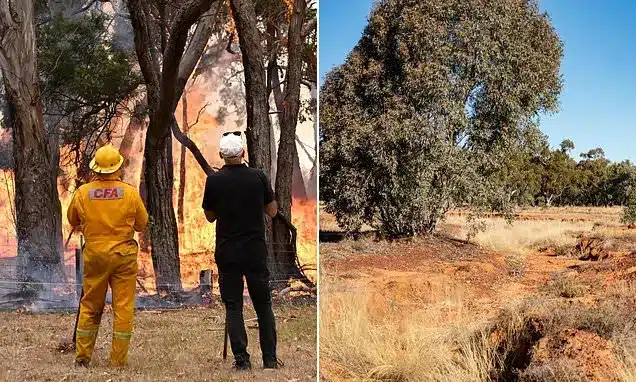
Nation Braces for Potentially Historic El Niño Event
Australians are being urged to prepare for extreme weather conditions later this year as a powerful El Niño event develops in the Pacific Ocean. Leading scientists warn this natural climate pattern, which typically occurs every four to five years, could escalate into one of the most significant on record, bringing hotter and drier weather.
Increased Bushfire Risk Due to Drier Conditions
Physicist Dr. Gail Isles has highlighted the heightened risk of bushfires associated with El Niño. She explained that the phenomenon leads to drier winds, which in turn dry out vegetation, creating a tinderbox effect. “It means that we’re getting drier winds, and drier winds are going to dry out the foliage – that’s going to make everything like a tinder box, and it means that the slightest spark is just going to generate bush fires,” Dr. Isles stated in a recent broadcast.
Dr. Isles further elaborated that El Niño events cause temperatures in the Pacific Ocean to rise. This warming reduces the moisture-laden easterly winds that are crucial for bringing rainfall to Australia’s east coast. She noted, “These El Niño events occur every four to five years. The last one was 2023 so we are building towards another one.”
Signs Point to a ‘Super’ El Niño
Recent assessments from weather experts confirm that the developing El Niño could rank among the strongest ever recorded. Climate scientists are concerned that the event could develop into a ‘Godzilla’ or ‘Super’ El Niño by year’s end. The Bureau of Meteorology has reported that the tropical Pacific has already warmed by 0.81 degrees Celsius, a threshold that signifies the onset of an El Niño event in Australia.
While a specific timeline for the event’s arrival has not been confirmed, numerous climate indicators suggest its increasing likelihood. “Computer models suggest that this El Niño signal is likely to strengthen further in the coming months and could persist through winter and spring in the Southern Hemisphere,” said meteorologist Ben Domensino of Weatherzone. He added, “In addition to the recent ocean warmth, there are also signs that the atmosphere has started responding to the warming in the tropical Pacific Ocean. These early signs of ocean-atmosphere coupling are a clear sign that El Niño is getting underway.”
The U.S. National Oceanic and Atmospheric Administration estimates a 63 percent probability of the event becoming ‘very strong’ between November 2026 and January 2027.
Historical Parallels and Global Impact
Scientists have drawn comparisons between the current developing El Niño and the devastating event of 1877. That historical El Niño triggered severe droughts and widespread crop failures globally, and is believed to have contributed to the deaths of over 50 million people. Many climate historians consider the 1877 event to be one of the first truly global climate disasters, with some suggesting it played a role in reshaping world history.
A significant rise of just 2.7 degrees Celsius in Pacific Ocean sea surface temperatures during that period led to extensive disruption across multiple continents. Australia, Southeast Asia, and parts of Africa experienced severe droughts and forest fires. India’s monsoon rains failed, while northern China endured devastating dry spells leading to harvest failures. In Brazil, agricultural sectors collapsed as rivers dried up. Researchers estimate that the resulting food scarcity and disease outbreaks led to the deaths of approximately 4 percent of the Earth’s population at the time.
