

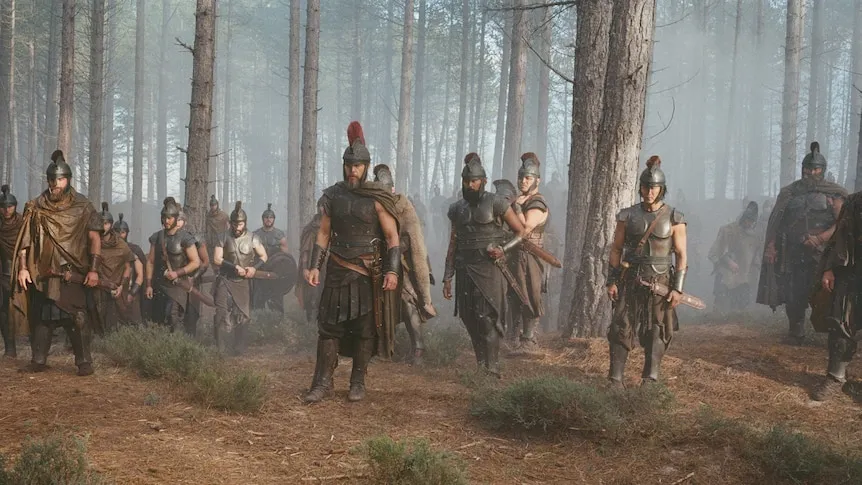
Elon Musk has recently voiced strong criticism regarding Christopher Nolan’s upcoming adaptation of Homer’s epic poem, The Odyssey. His objections, amplified across social media, primarily target casting choices and perceived deviations from historical accuracy, suggesting these are concessions to modern “woke” pressures aimed at securing awards. However, experts and the nature of the source material itself suggest these criticisms may overlook the fundamentally mythological and interpretive essence of The Odyssey.
Musk’s Criticisms and the ‘Woke’ Debate
The controversy ignited in January when Academy Award-winning actress Lupita Nyong’o was confirmed to play Helen of Troy. Musk publicly decried the casting as “disgusting” and accused Nolan of losing his integrity. He later agreed with a sentiment that Nolan would be labeled “racist” if a white woman were cast as “the most beautiful woman” in mythology, implying a deliberate move to appease diversity agendas.
Further fueling his critique, Musk accused Nolan of “desecrating” The Odyssey to win Oscars, linking this to the Academy’s diversity guidelines. This connection has been questioned, noting that Nolan’s own film, Oppenheimer, which featured a predominantly white and male cast, won seven Oscars in 2023, after the guidelines were already in place. As recently as June, Musk continued to label Nolan a “worm” and reiterated accusations of succumbing to “woke” pressure for awards.
The online discourse, amplified by Musk and other prominent accounts, has extended beyond casting. Criticisms have also targeted costume design, ship depictions resembling Viking vessels, and the use of modern language and accents, all under the banner of “historical accuracy.”
Understanding Homer’s Odyssey: Myth, Not History
To contextualize these debates, it’s essential to understand the nature of Homer’s epic poems. The Odyssey, along with The Iliad, is traditionally attributed to the ancient Greek poet Homer and is believed to have circulated around the 8th or 7th century BC. While The Iliad recounts the Trojan War and the exploits of heroes like Achilles, The Odyssey follows Odysseus’s arduous journey home to Ithaca after the war’s conclusion.
Christopher Mackie, emeritus professor of Classics and Ancient History at La Trobe University, emphasizes that these poems are not historical texts. “Homer’s poems are pre-Socratic, pre-historical,” Mackie explained. “This is not a historical text, not the least because history hadn’t been invented when the poem was created.” He further notes that the authorship of both poems by a single Homer is uncertain, and other epic poems from the period, known as the ‘Epic Cycle,’ have not survived.
Professor Mackie highlights that Odysseus is celebrated not just for his strength but for his cunning intellect and storytelling prowess. He is a “trickster and liar” who survives immense challenges, often with the favor of the gods. Similarly, Odysseus’s wife, Penelope, is portrayed as intelligent and resourceful, cleverly deceiving 108 suitors vying for her hand and Odysseus’s throne while he is away. Her “victory over the men in the house is a victory for the whole family,” Mackie states, underscoring the theme of cleverness and resilience.
Adaptations and Interpretations Through Time
Homer’s Odyssey has been adapted numerous times across various media, from silent films and musicals like the Coen Brothers’ O Brother, Where Art Thou? to television episodes. Unlike many previous adaptations, Nolan’s version has sparked significant controversy over perceived anachronisms.
The criticism regarding casting extends beyond Nyong’o. There was also backlash when actor Elliot Page was rumored to be cast as Achilles (he was later confirmed to play Sinon, Odysseus’s cousin). These reactions, often framed around historical accuracy, often overlook the source material’s origins.
Professor Mackie points out that “there are pre-conceived notions about what individuals might have looked like when the text may give us very little evidence.” He adds that the Greek poets operated in a world where divine intervention and myth were central, distinct from later eras of rational inquiry.
Notably, the casting of a Black woman as Helen of Troy is not unprecedented. Singer and actor Eartha Kitt played Helen in a 1950 stage production, and Galyn Görg appeared as Helen in a 1996 episode of Xena: Warrior Princess. Lupita Nyong’o herself has dismissed the controversy, stating that The Odyssey is a “mythological story” and that the cast is “representative of the world.” She acknowledged that criticism would persist regardless of her engagement.
Nolan’s Inspiration and Critical Reception
Christopher Nolan has cited Emily Wilson’s 2017 translation of The Odyssey as a key inspiration. Wilson’s work, the first English translation by a woman, was lauded for its modern sensibility and for challenging “centuries of masculinist translations.” Professor Mackie suggests that audiences often become entrenched in their reading of classical texts, while filmmakers are expected to interpret them for contemporary audiences. “The Greek poets did it their way, and we would expect a film director to do it their way today,” he commented.
Early critical responses to Nolan’s film, from those granted early access, have been largely positive. Los Angeles Times film editor Joshua Rothkopf described the movie as “staggering. Earthy, ghostly, weighty, touched by humor and grandeur alike. It’s pure cinema.” Conversely, Indiewire’s David Erlich, while finding the final act rewarding, deemed the film too “clunky” to rank among Nolan’s best work, though Anne Thompson, Indiewire’s Editor in Chief, predicted it would be a strong contender for the Best Picture Oscar.
Conclusion: A Mythological Tale Reimagined
The debate surrounding Christopher Nolan’s The Odyssey highlights a tension between the desire for historical fidelity and the nature of adapting ancient myths. While criticisms focusing on perceived inaccuracies and “woke” influences have gained traction, particularly amplified by figures like Elon Musk, scholars and the source material itself suggest that The Odyssey is fundamentally a work of myth, open to interpretation. The enduring power of the epic lies not in its literal historical accuracy, but in its timeless themes of journey, cunning, resilience, and the human condition, which filmmakers like Nolan seek to explore for new generations.
The Odyssey is scheduled for release in Australian cinemas on July 16.
