

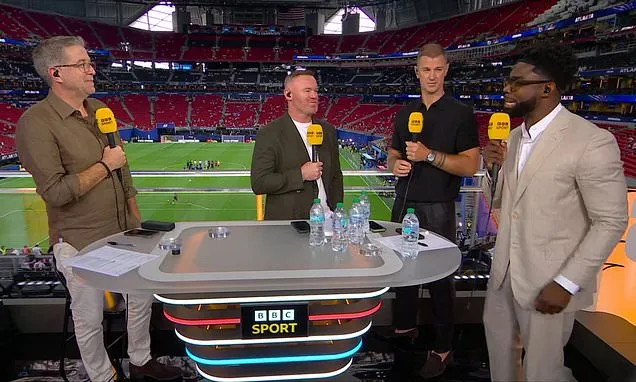
The BBC has concluded its work-from-home approach to the World Cup by broadcasting live coverage of England’s crucial semi-final match against Argentina directly from Atlanta, United States. This move marks a significant shift after the broadcaster faced scrutiny for covering the majority of the tournament from its studios in Salford, England, while competitor ITV opted for a studio with views of the Manhattan skyline.
Live Coverage from the Host Nation
For the first time during this World Cup, the BBC brought its television coverage from within the host country. The semi-final showdown was presented from inside the Mercedes-Benz Stadium in Atlanta by Mark Chapman, accompanied by pundits Joe Hart, Wayne Rooney, and Micah Richards. Viewers were offered their initial glimpse of the BBC’s on-site setup during the pre-match build-up on BBC News, where Chapman, Hart, Rooney, and Richards provided their analysis leading up to kick-off.
Chapman opened the broadcast with a reflective tone, referencing past encounters between England and Argentina, before a montage of historical moments between the two rival nations was shown. The decision to broadcast from the US for this pivotal match comes after the BBC had previously considered a move from the quarter-final stage.
Strategic Broadcasting Decisions
While the BBC did not broadcast England’s quarter-final victory over Norway from Miami for television, Mark Chapman did host BBC Radio 5 Live’s coverage of that match from the host city. For the semi-finals and the final, the corporation has now dispatched Kelly Cates and Gabby Logan to the US. They will join pundits Rooney, Richards, and Hart to cover both the television broadcasts on BBC One and the radio coverage on BBC Radio 5 Live.
This deployment means the BBC contingent will spend less than a week in the United States before returning to the UK, utilizing license-payers’ funds for this period. The rationale behind delaying the on-site presence until the semi-final stage was linked to the BBC’s broadcast rights for the tournament. Having based operations in Manchester for the initial four weeks, the corporation held the live rights for only one quarter-final match (Spain vs. Belgium). ITV, conversely, broadcast the other three quarter-final matches, including England’s game against Norway.
Financial Considerations and Defense of Strategy
The BBC’s director of sport, Alex Kay-Jelski, had previously defended the broadcaster’s strategy of covering the tournament remotely, asserting that it would save “millions” of license-payers’ money. He argued that deploying an additional couple of hundred staff members, along with the costs associated with building an on-site studio, would amount to substantial expenses. Kay-Jelski emphasized that a decision to send everyone to the host country was not financially sustainable or a prudent use of license fee revenue.
The corporation’s decision to broadcast from Salford for the majority of the tournament until the semi-finals had drawn criticism, particularly when contrasted with ITV’s more geographically proximate coverage. However, the BBC maintained that its approach was a responsible financial decision, prioritizing the efficient use of public funds.
Looking Ahead to the Final
Gabby Logan is slated to anchor the BBC’s coverage of the upcoming World Cup final. This final match will also be broadcast concurrently on ITV, providing viewers with multiple options to watch the conclusion of the tournament.
The strategic decision to remain in the UK for the initial stages of the World Cup, followed by a concentrated on-site presence for the latter, high-stakes matches, highlights a balancing act between comprehensive coverage and fiscal responsibility. While some viewers and media observers noted the difference in broadcasting locations compared to rivals, the BBC defended its approach as a necessary measure to manage costs associated with major international sporting events.
