

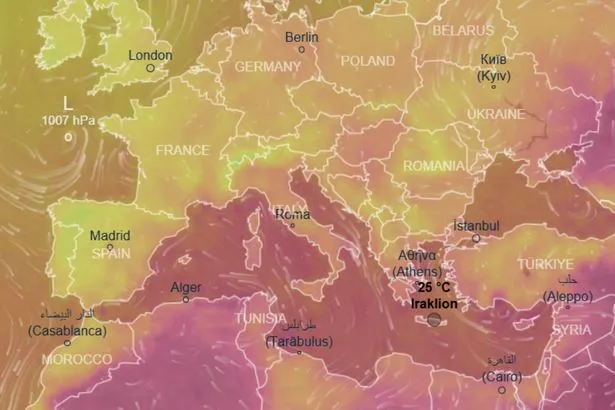
Europe faces the possibility of extreme heatwaves reaching 50C (122F) this summer, with experts warning that current record-breaking temperatures may be just the precursor to even more dangerous conditions. Holidaymakers, particularly those planning trips to the Mediterranean, are being advised to prepare for potentially severe heat and to adjust their travel plans accordingly.
Record Temperatures Looming
Recent weeks have already seen significant heat across southern Europe, with large areas of Spain experiencing temperatures as high as 44C (111.2F). This intense heat has contributed to wildfires, forcing thousands to evacuate their homes in Spain and France. Scientists suggest that the situation could escalate further.
Professor Bill McGuire, Emeritus Professor of Geophysical & Climate Hazards at University College London (UCL), indicated that temperatures exceeding 50C are a distinct possibility. He stated that such extreme heat could occur later this summer or even next year, coinciding with the peak impact of an El Niño event developing in the Pacific Ocean. Professor McGuire advised travellers to the Mediterranean to anticipate spending considerably more time indoors than originally planned.
“I wouldn’t say that they would be a total write-off, but I think holidaymakers will need to be prepared to spend a lot of time in air-conditioned hotel rooms, due to it simply being too hot to do anything outside,” Professor McGuire commented, suggesting that traditional outdoor holiday activities might become unfeasible.
Previous European Heat Records
The highest officially recorded air temperature in Europe to date is 48.8C (119.8F), registered in Sicily, Italy, in August 2021. Prior to this, the record stood at 48C (118.4F), recorded in Elefsina and Athens, Greece, in July 1977.
Expert Warnings and Health Risks
Professor Hanna Cloke, Regius Professor of Meteorology and Climate Science at the University of Reading, highlighted the potential for temperatures in parts of Spain and Portugal to reach the high 40s Celsius. She emphasized that high humidity can make the perceived temperature feel significantly hotter than the actual reading, creating conditions that pose serious health risks.
“Temperatures in the high 40s are possible in the hottest parts of Spain and Portugal. And where humidity is high it can feel even hotter than that, well above what the thermometer says. That’s the kind of heat that kills,” Professor Cloke warned.
She urged particular caution for vulnerable populations, including the elderly and those with pre-existing health conditions. “The old and vulnerable need to be very careful; keeping out of the sun and drinking plenty of water, as they can easily suffer and become ill in 40C+ temperatures,” she advised.
Climate Change as the Driving Force
Professor McGuire unequivocally linked the increasing frequency and intensity of extreme heat events to climate change. He pointed out that Europe is warming at a faster rate than other continents, attributing this to the continued release of greenhouse gases into the atmosphere.
“Europe is heating faster than any other continent as we continue to add more than 40 billion tonnes of CO2 to the atmosphere every year – equivalent to the weight of 800,000 Titanics,” Professor McGuire stated. He added that the average temperature in Europe has risen by over 2C in the last century, with extreme high temperatures increasing at an even more rapid pace.
The professor stressed that these intensifying heatwaves, which are becoming longer and hotter, are already responsible for thousands of deaths annually. He concluded with a stark warning:
“But this isn’t the new normal, this is just the beginning. Summers across the Mediterranean region are just going to keep on getting hotter as long as we continue to do next to nothing in terms of reining in carbon emissions.”
Preparing for Extreme Heat
As Europe braces for a potentially scorching summer, travellers are advised to stay informed about weather forecasts, heed official warnings, and take necessary precautions. This includes:
- Staying hydrated by drinking plenty of water.
- Seeking shade and avoiding prolonged exposure to direct sunlight, especially during peak heat hours (typically 11 am to 4 pm).
- Utilizing air-conditioned spaces whenever possible.
- Wearing lightweight, light-coloured clothing.
- Checking on elderly neighbours and relatives, as they are particularly susceptible to heat-related illnesses.
The escalating heatwaves underscore the urgent need for global action to mitigate climate change and adapt to its unavoidable consequences.
