

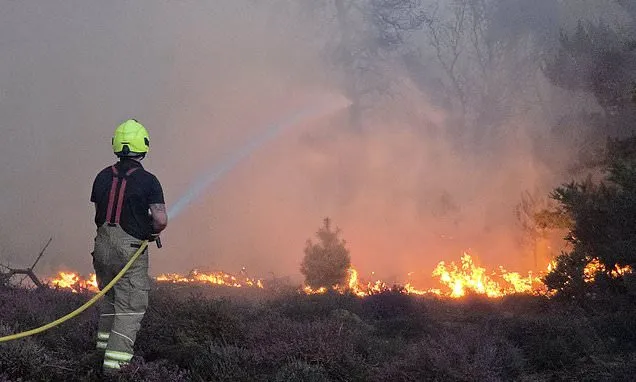
Recent wildfires across the UK and Europe, while often attributed to climate change and extreme weather, are also being exacerbated by environmental policies that restrict traditional land management practices, according to critics. As regions like Suffolk, the Cairngorms, and the Peak District grapple with blazes, and continental Europe faces similar threats in places like Bordeaux and Madrid, a debate is intensifying over the root causes of increasingly severe fires.
Wildfires: A Global Perspective vs. Local Policies
While hot, dry spells undeniably increase the likelihood of wildfires, data suggests that the global trend of wildfire frequency and acreage burned is not uniformly increasing with global warming. Satellite data from NASA indicates a steady decrease in burned acreage globally since 2000, with figures nearly halving over the past century. Historical accounts, such as the massive fires in Wisconsin and Michigan in 1871 that consumed over a million hectares, predate modern industrialization and widespread car use, occurring when the world was cooler.
Even in the current year, which has seen significant fires in some regions, global figures from the Global Wildfire Information System (GWIS) show a record low for hectares burned by this date since records began in 2012. In Europe, the area burned is less than half the average for this period. Despite these global statistics, local impacts are severe, leading to evacuations and significant damage.
The ‘Climate Change Excuse’ for Policy Failures
Critics argue that the narrative of ‘climate Armageddon’ is being used by politicians as a convenient excuse to avoid implementing necessary preventative measures. The argument is that instead of addressing the underlying issues, authorities can simply blame global warming for droughts, water shortages, and subsequent wildfires. This approach, it is contended, deflects responsibility from a failure to invest in infrastructure like reservoirs or to maintain effective land management strategies.
For instance, the current drought affecting parts of Britain and leading to hosepipe bans could be mitigated by greater investment in water storage. The slow progress on building new reservoirs, with the first proposed since the 1990s, highlights a potential gap in long-term planning.
The Role of ‘Fire Suppression’ and Fuel Load
A key factor in the severity of modern wildfires, particularly in fire-prone habitats, is the practice of ‘fire suppression’ and the resulting build-up of flammable vegetation, or ‘fuel load’. Decades of experience have shown that the longer a landscape goes without fire, the more intense and uncontrollable future fires become. Controlled, low-intensity burns, often conducted in winter, have historically been used to manage this fuel load.
These controlled burns, often referred to as ‘cool burning’, help to clear out dead vegetation and create a mosaic of different heather heights. This practice benefits biodiversity by encouraging new growth for grazing animals and providing nesting grounds for certain bird species. A demonstration involving a Mars bar placed on moss, with a fire lit over it, showed how such cool burns could remove surface vegetation without damaging the underlying moss layer, which is crucial for retaining moisture and preventing peat fires.
Controversial Policies and ‘Rewilding’
However, environmental bodies like Natural England have increasingly restricted or banned heather burning, particularly on deep peat soils. Their stance is often based on the argument that such burns harm sensitive habitats. Conversely, researchers and land managers argue that regular cool burns are vital for habitat health and, crucially, for reducing the risk of catastrophic wildfires that can burn deep into peat layers, releasing significant amounts of carbon.
The push towards ‘rewilding’ by some conservation groups, such as the RSPB and the National Trust, further complicates the issue. While rewilding efforts sometimes include ‘rewetting’ moors by building dams to slow water runoff, this method is seen as ineffective during prolonged droughts. Critics point to recent fires, like the one in the Peak District that spread rapidly across a ‘rewetted’ moor, as evidence of this approach’s limitations.
Concerns Over Firefighter Safety and Resource Allocation
The National Fire Chiefs
