

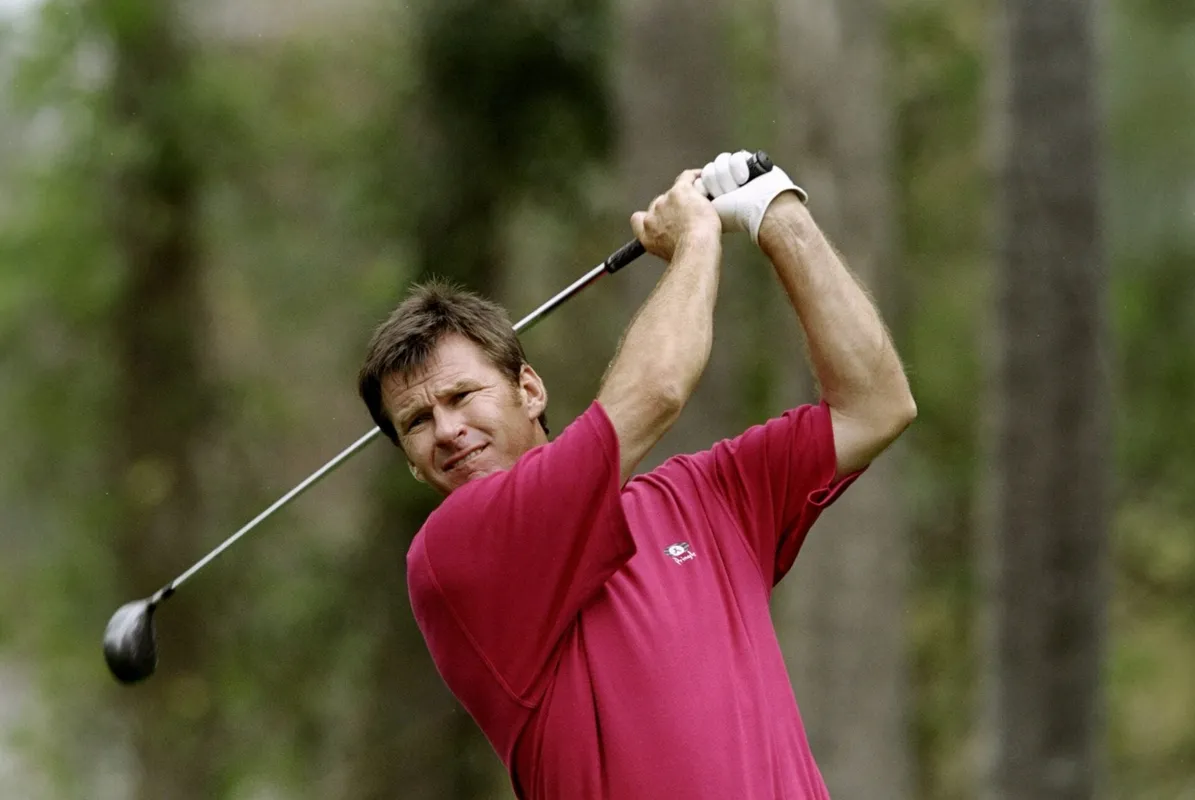
The 1999 Players Championship remains a notable, albeit unfortunate, chapter in Sir Nick Faldo’s illustrious golf career. Despite his immense success, including six major championships, Faldo never managed to win The Players Championship at TPC Sawgrass. His 21 appearances yielded only two top-5 finishes and six missed cuts, a surprisingly modest record for a player of his caliber on a course that seemed to suit his game. However, one particular appearance in 1999 stands out not for a near-win, but for a disqualification that Faldo himself attributed, in part, to advice from fellow competitor Corey Pavin.
The Disqualification at TPC Sawgrass
During the final round of the 1999 Players Championship, held in Ponte Vedra Beach, Florida, Nick Faldo faced a rules infraction that ultimately led to his disqualification. While playing the seventh hole, an official informed Faldo that he had taken an incorrect penalty drop on the preceding sixth hole. The situation arose after Faldo’s tee shot on the sixth landed in a tree. After the ball remained lodged in the branches, Faldo opted to take a penalty drop near the tree and continue play.
The crux of the issue lay in Faldo’s certainty about the ball’s final resting place. According to the rules, a player must be certain of the ball’s location before taking a drop. A spectator alerted a rules official, who then investigated Faldo’s drop. Because Faldo could not definitively see his ball in the tree, his subsequent drop was deemed improper. This led to his disqualification from the tournament on the following hole.
The disqualification capped off a difficult week for the English golfer in Jacksonville, Florida. His score for the third round had already been a high 83, and the rules infraction compounded his struggles.
Corey Pavin’s Role and Faldo’s Account
In the aftermath of his disqualification, Nick Faldo spoke to reporters and pointed to advice he received from his playing partner at the time, Corey Pavin. Faldo explained that he relied on Pavin’s counsel regarding the penalty drop.
“He said because we saw it go into the tree we could drop it there,” Faldo recounted, as reported by BBC Sport. “He said the same thing had happened to him only a couple of weeks ago and he talked me into it.”
Faldo expressed his frustration, adding, “That just about caps the week. It all adds to the frivolity.” This statement suggested a sense of exasperation with the series of events that led to his early exit from the tournament.
Player Responsibility and Rules Knowledge
Despite Faldo’s assertion about Pavin’s advice, the ultimate responsibility for adhering to the rules of golf rests with the player. Golf is a sport that demands meticulous attention to detail, and players, especially those with extensive experience like Faldo, are expected to possess a thorough understanding of the rules. The six-time major champion’s knowledge of the game and its regulations was well-established, making the situation particularly surprising.
Golf rules stipulate that if a ball is lost or unplayable in a tree, and the player cannot identify its exact spot, the correct procedure often involves returning to the previous spot and playing a ball under penalty of stroke and distance. By taking a drop without absolute certainty of the ball’s location, Faldo inadvertently violated this rule.
The incident at the 1999 Players Championship serves as a stark reminder of the complexities of golf’s rules and the importance of player diligence. While playing partners can offer advice, the final decision and its adherence to the rulebook remain solely with the individual competitor. For Nick Faldo, the 1999 tournament at TPC Sawgrass became a memorable event for reasons he would have preferred to avoid, underscoring the fine margins and strict regulations that govern professional golf.
Faldo’s Legacy at The Players Championship
Although Nick Faldo never lifted the coveted trophy at The Players Championship, his career is marked by numerous other significant achievements. His six major championship victories solidify his status as one of golf’s all-time greats. The 1999 disqualification, while a notable event, does not diminish his overall impact on the sport. It remains a peculiar footnote in a career defined by excellence, highlighting a moment where a lapse in judgment, influenced by well-intentioned but ultimately incorrect advice, led to an uncharacteristic early departure from a prestigious tournament.
The course at TPC Sawgrass, known for its challenging layout and demanding conditions, has tested many of the world’s best golfers over the years. Faldo’s history with the tournament, including his two top-5 finishes, demonstrates that he was indeed competitive at the venue. The 1999 event, however, serves as a unique case study in the intersection of player interaction, rules interpretation, and individual accountability in professional golf.
